Waltz of Invisible Moons: The First Spectroscopic Find ✛ ✎
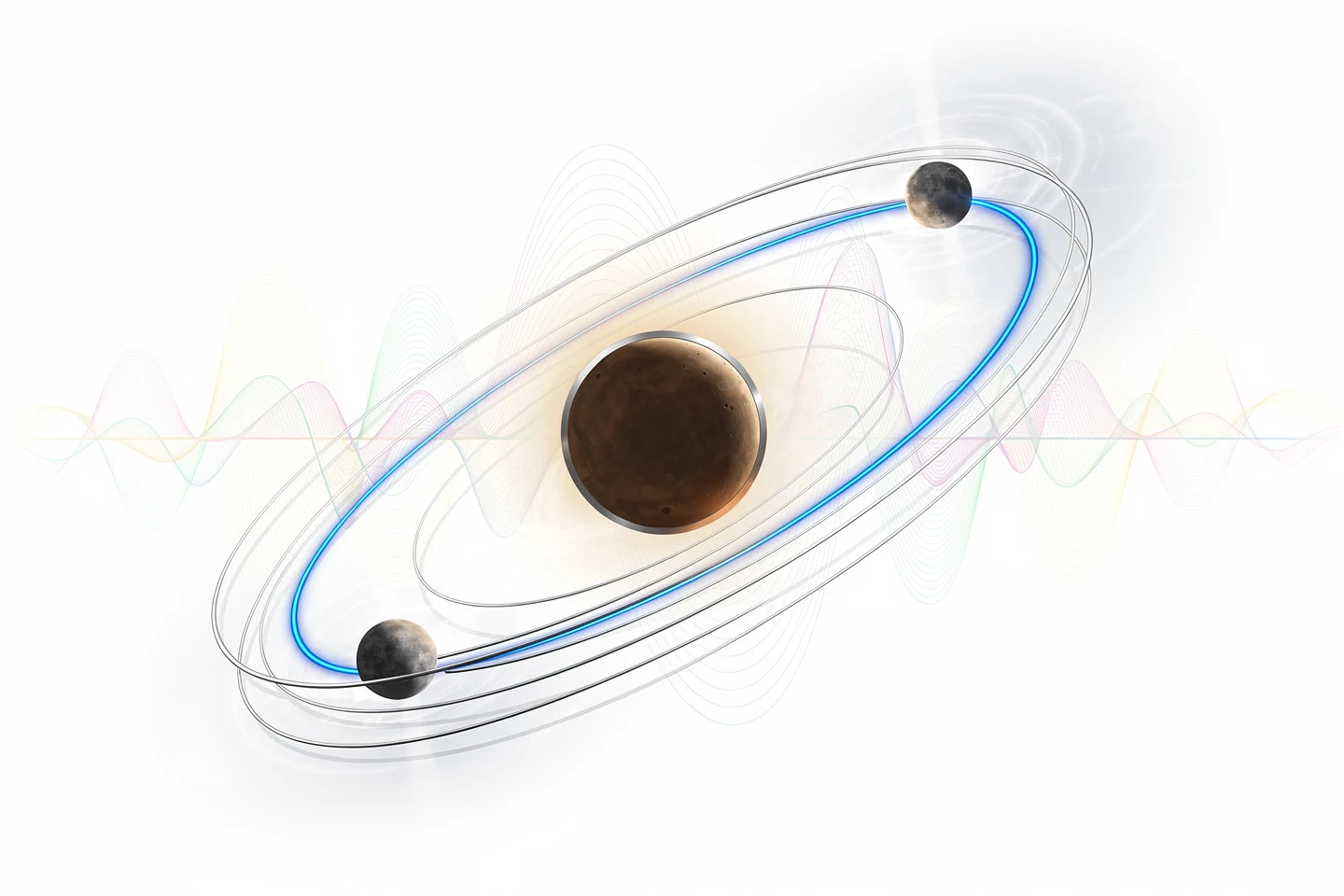
The gravitational dances of celestial bodies long remained silent to astronomers. We learned to catch the shadows of planets against stars with the transit method — a breakthrough that delivered thousands of worlds thanks to William Borucki and his Kepler telescope. But their moons eluded us — too small, too faint. The turning point came when astronomers switched from sight to sound. High-resolution spectroscopy turned the light of the brown dwarf CD-35 2722 B into a musical score, and the barely perceptible shift in 'frequencies' — the Doppler shift, governed by the constancy of the speed of light — revealed the presence of massive moons.
The dwarf's radial velocity wobbled with a period of about 170 days, as if the celestial body were dancing a slow waltz. Mathematical analysis unveiled a two-component picture: a large moon of at least 0.74 Jupiter masses circles at a distance of 0.2 AU, and its likely companion — 0.28 Jupiter masses — completes an orbit in 87 days. The orbits are in a 2:1 resonance, reminiscent of the Galilean moons. Most strikingly, these invisible partners are not mere specks against their host. Their masses rival planets, and the mass ratio to the brown dwarf (2% for the main moon) notably surpasses even the record Earth–Moon pair (1.2%).
Every line in the spectrum is the voice of an atom. Hydrogen, whose Balmer series was catalogued nearly a century and a half ago by Johann Balmer, sounds quiet but discernible against molecular bands. To hear this chorus through the noise of Earth's atmosphere, you need an instrument with a resolution approaching a hundred thousand, and the equations of James Clerk Maxwell guarantee that the electromagnetic echo preserves all information about the source's motion. The CRIRES+ spectrograph acts like a merciless music critic, catching the slightest false vibrato.
This discovery means that massive moons can be born directly from the protoplanetary disk through gravitational instability — just like stellar companions. It breaks the stereotype that regular moons necessarily form from circumplanetary material. Looking ahead, future giants like the Extremely Large Telescope (ELT) will not only refine the orbits but possibly even get direct images. Hubble and its successors can search for transits in such systems. And if the moons turn out to be cold enough, their atmospheres will preserve lines of the same hydrogen. In the distant future, next-generation gravitational wave detectors might catch the ripple from mergers of such bodies — the final chord of their celestial music.
Now a hierarchy of questions opens before astronomers: How common are such systems? What is the mass limit for moons? And could life exist on them? Every atom, inherited from the Big Bang, carries a story, and we're only beginning to learn to read it through spectral clues. This study is a tuning fork, calibrating our instruments to search for habitable worlds beyond the Solar System.
The brown dwarf CD-35 B, at 37 Jupiter masses, almost qualifies as a star, and its giant moon is heavier than many known exoplanets.
Fantastical ocean moons — Pandora from 'Avatar' or Clarke's icy Europa — were long the stuff of imagination. Now we've caught real massive exomoons for the first time, making dreams of life on them a bit more tangible.