Planetary-Mass Satellites: First Discovery around a Brown Dwarf via Spectroscopy ✛ ✎
Context
The discovery of exoplanets revolutionized astrophysics, but the search for their moons—exomoons—remained elusive for a long time. Why does it matter? Moons not only help unravel the history of dynamical evolution of systems but can also serve as potential havens for life thanks to tidal heating. The traditional transit method, so successful for planets, has not yet yielded unambiguous confirmations for moons. This study employed a different approach—high-precision spectroscopy, which measured tiny wobbles in the motion of the brown dwarf caused by the gravity of unseen satellites. This became possible thanks to recent upgrades of instruments that split light into the finest details, using the constancy of the speed of light as a reference. These studies allow us to peer into the distant past, reminding us that the entire diversity of present-day objects stems from primordial fluctuations after the Big Bang.
Methods
The methodology resembles the hunt for exoplanets, but with unprecedented precision. From October 2023 to January 2025, the team led by Alice Zurlo conducted 21 observing sessions of the brown dwarf CD-35 2722 B at the VLT. The CRIRES+ spectrograph, with a resolution of about 100,000, captured infrared spectra based on the laws of electromagnetism formulated by James Clerk Maxwell. Each session included nodding (AB sequence) to subtract the sky background. The spectra were calibrated using telluric lines, whose stability relies on the speed of light as an absolute standard. Although molecular bands dominate the spectrum, hydrogen lines are also present. Radial velocities were extracted using the viper code, which matches observed spectra to an empirical template built iteratively without theoretical models.
Results
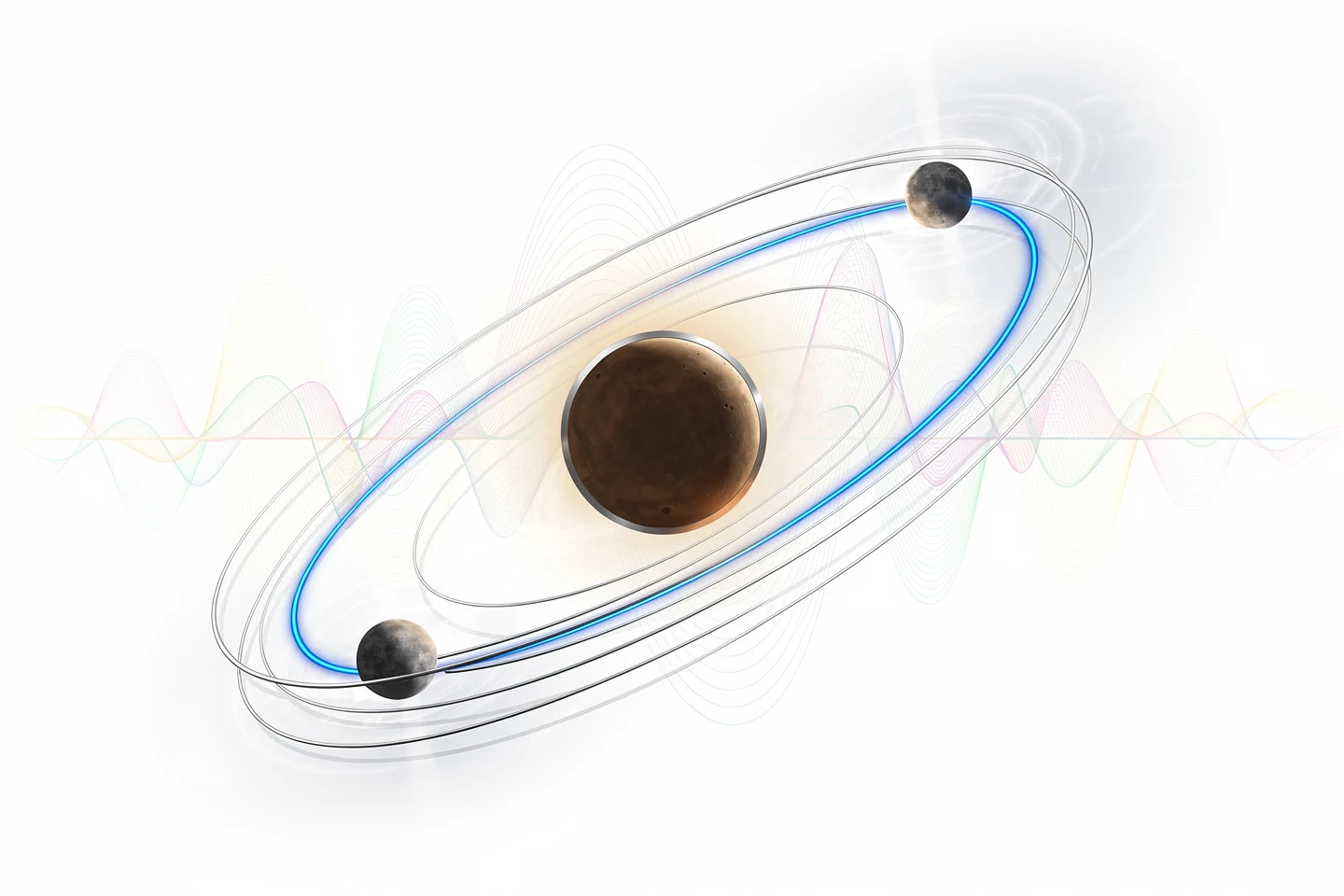
The analysis revealed a clear periodic signal with a period of about 170 days, exceeding the 0.1% false-alarm threshold in the Lomb-Scargle periodogram. The best-fitting two-satellite model, obtained with the EMPEROR code, predicts a large satellite with a minimum mass of 0.743 Jupiter masses (M sin i) on a nearly circular orbit (eccentricity <0.01) and a period of 169.45 days. The semi-major axis is about 0.2 AU, well within the Hill sphere and Roche limit. A second candidate satellite has a period of 87.46 days, a minimum mass of 0.277 Jupiter masses, and also moves on a circular orbit at a distance of 0.13 AU. The periods of these two bodies are in a 2:1 resonance, reminiscent of the Galilean moons of Jupiter. The model with a single eccentric satellite (eccentricity 0.29) fits the data worse, with a Bayesian evidence log difference ΔlogZ = 6.9 in favor of the two-satellite scenario. Crucially, the rotation of the brown dwarf itself, with a maximum period of 0.65 days, cannot account for the observed variations. This success was made possible by the high precision of spectroscopy, which, unlike the transit method, does not depend on geometric alignment. The Doppler shifts of lines are proportional to the radial velocity, which directly follows from the constancy of the speed of light.
Implications
The discovery of massive satellites around a brown dwarf has profound implications for formation theories. Massive satellites are more naturally formed via gravitational instability in the protoplanetary disk, consistent with how CD-35 B itself likely formed as a wide companion. The mass ratios of the satellites to the host (2% and 0.7%) far exceed those in the Solar System, where even the Earth-Moon system reaches only 1.2%. This supports the idea that moon formation mechanisms can vary drastically depending on the mass of the central body and its environment. Moreover, the 2:1 resonance points to dynamical evolution involving migration and resonant capture.
Future development
Future observations at even higher resolution, perhaps with upcoming telescopes like the ELT, will not only confirm the second satellite but possibly detect smaller bodies. Advances in direct imaging and interferometry could yield direct separation of the satellites and their spectra. Of particular interest is the study of the atmospheres of these satellites: if they are cold enough, they may host lines such as the hydrogen Balmer series, discovered by Johann Balmer in the 19th century. Next-generation gravitational wave detectors might even catch mergers of such massive objects if they spiral together.
Impact
This discovery will impact several areas: the dynamics of hierarchical systems, models of planet and moon formation, astrobiology (the search for habitable moons), and the instrumental development of high-precision spectroscopy. Hubble and its successors will likely include such targets in their programs to search for transits and study atmospheres.
Next steps
Key steps include additional observations at other epochs to resolve the period degeneracy of the second satellite, detailed characterization of the atmospheres of the brown dwarf and satellites, and searches for similar signals in other systems with wide substellar companions.
Key open problems
This research directly ties into unresolved questions: How do substellar companions with wide orbits form? What are the universal patterns of satellite formation? What is the maximum mass of a moon, and where is the boundary between a planet and a satellite? Determining the nature of objects in hierarchical systems touches on fundamental problems in the evolution of the Universe from the Big Bang to the formation of chemical elements.
The knowledge machine's view
This section is addressed to the author of the paper and their colleagues. Neighbouring works were found by meaning-based search across our archive, not by word overlap. We do not review: we show the field around the work.
What the work does
Using high-precision infrared spectroscopy with VLT/CRIRES+, the radial velocity variations of the brown dwarf CD-35 2722 B were measured. A periodic signal of ~170 days was detected, interpreted as two companions with masses on the order of Jupiter's mass and orbital periods of 169.45 and 87.46 days, close to a 2:1 resonance.
Where its strength is
The strength of this work lies in demonstrating the capability of high-resolution spectroscopy to detect companions around substellar objects, opening a new channel for exomoon searches that complements the transit method.
Where it could go next
- It may be interesting to compare the derived companion parameters with results from simulations of moon formation around brown dwarfs, as discussed in a neighboring work that also analyzes massive satellites.based on: Gravitational Duet: Brown Dwarf Reveals Its Massive Moons arXiv:2607.05193
- There is also experience in searching for planets around white dwarfs using Doppler spectroscopy; some methodological approaches for radial velocity calibration and systematic error correction could prove useful for future brown dwarf observations.based on: How to Hear a Planet Near a Dead Star arXiv:2605.14077
- The archive contains a study on direct imaging of planets in contrast with a bright star; combining high-contrast imaging with radial velocities could provide independent confirmation of the companions' existence and refine their orbits.based on: How to Spot a Pale Planet in a Star's Blinding Light arXiv:2607.06931
Worth trying
- Test the stability of the two-companion solution in a 2:1 resonance over a longer observational baseline.
- Compare the derived masses and orbits with predictions from models of satellite formation in disks around brown dwarfs.
- Assess the feasibility of detecting these companions via high-contrast imaging with future instruments.
Why this may matter
The detection of planetary-mass companions around a brown dwarf opens a new window into the study of planet formation and evolution processes, and expands the search for potentially habitable worlds beyond the Solar System.
Nearby works in our archive
- Gravitational Duet: Brown Dwarf Reveals Its Massive Moonssimilarity 0.65
- How to Hear a Planet Near a Dead Starsimilarity 0.63
- A Swarm of Tiny Sails Heads to Proxima bsimilarity 0.62
- A Sun-Sized Lens Searches for Life Around Distant Starssimilarity 0.62
- Dark Matter as Ripples on a Cosmic Pondsimilarity 0.61
- How to Spot a Pale Planet in a Star's Blinding Lightsimilarity 0.60
The closest work in the archive sits at 0.65 by meaning — the usual level for our corpus.
The brown dwarf CD-35 B has a mass of 37 Jupiters, making it almost a star. And the satellite with a minimum mass of 0.743 Jupiter masses is itself heavier than some known exoplanets!
Fictional worlds like Pandora from 'Avatar' or Europa from '2001: A Space Odyssey' have long portrayed moons as habitable oases. The discovery of real massive exomoons brings these dreams a bit closer.
Key numbers
- minimum mass of the large satellite: 0.74 Jupiter masses
- orbital period of the large satellite: 169 days
- mass of the brown dwarf: 37 Jupiter masses
- semi-major axis of the large satellite's orbit: 0.2 AU
- period of the second satellite: 87 days