The Dancing Dwarf: How Two Moons Were Found Around a Failed Star ✛ ✎
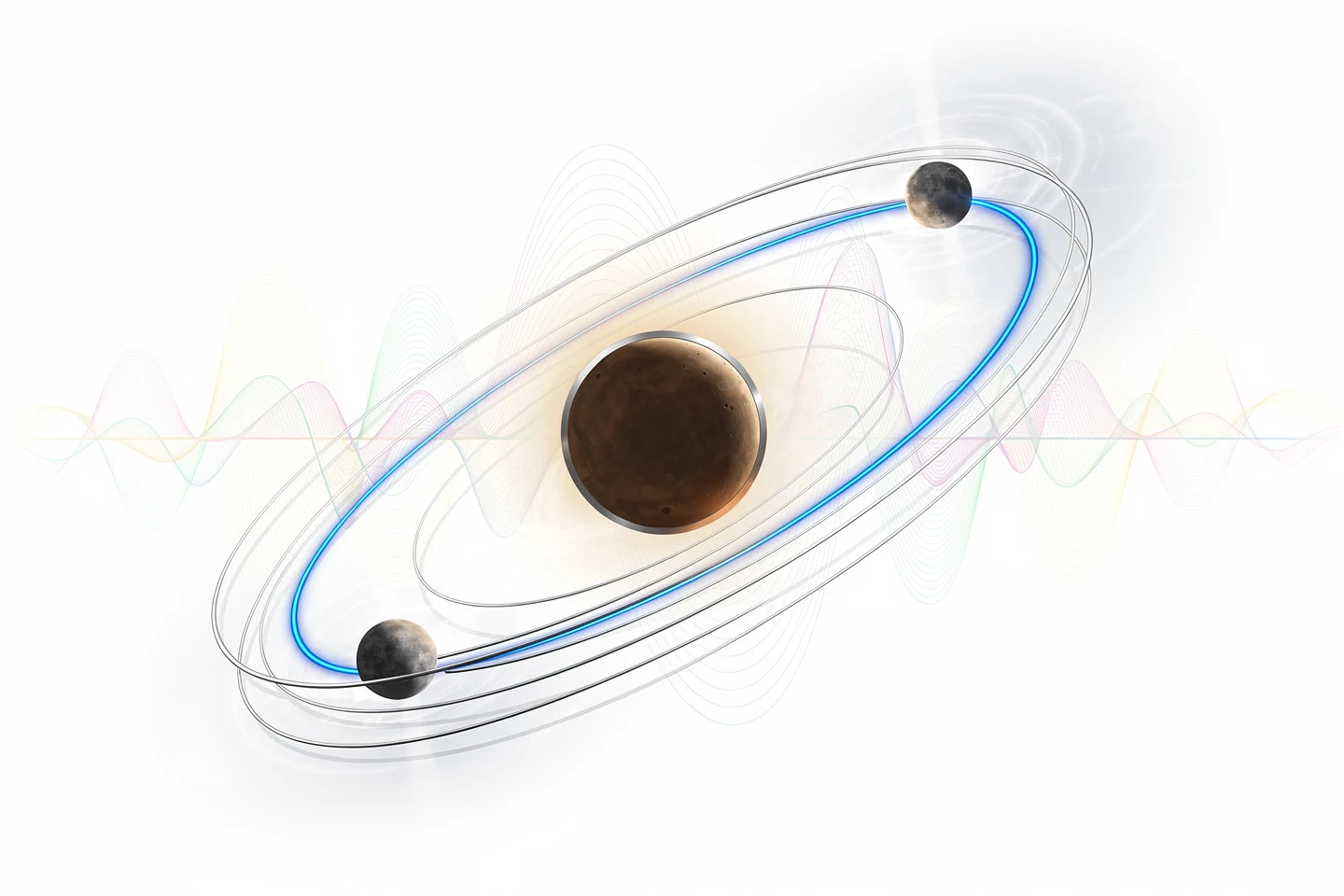
When a train whizzes past with a horn, the pitch changes: higher as it approaches and lower as it recedes. Light works the same way, because Maxwell showed that light is a wave, and its speed of light is constant. A star's color shifts ever so slightly if it's moving. Astronomers use ultra-precise instruments, spectroscopy, to catch those shifts. That's exactly how they found invisible moons around the brown dwarf CD-35 2722 B.
Dwarf CD-35 B, a dim object 37 times Jupiter's mass, was wobbling ever so slightly under the gravity of something unseen. Analysis showed two massive moons circling it. One is a giant just lighter than Jupiter with a 169-day orbit, the other smaller (a third of Jupiter) with an 87-day orbit. Their orbits are in a 2:1 resonance: for every one orbit of the big one, the small one completes two.
Before, scientists searched for moons using the transit method, perfected by Borucki — spotting a slight dimming as a planet passes. But that requires the orbit to be edge-on. The new spectroscopy approach sidesteps that limit. The discovery hints that many failed stars have massive moons, born much like planets. If such a moon has water and tidal heating warms its interior, life could exist, just like on the icy moons of Jupiter.
And it all began with tiny shifts in the hydrogen spectral lines discovered by Balmer. And let's remember: the current diversity of the cosmos has its roots in the perturbations after the Big Bang.
The brown dwarf CD-35 B is 37 Jupiter masses, almost a star. And its largest moon is heavier than many full-fledged exoplanets!
Fictional worlds like Pandora from 'Avatar' or Europa from '2001: A Space Odyssey' have long portrayed moons as habitable oases. The discovery of real massive exomoons brings those dreams a little closer.