Mini

Cosmic Tuning Fork: KLT-Net Neural Network Rewrites the Distance Ladder
Original: "KAN-LSTM-Transformer Neural Networks, MFV and Cosmological Parameters"
· Jiang Zhang, Yan-dong Chen
arXiv:2607.06959 · 2026-07-08 · CC BY · ⏱ 1 min · Cosmology
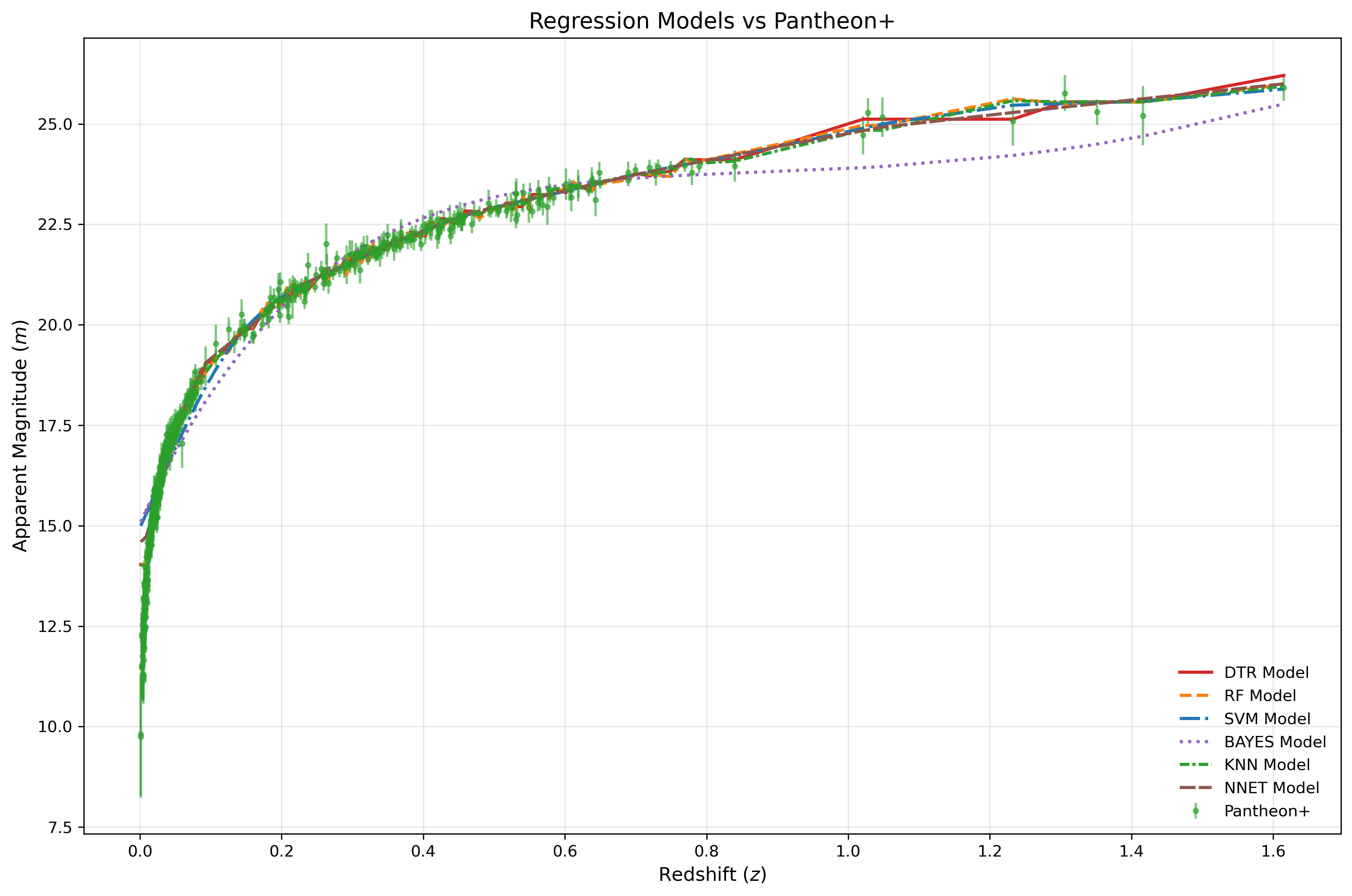
A hybrid AI combining the Kolmogorov-Arnold theorem, long memory, and attention impartially measures the universe's expansion and challenges the mystery of the Hubble tension.
Links in the knowledge graph 1

Cosmological crisis: local measurements of galaxy recession give a speed of 73 km/s, global ones 67. The 5σ discrepancy doesn't fit any model. KLT-Net is a conductor tuning the cosmic orchestra of supernovae, using splines instead of notes. The result is a clean note H₀≈69.6 km/s/Mpc. Smoothing the dissonance, the network opens the way to automatic discovery of physical laws from data. We are on the threshold of scientific 'psychohistory'.

🎯 The most frequent value (MFV) method, used to estimate the absolute luminosity of supernovae, works like finding the most popular opinion among experts: it discards extreme values, relying on the 'chorus' of the majority of data.

🎬 This is reminiscent of 'psychohistory' from Asimov's Foundation, where analysis of massive datasets without knowledge of detailed mechanisms allowed prediction of the galactic empire's future. Here the neural network predicts the expansion history from the light of distant stars.

\mu = m - M = 5 \log_{10}\left(\frac{D_L}{\text{Mpc}}\right) + 25
The distance modulus μ is a logarithmic measure of brightness, linking the apparent magnitude m of a supernova, its absolute luminosity M, and the luminosity distance D_L. Just as the loudness of a sound decreases with distance, so does light dim, and this formula is the acoustics of the cosmos.
H(z) = H_0 \sqrt{\Omega_{m0}(1+z)^3 + (1-\Omega_{m0})}
The Hubble parameter in a flat ΛCDM model describes how the expansion rate changes with [tag:redshift]redshift[/tag] z. It is the rhythmic pattern of the universe, set by matter density Ωₘ and vacuum energy.
Scientists
Alan GuthAndrei LindeGeorges LemaîtreJames PeeblesAdam RiessBrian Schmidt
Tags
supernova expansion of the universe redshift dark energy dark matter cosmic microwave background Standard Model numerical simulation big bang spectroscopy photometry
Laws
Friedmann equationsHubble's lawDoppler effectgravitational lensingNoether's theoremEinstein field equations
Original: arXiv:2607.06959 · CC BY · bridge42worlds