Neural Network Leap: KLT-Net Rethinks the Cosmic Distance Ladder ✛ ✎
Context
Modern cosmology faces a crisis: local measurements of the Hubble constant using supernovae and Cepheids give about 73 km/s/Mpc, while global constraints from the cosmic microwave background within the standard ΛCDM model point to 67 km/s/Mpc. This ~5σ discrepancy, known as the 'Hubble tension,' may hint at new physics, systematic errors, or unaccounted effects in constructing the cosmic distance ladder. To bypass model dependence, researchers increasingly turn to deep learning methods capable of capturing complex nonlinear distributions in photometric and spectroscopic data of Type Ia supernovae — standard candles visible at enormous redshifts.
Methods
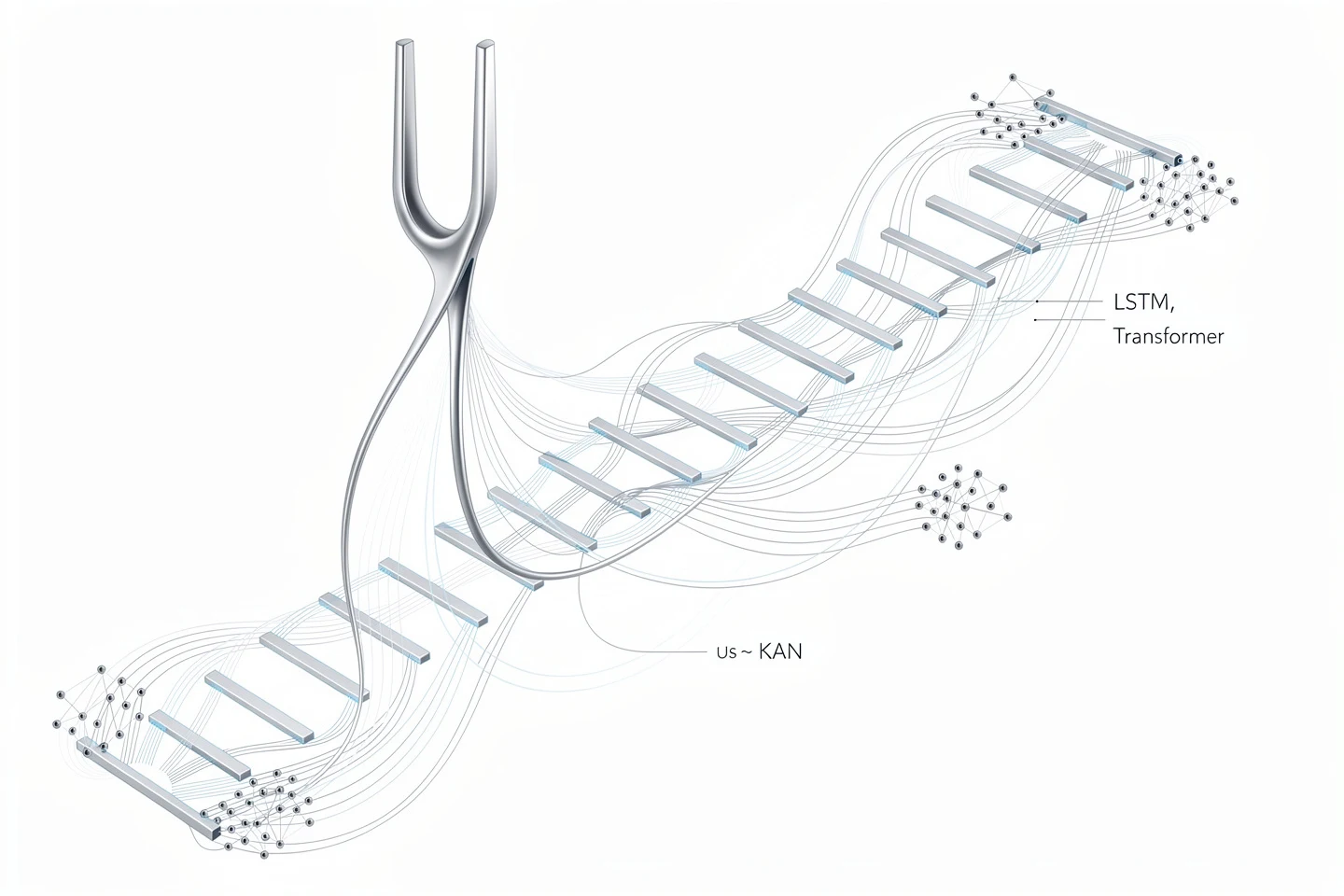
The researchers built a hybrid neural network, KLT-Net, inspired by the Kolmogorov-Arnold theorem, and trained it on Pantheon+ data (1701 light curves) without tying it to a specific cosmological model. The architecture combines three components: LSTM layers to capture local temporal dependencies in the sequences of observed magnitudes; KAN layers with learnable B-splines that efficiently approximate multidimensional nonlinearities with few parameters; and a Transformer encoder with self-attention for global context modeling of the entire expansion history. The network outputs the distance modulus µ(z) given an input redshift. To estimate the absolute magnitude $M_B$ of supernovae, they used the robust Most Frequent Value (MFV) method with bootstrap errors. Cosmological parameters H₀ and Ωₘ were derived via Bayesian MCMC sampling assuming a flat ΛCDM model with the Friedmann equations. Robustness was checked through the Hessian matrix and ablation experiments with individual components turned off.
Results
Ablation testing over ten random initializations showed that the full KLT-Net achieves the lowest variance in mean squared error ($σ_{MSE}$ = 0.559×10⁻³), which is critical for suppressing random fluctuations in the reconstructed µ(z) and, consequently, for the stability of Hubble constant estimates. Although the variant without LSTM (KT) gave a slightly better average MSE (0.016089), KLT-Net demonstrated the highest robustness to random initial weights. Final metrics of the full model: MSE = 0.015727, RMSE = 0.125409, MAE = 0.098847. Using MFV, $M_B$ = –19.3772⁺⁰.⁰²⁴⁷₋₀.₀₁₂₂ (1σ). Bayesian analysis yielded H₀ = 69.576⁺⁰.⁴⁸³₋₀.₄₈₂ km/s/Mpc and Ωₘ = 0.301⁺⁰.⁰³⁹₋₀.₀³₆, consistent with estimates via χ² minimization and Hessian matrix (68.718±0.352 km/s/Mpc for the original Pantheon data). The discrepancy in Ωₘ between direct data and network predictions (0.349 vs. 0.301) is explained by the smoothing of high-redshift features by the neural network.
Implications
The work demonstrates that integrating KAN blocks with adaptive splines enhances the interpretability and efficiency of neural networks in cosmological inference tasks. Unlike purely LSTM architectures, KLT-Net significantly dampens training instability, reducing the risk of artifacts when Bayesian sampling parameters of dark energy and dark matter. This approach enables independent cross-checking of the standard cosmological model and mitigating the Hubble constant tension through more reliable treatment of systematics.
Future development
The direction naturally evolves toward 'physics-informed' neural networks, where dynamic Friedmann equations or luminosity evolution principles are embedded into the architecture. Hybrid schemes are already proposed, combining symbolic regression with dimensional consistency and large language models to automatically derive equations of state for dark energy or modified gravity. This will minimize prior assumptions and move closer to fully extracting physical laws from data.
Impact
The method will directly impact the processing of upcoming massive photometric and spectroscopic surveys (LSST, Euclid, Roman), where noise- and gap-resistant distance recovery methods are needed. Moreover, it will find use in stellar and galactic astrophysics for predicting parameters from light curves and spectra.
Next steps
Validating KLT-Net on simulated data with realistic systematics and combining it with transfer learning methods to adapt to new instruments. Of particular interest is extending the architecture to anisotropic cosmologies and joint analysis of supernovae, baryon acoustic oscillations, and Big Bang nucleosynthesis.
Key open problems
The paper directly addresses the 'Hubble tension' — one of the most acute problems in modern physics — by offering a model-independent way to reconstruct the distance ladder and estimate H₀. It also touches on the nature of dark energy and the possible incompleteness of the standard cosmological model.
The knowledge machine's view
This section is addressed to the author of the paper and their colleagues. Neighbouring works were found by meaning-based search across our archive, not by word overlap. We do not review: we show the field around the work.
What the work does
We trained a hybrid neural network, KLT-Net, on Pantheon+ data to reconstruct the distance modulus μ(z) without assuming any cosmological model, using a combination of LSTM, KAN, and Transformer layers. With the robust MFV method, we estimated the absolute magnitude of supernovae, M_B, and then, through Bayesian analysis within a flat ΛCDM framework, obtained H₀ = 69.576⁺⁰.⁴⁸³₋₀.₄₈₂ km/s/Mpc and Ωₘ = 0.301⁺⁰.⁰³⁹₋₀.₀₃₆. Ablation tests showed that the full model achieves the lowest MSE variance, ensuring stability of the estimates.
Where its strength is
KLT-Net demonstrates high robustness to random initial weights and is capable of capturing subtle systematics in the data without explicit modeling, paving the way to reduce dependence on assumptions about supernova physics.
Where it could go next
- It might be interesting to compare your approach with independent H₀ measurements from gravitational waves: there is a paper in the archive where the expansion rate is estimated from neutron star merger events, providing a cross-check of systematics.based on: Gravitational waves measure the expansion rate of the universe arXiv:2605.27227
- Nearby, there is an analysis of Pantheon+ data using 'twin' supernovae for luminosity calibration—perhaps your network could benefit from including such pairs in the training set.based on: Universe's expansion rate refined using supernova 'twins' arXiv:2512.02391
- There is a recent Hubble constant measurement from supernova echoes in the archive, also based on Pantheon+; comparing your model's predictions on the same objects could reveal which light curve features the network finds most informative.based on: Supernova Echoes: A Fresh Measure of the Hubble Constant arXiv:2606.25205
Worth trying
- Try adding a layer to the architecture that accounts for correlations between supernovae from the same galaxy, to see if the residual scatter decreases.
- Train KLT-Net on simulated light curves with known systematics and check whether the network recovers these distortions without explicit guidance.
- Apply SHAP or a similar method to interpret the contribution of different parts of the light curve to the μ(z) prediction and compare with known phases important for standardization.
Why this may matter
If neural network methods can reliably reduce systematics in the distance ladder, we move closer to resolving the Hubble tension and refining cosmological parameters, which is critical for understanding dark energy.
Nearby works in our archive
- The Cosmic Tuning Fork: Why the Universe Plays Two Different Notessimilarity 0.69
- Cosmic Clocks Diverge: A New Mystery of the Universe's Expansionsimilarity 0.64
- Neutrinos Reveal the Universe's Expansion Ratesimilarity 0.63
- Why Has Cosmology Cracked?similarity 0.62
- Why Cosmic Data Refuse to Convergesimilarity 0.62
- Universe's expansion rate refined using supernova 'twins'similarity 0.61
- Supernova Echoes: A Fresh Measure of the Hubble Constantsimilarity 0.60
- Gravitational waves measure the expansion rate of the universesimilarity 0.60
The closest work in the archive sits at 0.69 by meaning — the usual level for our corpus.
The network uses B-splines — the same mathematical constructs employed in computer graphics and animation for smooth curves. And once Edwin Hubble deduced the expansion of the Universe by eye from photographic plates!
The idea of a neural network autonomously reconstructing cosmic history echoes the 'Encyclopedia Galactica' from Isaac Asimov's Foundation series: there, mathematicians predicted the future of civilizations by analyzing massive data sets without knowing detailed mechanisms.
Key numbers
- Hubble constant H₀: 69.576 km/s/Mpc
- matter density Ωₘ: 0.301
- absolute magnitude of supernovae M_B: –19.38 mag
- mean squared error of KLT-Net (MSE): 0.0157
- number of supernovae in sample: 1701