Cosmic Tuning Fork: KLT-Net Neural Network Rewrites the Distance Ladder ✛ ✎
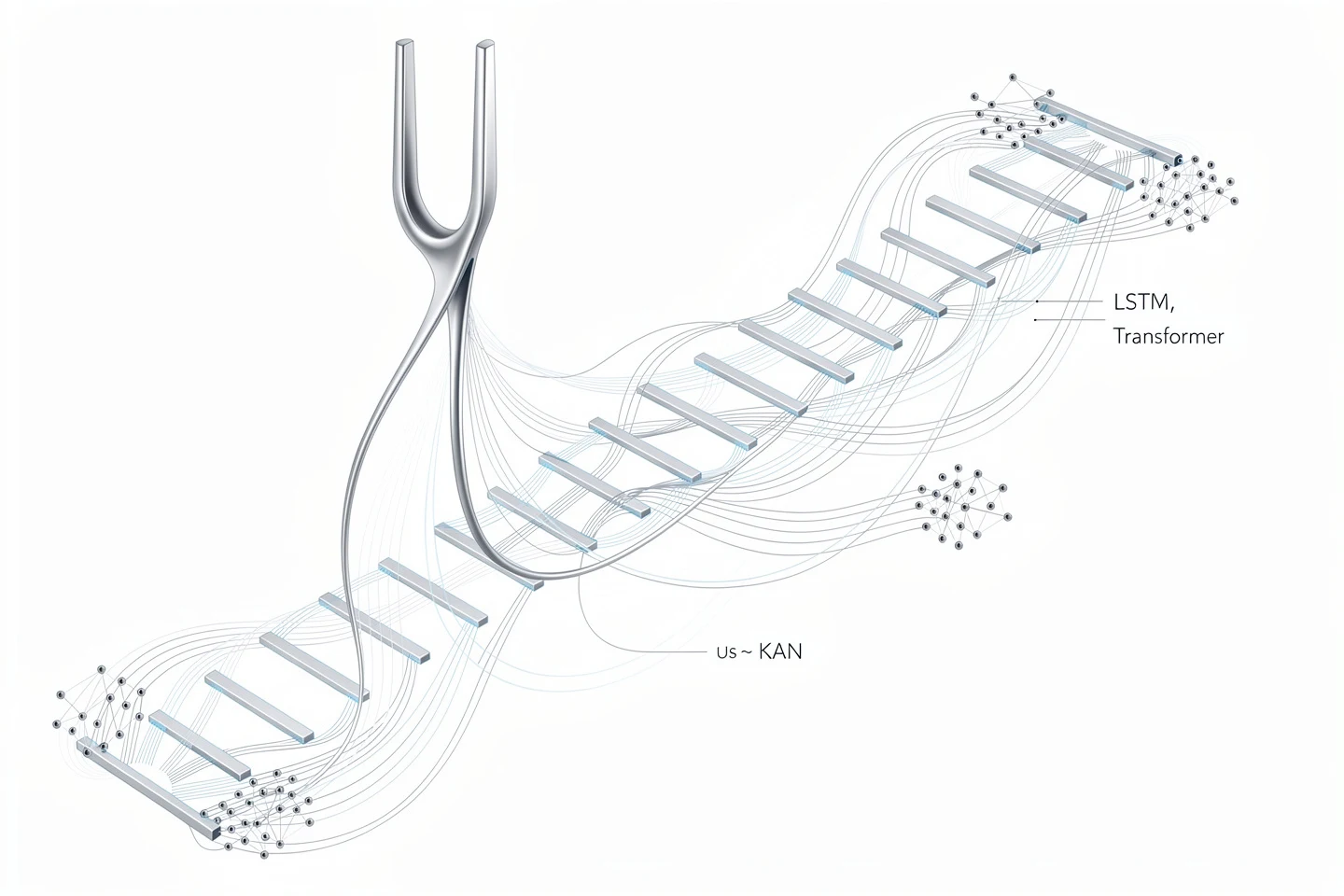
Modern cosmology has hit a dissonant chord. Local measurements of the Hubble constant from supernovae and Cepheids give around 73 km/s/Mpc, while global constraints from the cosmic microwave background within the standard ΛCDM model point to 67 km/s/Mpc. This ~5σ discrepancy, known as the 'Hubble tension,' sounds like a jarring note that demands either new physics or a rewrite of the entire distance ladder. This ladder, where each rung rests on the previous one, can be likened to an orchestra: Type Ia supernovae are tuning forks that set the tone, but systematic errors and model assumptions introduce discord. The traditional approach, manually adjusting calibrations, is akin to tuning instruments by ear in a noisy hall. But now a new kind of conductor has arrived: KLT-Net.
This conductor is not human: it's a hybrid neural network inspired by the Kolmogorov–Arnold theorem. It weaves three elements into a single score. LSTM layers capture local overtones, temporal dependencies in light curves, like a musician keenly following sound nuances. KAN layers with learnable B-splines construct complex nonlinear melodies from simple elements, like a composer building a symphony from scales. And the Transformer encoder with self-attention grasps the entire harmonic structure, sensing the global rhythm of expansion. Training was on 1701 supernovae from the Pantheon+ catalog, and just as a musician relies on perfect pitch, KLT-Net trusts the data, not cosmological dogma.
So what did this conductor reveal? Ablation tests, when solo components left the orchestra one by one, confirmed: the full KLT ensemble sounds the most stable, reducing error variance to 0.0005. Through the data noise a pure note emerged: Hubble constant H₀ = 69.58 km/s/Mpc. It turned out slightly lower than local measurements by Edwin Hubble and his followers, but higher than the CMB value, smoothing out the agonizing gap. Matter density Ωₘ=0.301 echoes other probes, hinting at a universal motif. Interestingly, the absolute magnitude of supernovae $M_B$ = –19.38 mag was obtained using a robust method of most frequent value, as if the conductor listens to the 'chorus' of the majority, ignoring extreme outliers.
This work is just an overture. Physics-informed neural networks (PINNs) are already weaving Friedmann equations directly into the score, and symbolic regression promises to automatically derive laws for dark energy and dark matter. Imagine a network that doesn't just tune instruments but composes the music of the universe, drawing on light from billions of stars. Upcoming LSST and Euclid surveys will generate millions of "notes," and KLT-like algorithms will become the chief arrangers. Step by step, we are getting closer to hearing the true harmony of the cosmos.
The most frequent value (MFV) method, used to estimate the absolute luminosity of supernovae, works like finding the most popular opinion among experts: it discards extreme values, relying on the 'chorus' of the majority of data.
This is reminiscent of 'psychohistory' from Asimov's Foundation, where analysis of massive datasets without knowledge of detailed mechanisms allowed prediction of the galactic empire's future. Here the neural network predicts the expansion history from the light of distant stars.