The Universe in the Balance: Neural Network Refines Cosmic Expansion ✛ ✎
Imagine a dark room and a light bulb. You know its true power is 100 watts, but it looks dim: that means it's far away. The dimmer it is, the farther. Astronomers use a similar trick: they observe special explosions — supernovae whose true brightness is almost the same. It's as if the cosmos itself placed beacon lights. That's exactly how in the 1990s Adam Riess and colleagues discovered that the Universe is expanding faster and faster.
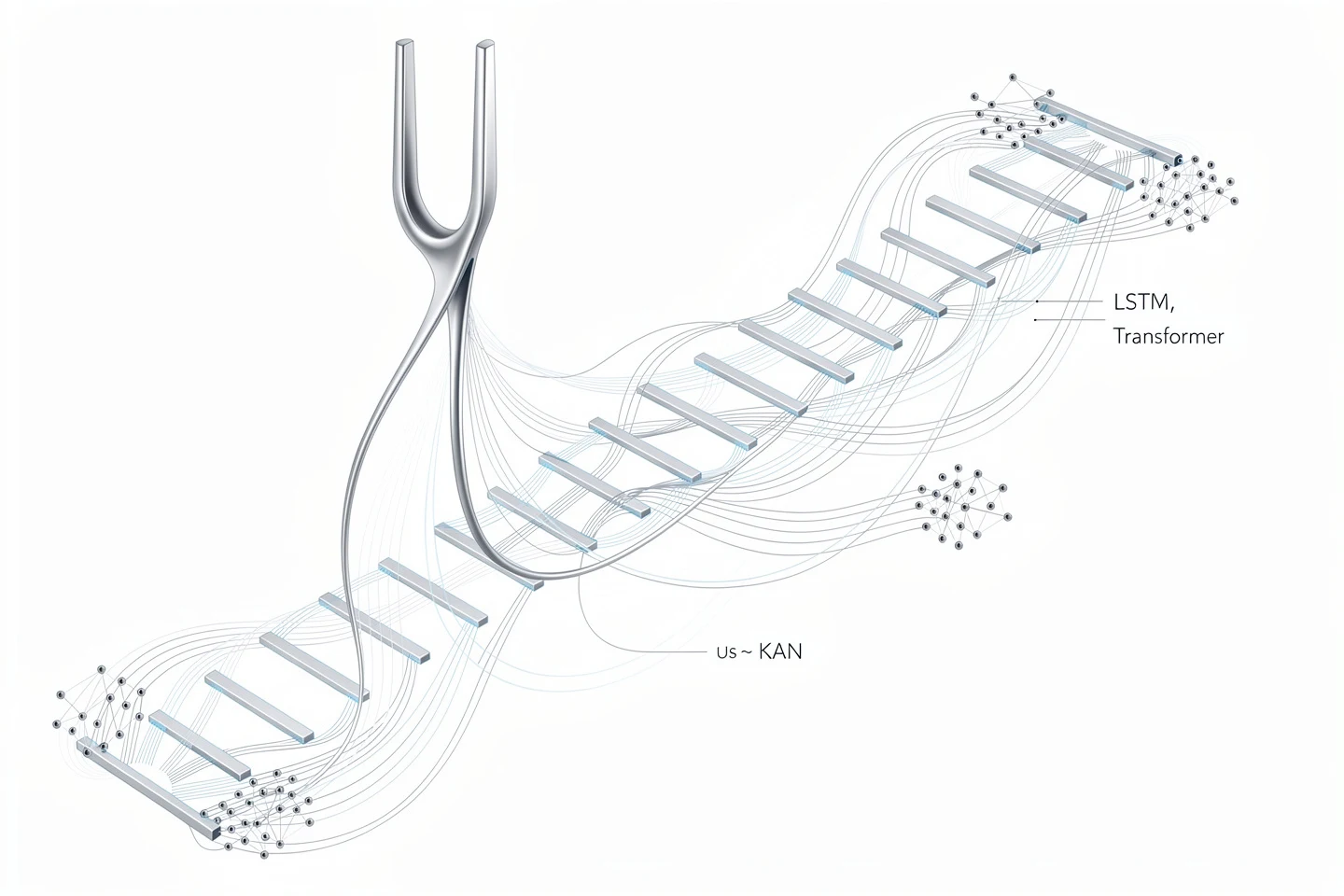
For a long time it seemed that expansion proceeds at a constant rate — called the Hubble constant after Edwin Hubble (though the idea was first voiced by Georges Lemaître). Yet measurements from supernovae give one number, while those from the ancient cosmic microwave background give another. This discrepancy could point to new properties of dark energy or gaps in theory. To bypass the debate, scientists created the neural network KLT-Net: it looks at the redshift of light (its reddening due to space stretching) and itself derives what distance it corresponds to. The network's three 'brains' — one memorizes sequences, another finds main patterns, the third captures the big picture — learn without ready-made formulas.
The result: the Hubble constant came out at about 69.6 km/s per megaparsec — roughly the speed two houses, separated by a million light-years, gain as they race away from each other every second. This value is slightly closer to the cosmic microwave background data, easing the contradiction. The value of this approach is that it doesn't tailor numbers to dogma but honestly seeks the connection directly. When new telescopes flood us with precise images, similar networks will help fish out hints of the mysterious dark energy — the cause of the galaxies' ever-accelerating rush.
The network uses B-splines — the same mathematical curves that draw smooth lines in computer animation. And once upon a time Edwin Hubble deduced the expansion of the Universe by eye from photographic plates!
The idea of a program that itself reconstructs the history of the cosmos is reminiscent of the 'Encyclopedia Galactica' from Isaac Asimov's Foundation novels: mathematicians there predicted the future by analyzing mountains of data without knowing all the mechanisms.