Dark Matter or a Law of Nature: The Debate over Galaxy Motion express
A galaxy's speedometer is pegged. Outer stars orbit so fast that, by all laws of gravity, they should fly off like spray from a spinning wheel. Astronomers have long noticed this discrepancy and proposed two explanations: either there is invisible mass around galaxies (dark matter), or the law of gravity itself works differently at large distances than we were taught in school.
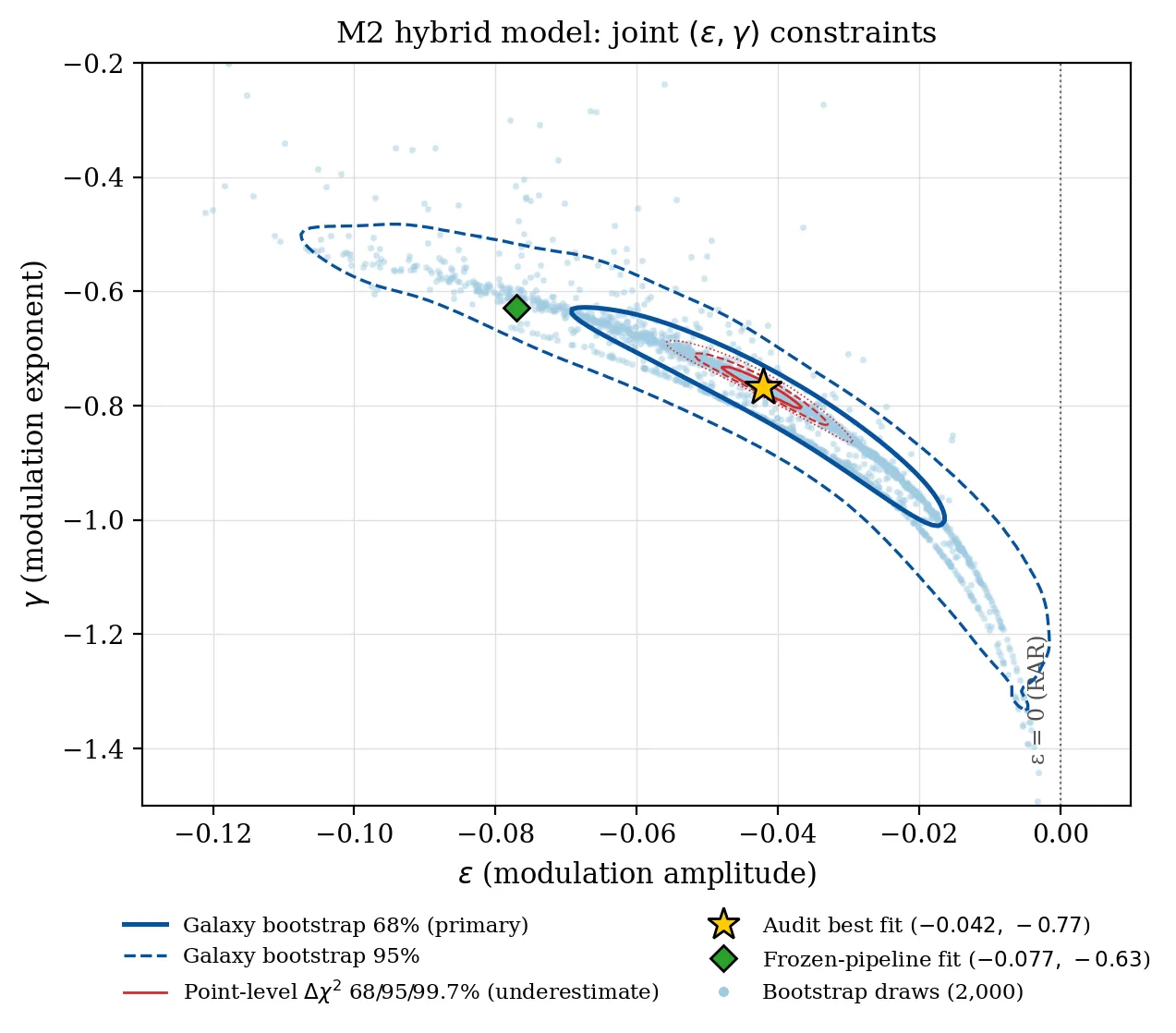
The authors of the new study gave the second option a rigorous exam. They took rotation data for 126 galaxies and tested whether a single correction to the law of gravity could explain all observations at once. It turns out it cannot: the correction improves the fit to data, but only because each galaxy has its own 'freedom'—as if you were tuning a speedometer for each car individually. Under an honest cross-validation, this correction predicts nothing better than a simple calculation based on visible mass.
The main takeaway is not a discovery but a threshold. Any future theory that wants to do without dark matter must surpass this level of precision. Otherwise, it need not be taken seriously.
Original abstract
as written by the authors arXiv:2608.08945v1
We ask whether any one-parameter structural correction to the radial acceleration relation (RAR) can be uniquely recovered from SPARC rotation curves, and answer with an identifiability audit: each candidate is benchmarked against per-galaxy nuisance freedom, with predictive scoring against mass-only and data-quality baselines. In the full sample (N = 126) the answer is no: a hybrid compactness term improves the fit, but zero-point freedom absorbs the gain, and in cross-validation the model fails to out-predict a mass-only baseline and loses to a quality-flag baseline. One regime retains structural information: in gas-dominated, low-acceleration disks -- where MOND's strict locality and $$\Lambda$$CDM feedback models diverge most sharply -- the RAR residual correlates with compactness ($$r=0.46$$, $$p=1.3\times10^{-4}$$), remains significant under hierarchical partial pooling ($$\beta=0.23$$, $$p=1.7\times10^{-5}$$; N = 63), and survives canonical joint control for quality, sampling, mass, inclination error, and first-order pressure support ($$r=0.30$$, $$p=0.02$$). All significant results pass a Benjamini-Hochberg correction over the declared 27-test family. Three limits temper that survival: it is not significant under rank-based control over the widest proxy set; it resides in faint dwarfs independent surveys do not reach; and after mass control it is shared across the mass-size manifold. Pressure support brackets the interpretation -- isotropic drift correction absorbs a quarter of the amplitude, while a Jeans treatment overcorrects resolved cases -- leaving the physical origin undetermined. The audit's product is the extraction limit: claimed corrections must clear the 0.106 dex per-galaxy nuisance floor, a mass-only baseline, and data-quality stratification.
Dark matter is invisible to every telescope, but without it, calculations of the motion of galaxies, clusters, and even the bending of light from distant objects do not add up.