Dark Matter or a Law of Nature: The Debate over Galaxy Motion express
A galaxy's speedometer is pegged. Outer stars orbit so fast that, by all laws of gravity, they should fly off like spray from a spinning wheel. Astronomers have long noticed this discrepancy and proposed two explanations: either there is invisible mass around galaxies (dark matter), or the law of gravity itself works differently at large distances than we were taught in school.
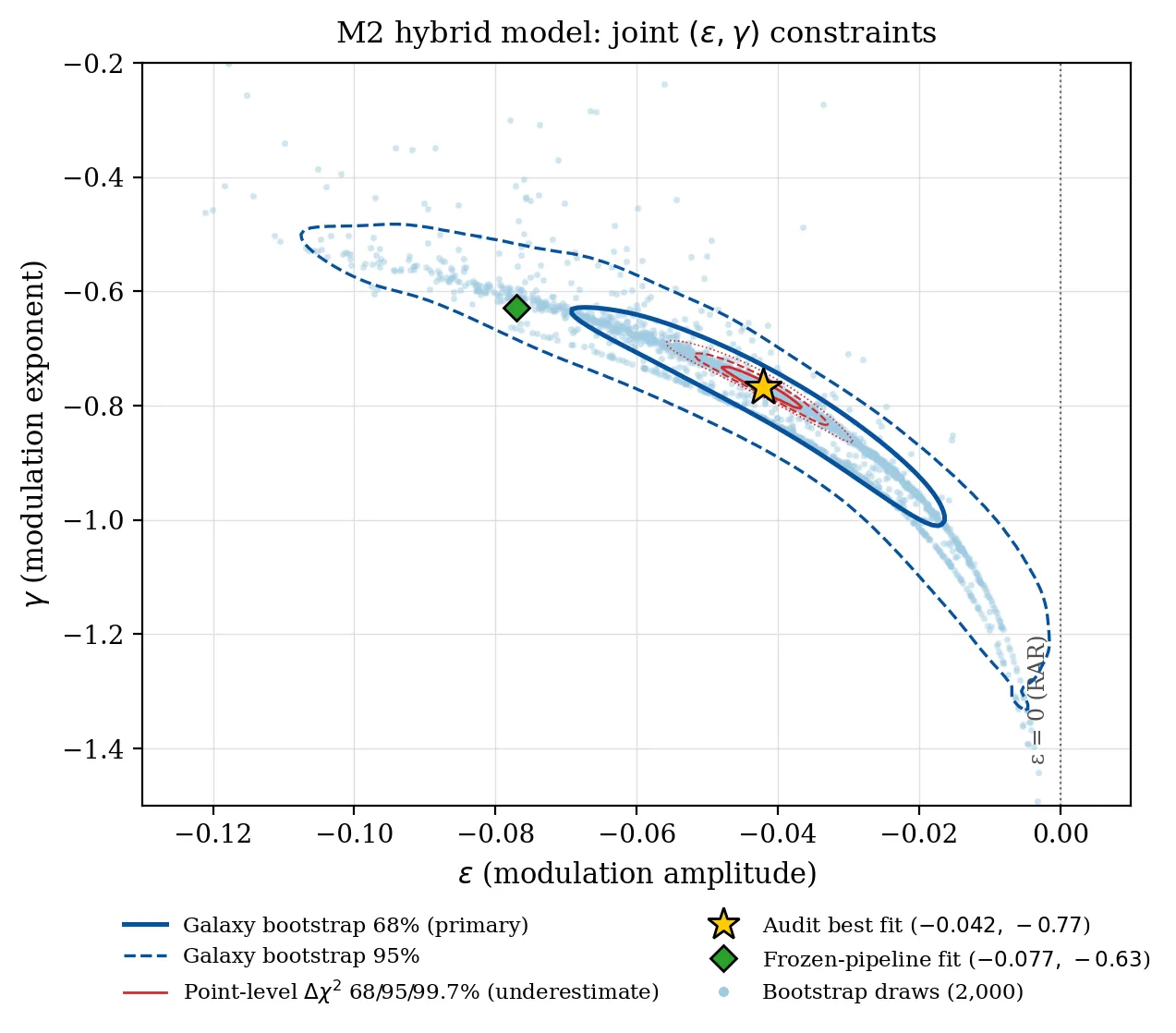
The authors of the new study gave the second option a rigorous exam. They took rotation data for 126 galaxies and tested whether a single correction to the law of gravity could explain all observations at once. It turns out it cannot: the correction improves the fit to data, but only because each galaxy has its own 'freedom'—as if you were tuning a speedometer for each car individually. Under an honest cross-validation, this correction predicts nothing better than a simple calculation based on visible mass.
The main takeaway is not a discovery but a threshold. Any future theory that wants to do without dark matter must surpass this level of precision. Otherwise, it need not be taken seriously.
Dark matter is invisible to every telescope, but without it, calculations of the motion of galaxies, clusters, and even the bending of light from distant objects do not add up.