Time dilation is an effect of relativity theory in which time intervals stretch in a moving reference frame or in a gravitational field compared to a stationary observer. In special relativity, time slows down by a factor of γ = 1/√(1 − v²/c²), where v is the speed of motion and c is the speed of light. Gravitational time dilation is predicted by general relativity: clocks in a stronger gravitational potential run slower. Both effects have been precisely measured and they add together.
History
The foundations were laid in the works of Hendrik Lorentz (1892, 1895) and Henri Poincaré (1905), who introduced 'local time' and coordinate transformations. In 1905, Albert Einstein showed that time dilation is a direct consequence of two postulates: the equivalence of inertial frames and the constancy of the speed of light. Experimental confirmation came from the observation of atmospheric muons (1941): the lifetime of fast muons was extended, and they reached the surface. Later, the effect was tested with atomic clocks on airplanes (Hafele–Keating, 1971) and is used daily in GPS.
How it works
Time dilation preserves the invariance of proper time dτ² = dt² − dx²/c² in flat spacetime. In a moving system, worldlines maximize proper time, leading to the 'twin paradox.' Gravitational time dilation arises from the metric: the component g₀₀ = (1 + 2φ/c²) determines the rate of clocks. The equivalence principle connects both types: acceleration is indistinguishable from gravity, so clocks in an accelerating rocket also slow down.
In practice
GPS satellites travel at tremendous speeds and are farther from Earth, where gravity is weaker. Without relativistic corrections, their clocks would diverge from Earth clocks by 38 microseconds per day, and navigation would be off by kilometers daily.
Fun fact
On GPS satellites, time runs faster by 45 microseconds per day due to weaker gravity (they are farther from Earth), but slower by 7 microseconds due to speed; the net correction is 38 microseconds, without which the navigation error would reach tens of kilometers after one day.
Two runners start a race on a course with changing incline. One starts earlier, the other later, and the judge measures their speeds without knowing about the staggered starts. So it is with virus variants: data arrive with delays, and if those delays are unequal, estimates of competitive advantage can be badly wrong.
Two runners start a race on a course with changing incline. One starts earlier, the other later, and the judge measures their speeds without knowing about the staggered starts. So it is with virus variants: data arrive with delays, and if those delays are unequal, estimates of competitive advantage can be badly wrong.
As planets orbit the Sun, they don't just follow their paths: they give each other a slight tug. It's like a dance where each partner feels the movements of the others. Scientists set out to determine how strongly this mutual attraction alters the planets' trajectories.
It turns out there are small corrections that were previously overlooked.
A light ray passing by a massive body slightly changes its direction, like a stream of water bending around a rock in a creek. In the solar system, there are many such "rocks": planets, their moons, asteroids. And each one, with its own gravity, bends the path of light coming from distant stars.
A stone thrown into water quickly loses speed. A meteor entering the atmosphere should behave the same way: air slows it down, and friction burns up its material. But cameras of the Global Fireball Observatory network have captured hundreds of bright fireballs over ten years that streak across the sky with almost no deceleration.
A superconductor pushes out a magnetic field like a sponge squeezing out water. This Meissner effect has been known for nearly a century, but it's usually calculated in a flat world — without gravity. In the strong field of a black hole or at enormous speeds, the picture changes.
An ordinary mirror swaps left and right. Many laws of physics don't notice the swap: they are mirror-symmetric. But some phenomena, like the weak interaction, break this symmetry. Until now, it was thought that gravity and light each break mirror symmetry in their own independent way.
Hot water sometimes freezes faster than warm water: this odd fact is known as the Mpemba effect. Now something similar has been found in the quantum world: a state with weak entanglement (a special quantum connection between particles) can beat a more entangled one to the finish line.
The quantum world does not forgive forgetfulness. Throw a stone into a pond — the ripples spread and vanish, the information about the impact dissipates without a trace. In quantum mechanics, everything is different: the evolution of a system is reversible, and the past is never completely erased.
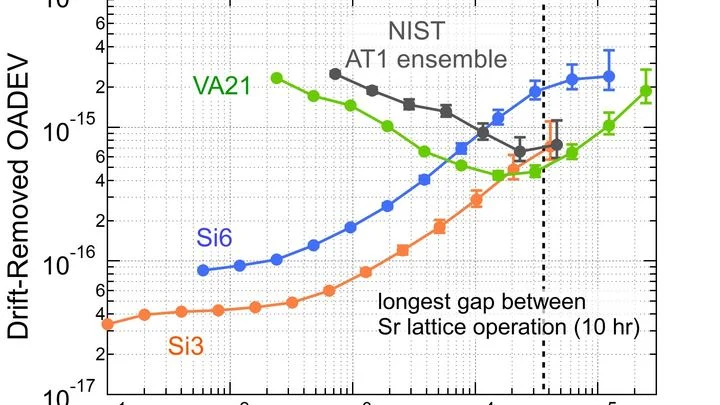
The ticking of atomic clocks is like the beat of a metronome, but instead of a pendulum, it's the oscillation of electrons in an atom. Two such clocks — one using an ytterbium ion, the other using strontium atoms — were made to tick side by side, and their rhythms were compared.
The world's most precise stopwatch still runs with one eye on an old pendulum. Hydrogen masers — the best radio-frequency flywheels (devices that keep the rhythm between comparisons with a reference)—accumulate error because noise between ticks leaks into the final signal.
In 2017, detectors picked up a gravitational wave from the collision of two neutron stars. Just 1.7 seconds later, telescopes saw a flash of gamma-ray burst from the same spot. That tiny delay became a treasure for physicists.
A globular cluster, a dense swarm of hundreds of thousands of stars, plows through a galaxy like a bullet through water. In ordinary dark matter (the invisible mass that holds galaxies together), it should quickly lose speed due to dynamical friction.
A thrown stone arcs through the air and falls. A planet orbiting a star is the same stone, but it falls forever, looping around the star in a closed curve. In Newton's world, that curve is a perfect ellipse, and the planet returns to the same point each orbit. In reality, the orbit slowly rotates: its closest point to the star, the perihelion, shifts.
Hot water sometimes freezes faster than cold. Ice forms more quickly from boiling water. This paradox, discovered by schoolboy Erasto Mpemba, long puzzled physicists. It turns out: the farther a system is from equilibrium, the faster it relaxes back to it.
The Mpemba effect remains controversial today: too many variables, hard to reproduce.
A stone falls into still water — ripples spread across the surface. A black hole behaves similarly when something falls into it or when it merges with another black hole. The hole begins to oscillate, and these oscillations propagate through space as gravitational waves.
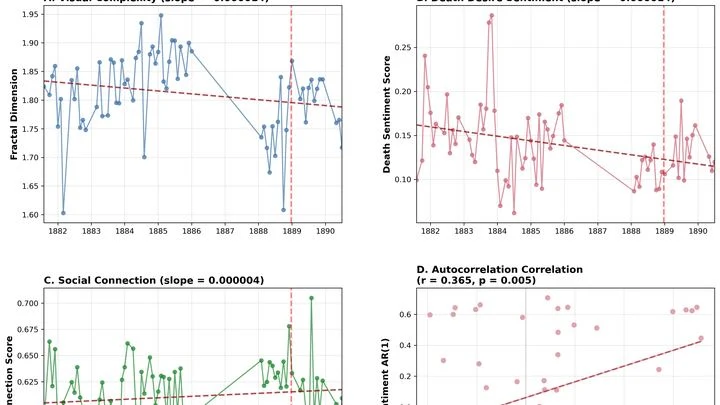
In 1888, Vincent van Gogh cut off his earlobe. Biographers and psychiatrists have been trying to explain this act ever since. But mathematicians approached the mystery differently: they measured how the artist's feelings changed in his letters and how the 'nervousness' of his brushstrokes grew, and they saw a clear signal of impending trouble.
A swing that gets pushed usually swings and quickly calms down.
Two balls dropped from different heights fall to the ground with different accelerations. In space, things are more complicated: even emptiness makes bodies move differently.
A light ray passing by a massive body gets deflected: this is the effect of gravitational lensing, familiar from images of distant galaxies. The astrophysicists started with a rotating black hole (Kerr spacetime) and added a tiny correction to how light itself propagates.
When two neutron stars circle each other, they don't remain rigid spheres. The partner's gravity stretches each star, creating tidal bulges — much like the Moon raises ocean tides on Earth. But unlike water, here it's superdense matter that deforms: a teaspoon of this stuff weighs billions of tons.
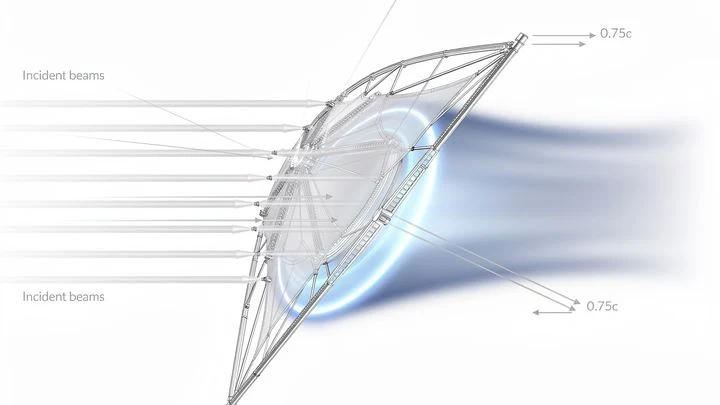
Imagine a three-faced dancer on the crest of a light wave. One face is a catcher, absorbing incoming photons. The second is a perfect mirror, throwing light back. The third is frosted glass, scattering rays in all directions. As long as speed is low, the dance is harmonious. But at near-light speeds, the choreography breaks.
This is like a surfer chasing a wave.
An orchestra without a conductor: each musician hears only their neighbor and is slightly late or early. In ordinary atomic clocks, the picture is similar — atoms oscillate, but their rhythm is disrupted by thermal jitter, limiting timekeeping accuracy.
However, a group of physicists has managed to turn this flaw into a feature.
You can zoom into a high-resolution photo for a long time — until suddenly a smooth face dissolves into individual pixels. Something similar, according to a new study, happens to spacetime itself. The authors propose that tiny intervals of length are not pre-existing 'parts' of the universe but results of measurements.
An ordinary photometry detector can't tell a left photon from a right one. But let it start moving, and everything changes.
Imagine a rower moving between two flutists playing the same note. His ear is perfectly tuned to that note and ignores all others. As he moves, the pitch from the flutist ahead sounds higher, and from the one behind sounds lower.
A pebble tossed into a pond sends ripples spreading in all directions. Now imagine the pond itself suddenly turning into jelly — instantly, faster than the wave can complete a single crest. Some ripples would keep spreading but change their spacing, while others would unexpectedly turn around and run back toward the point of impact, as if time were flowing backward for them.
Place two identical alarm clocks on a table and set them off at the same time. If one is on a slippery surface and starts to slowly slide, its timing will be thrown off, and within a minute they'll ring out of sync. That's roughly how the new method proposed by astrophysicists for supermassive black holes works.
Photographing the vicinity of a black hole is like shooting a fountain: a short exposure freezes the droplets, a long one blends everything into blurry streaks. Light from the superheated gas swirling around the hole reaches us along different paths. Some rays curve around it in an arc, others make multiple loops due to spacetime curvature.
A stone falls into a well, and the splash reaches your ears with a delay. Something similar happens to light as it leaves Earth: its oscillations become less frequent, the beam seems to 'tire.' This is gravitational redshift — a phenomenon Einstein spoke of a century ago.
In the basements of four European institutes stood seven devices: each can be compared to a tuning fork of unimaginable precision. But instead of sound, they emit 'ticks' made of light: oscillations of a laser locked to a specific frequency by atoms of strontium, ytterbium, or mercury.
Light zips faster than anything else in the Universe, and that's not just a fact, it's the foundation of general relativity. But what if we mentally slow light down to a snail's pace? That's exactly the kind of game with equations the authors of a new paper have played.
An ordinary camera flash lasts thousandths of a second. An attosecond pulse is a trillion times shorter — in the time it takes, light travels a distance smaller than the size of an atom. Such flashes act as an ultra-high-speed shutter: they freeze the motion of electrons, letting us see them jump between orbitals or take part in a chemical reaction.
Your hand rests on the table, and two short vibrations arrive at your wrist — one after the other. You need to say which is stronger. The task seems simple, but the answer depends on which vibration came first. If the first is weak and the second is strong, the difference feels larger than when they are swapped.
A clock isn't just hands. Every atomic nucleus is a natural metronome: it oscillates with nearly perfect regularity. If you lift one such metronome a couple of meters, its rhythm speeds up ever so slightly — that's time warping, as predicted by Einstein.
On the table sits a sensitive instrument — a torsion balance. Two heavy masses rotate near a suspended rod, and their attraction tends to twist the rod. But the masses are arranged so that their ordinary Newtonian attraction cancels out: one pulls one way, the other the opposite. Only a weak residual remains, which the instrument captures.
In giant accelerators, particles zip through detectors in billionths of a second, and telling one from another requires a stopwatch of incredible precision. The new µRWELL-PICOSEC detector acts as such a stopwatch: it captures the moment a particle passes with a precision of 48 picoseconds: that's 48 trillionths of a second.
An atomic gravimeter works like a very precise scale for gravity: it tosses up a cloud of atoms and watches how fast they fall. But these instruments have a hidden flaw — the shape of the signal they produce is slightly skewed. This skew, like a ruler with a chipped edge, subtly shifts every measurement.
When an aircraft is on final approach or a submarine is navigating blind, the navigator needs an instrument that never loses track of motion. Conventional gyroscopes based on atomic waves are extremely precise, but they have a quirk: the signal repeats like a wallpaper pattern, and after half a step, the pattern starts to look the same. The instrument loses its sense of position.
A supersonic gas jet is like a highway where some cars zoom past faster than sound while others crawl. Measuring each car's speed at once without disrupting traffic is a tough challenge.
Two phones with identical batteries: one charges in a basement with a weak signal, and the process goes slower. The battery percentage here plays the role of a clock hand. Physicists applied the same logic to the quantum world. Their clock is a microscopic battery that stores energy. The charging rate depends on a hidden quantum 'mode'—like a switch.