Lasers Straighten Out Signals express
Data zips through optical fibers at the speed of light, but the path isn't perfect: the signal gets muddled, like a voice echoing down a long hallway. The faster the speed and the longer the distance, the worse the distortion. Usually, electronics fix this, but they can't keep up with light.
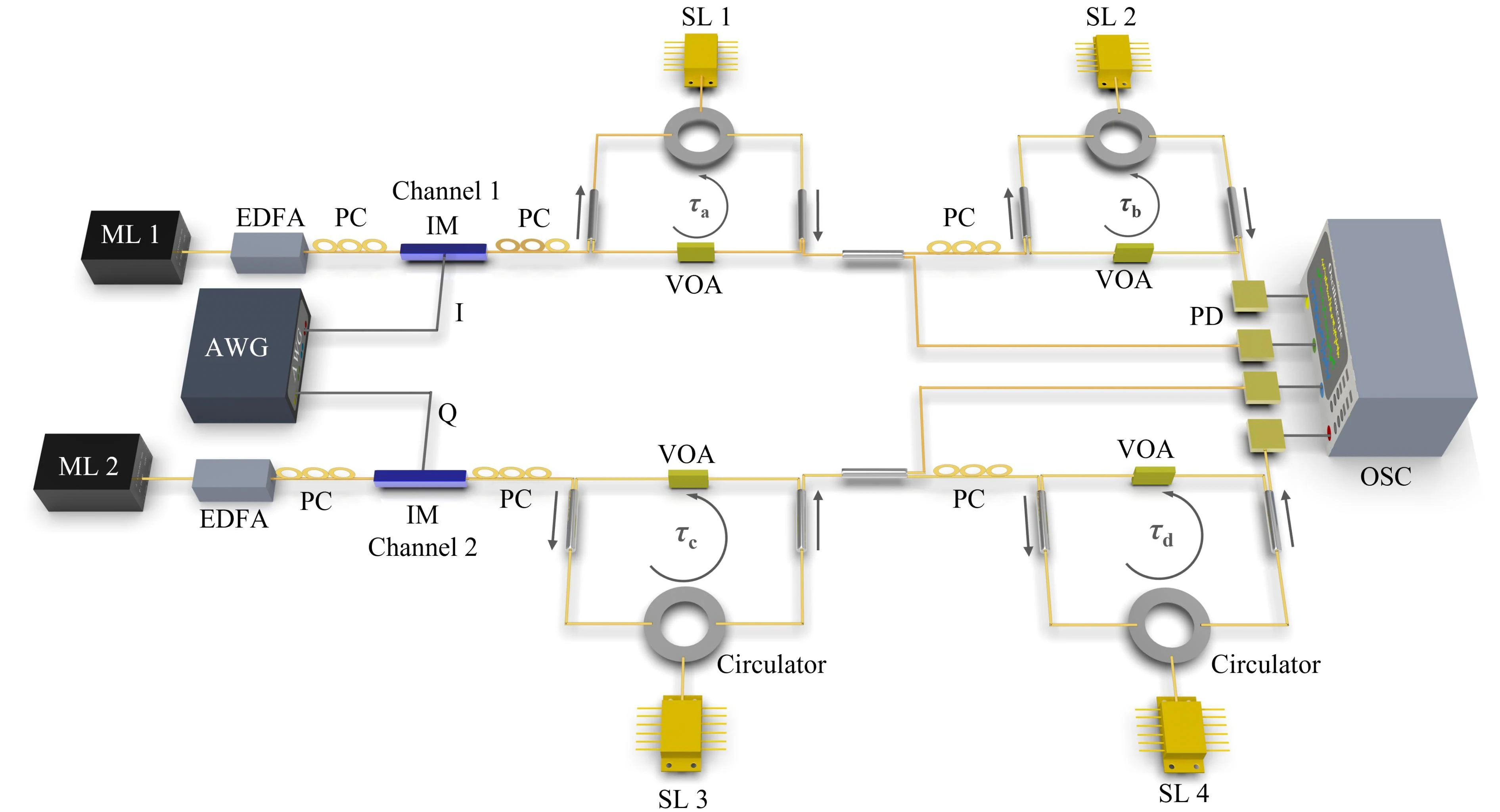
Scientists assembled a light-based computer from several lasers linked in a chain. Each laser acts like a network node that slightly adjusts the signal. Together, they learn on the fly: the first layer catches gross errors, and the subsequent layers refine the details. In tests, this computer processed a signal at 240 gigabits per second: that's about 30 gigabytes of data every second.
Trials showed that the light-based computer handles distortions at different signal powers and over various distances. That means it could be integrated into real communication lines — helping data travel farther and more accurately, without bulky electronics.
Original abstract
as written by the authors arXiv:2608.17419v1
Photonic reservoir computer (PRC) is a promising optical computing framework for high-speed optical signal processing, and various reports have shown its functionality of linear equalization for intensity-modulation direct-detection communication links. However, coherent communication links suffer more from nonlinear impairment, whereas its nonlinear equalization is very challenging. Here we demonstrate the nonlinear equalization of coherent 16-level quadrature amplitude modulation (16-QAM) signals using a deep PRC in experiment. The deep PRC consists of cascading injection-locked semiconductor lasers with optical feedback loops. For 16-QAM signals with a transmission rate of 240 Gbps and a launch power of 12 dBm, the single-channel PRC with 3 hidden layers raises the Q factor by as high as 0.58 dB, while the dual-channel PRC with 2 hidden layers raises the Q factor by 0.55 dB. In addition, we prove that the deep PRC is able to equalize 16-QAM signals of different launch powers and transmission distances.
The lasers in this system work like musicians in an orchestra: each one hears the common rhythm and adjusts so the melody sounds clearer.