Popular

Charles Townes

1915–2015 · quantum electronics, physics
American physicist, inventor of the maser and laser — devices that use stimulated emission to generate coherent electromagnetic radiation. His inventions revolutionized spectroscopy, communications, medicine, and countless technologies, forming the basis for many scientific instruments, including LIGO and space telescopes.

Biography

Born in Greenville, South Carolina. Studied at Furman University, Duke, and Caltech. Worked at Bell Labs, Columbia University, MIT, and the University of California, Berkeley. He conceived the maser while sitting on a park bench. Received the 1964 Nobel Prize in Physics. Also awarded the US Medal of Honor and many others.

Key discoveries

💡 He thought up the maser principle while scribbling calculations on the back of an envelope in a Washington park. Later he admitted that colleagues advised him not to waste time on this "crazy" idea because it violated the then-known laws of physics (in reality, it was the other way around).
Quote: "It was like a solution looking for a problem. (About the laser)"
Links in the knowledge graph 1
Related tags
LIGOquantum opticsradio astronomyspectroscopy
Related laws
invention of the laser
Related scientists
Robert HookeJohann Jakob BalmerJocelyn Bell BurnellArno PenziasJames Clerk MaxwellAlain AspectErwin SchrödingerCecilia Payne-Gaposchkin

Related articles

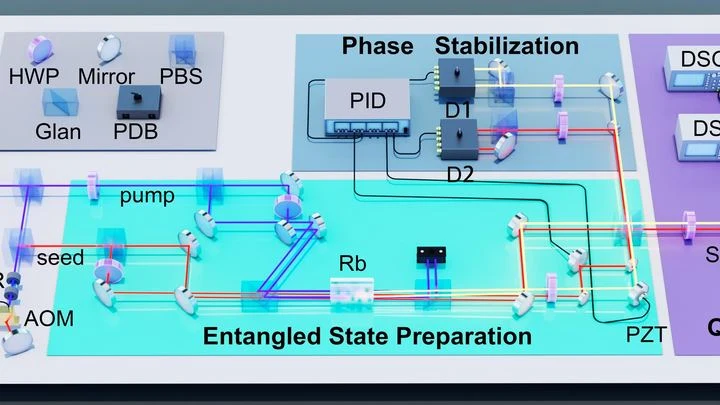
Donut Beam Locks Mirrors with Subatomic Precision

Scientists stabilized a pair of micromirrors using a donut-shaped laser beam. The beam’s dark center lands right on the detector, letting the camera capture the glow of single atoms without interference. This will boost the reliability of quantum devices.
arXiv:2412.00271 · 2024-11-29

Social Laser: Why We Act in Sync

Scientists applied the laser principle to crowd behavior. People are like atoms: they get charged by news and slogans. Once enough charge builds up, a single impulse triggers synchronized action. The model promises to predict mass events.
arXiv:2510.16012 · 2025-10-15

A Quantum Turnstile Chip for Photons

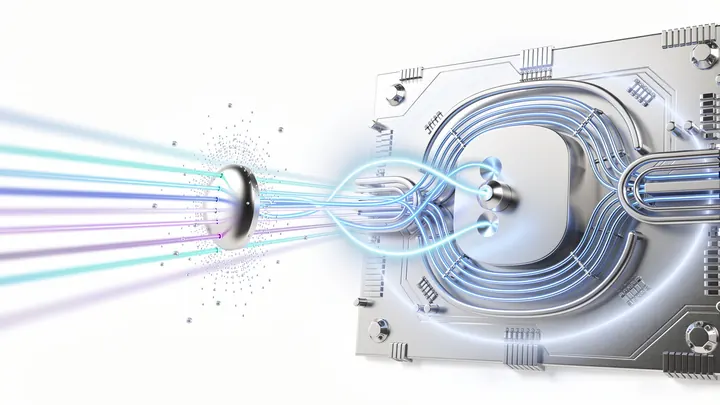
Ordinary light spreads in both directions, like a stream through an open door. The new chip acts as a turnstile—photons move only forward, and their quantum properties aren't erased. The technology will become the foundation for interference-resistant quantum networks.
arXiv:2511.00570 · 2025-11-01

How ytterbium atoms hunt for new forces of nature

Physicists measured with unprecedented precision how the glow colors of different ytterbium isotopes differ. They compared these atomic 'voices' using a King plot—a tool for hunting unknown forces. It turned out that the anomaly previously thought to be a hint of a fifth force was due to inaccurate
arXiv:2601.08487 · 2026-01-13

A Diamond Speck Becomes a Sound Laser

Physicists made a diamond speck with a special defect work as a laser for sound. Under light and microwaves, energy flowed into rhythmic oscillations. The process required a tiny excess of excited states — just a couple percent. The discovery promises ultra-sensitive sensors and the chance to observ
arXiv:2601.17552 · 2026-01-24

The Laser Where Atoms Listen to Each Other

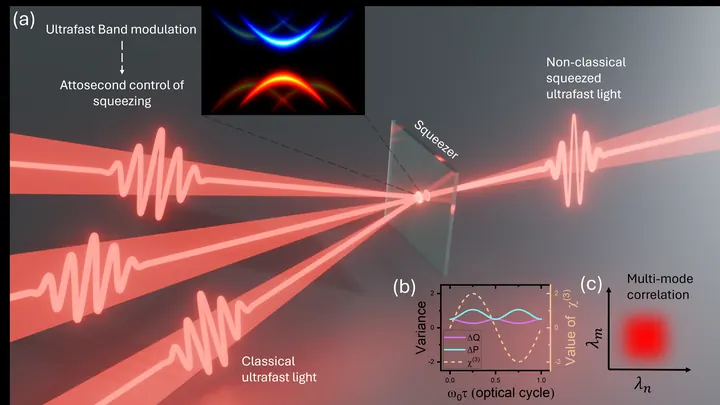
A regular laser is a collection of soloist atoms. In the new laser, atoms form a choir: they hear each other and synchronize their emission. This gives birth to squeezed light with drastically reduced quantum noise, enabling measurements of unprecedented precision.
arXiv:2602.16215 · 2026-02-18

Graviton Laser: Translating Gravity into the Language of Light

The main obstacle for a graviton laser is that gravitational waves cannot be reflected: they pass through any substance. The solution lies in the Gertsenshtein effect. Under a powerful magnetic field, gravity particles temporarily become photons, which are easily reflected by ordinary mirrors. The r
arXiv:2605.14050v1 · 2026-05-13

Taming Light's Sideways Shift

Falling almost parallel to a surface, a light beam subtly slides along it for a few microns. Now this sliding can be controlled: by placing a cloud of rubidium atoms between a prism and metal, scientists use a second laser to change its transparency. As a result, the shift can be stretched, compress
arXiv:2605.20757 · 2026-05-20

Erythrulose: The First Sugar Baked in an Interstellar Furnace

Spectral lines of erythrulose (C₄H₈O₄), caught by the Yebes 40m and IRAM 30m radio telescopes, betrayed the presence of this sugar in the cloud G+0.693. For the first time, we see how, in the interstellar medium, on the surface of icy dust grains, components of nucleic acids are born from glycolalde
arXiv:2606.03313v1 · 2026-06-02

Tiny Crystal Measures Temperature and Magnetic Field Simultaneously

Scientists built a sensor from boron nitride — a transparent cousin of graphite. It contains a glowing speck whose hue shifts with heat and flicker rate changes with magnetism. So one miniature device replaces both thermometer and magnetometer, with no cross-talk. The technology will find use in mic
arXiv:2606.19978 · 2026-06-18

Buffer for Light: A Step Toward the Quantum Internet

A new optical buffer holds particles of light, preserving the quantum information encoded in them intact. Operating at room temperature, it's compatible with standard fiber optics, holds over 200 light signals, and works with all encoding methods. This solves a key synchronization problem on the pat
arXiv:2606.24681 · 2026-06-23