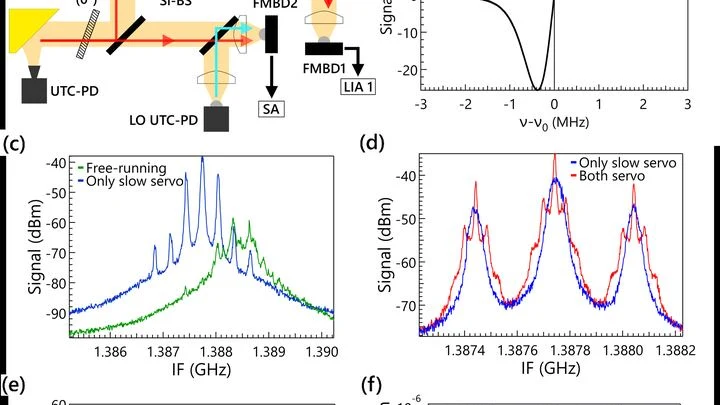
Frequencymodulation (FM) is a method of encoding information in a carrier wave by varying its instantaneous frequency. Unlike amplitude modulation (AM), which changes the wave's height, FM changes how fast the wave oscillates. This makes FM signals more resistant to amplitude noise and interference, which is why FM radio sounds clearer than AM. Beyond radio, FM is used in radar, telecommunications, and even in quantum sensing, where modulating a laser's frequency can improve detection of weak signals.
History
FM was invented by Edwin Armstrong in the 1930s, who demonstrated its advantages over AM in reducing static. It became the standard for high-fidelity radio broadcasting after World War II.
How it works
In FM, the carrier wave has a constant amplitude, but its frequency is shifted up or down proportionally to the amplitude of the input signal (e.g., audio). The instantaneous frequency is f(t) = f_c + k_f * m(t), where f_c is the carrier frequency, k_f is the modulation index, and m(t) is the message. The receiver demodulates by detecting frequency changes, often using a phase-locked loop or discriminator. Because noise typically affects amplitude more than frequency, FM provides a higher signal-to-noise ratio.
In practice
FM is used in FM radio broadcasting, two-way radios, telemetry, and radar systems. It is also a key technique in frequency-modulatedcontinuous-wave (FMCW) lidar, used in autonomous vehicles.
Fun fact
FM radio's superior sound quality comes from a phenomenon called the 'capture effect,' where the receiver locks onto the strongest signal and suppresses weaker ones, eliminating the fading and static common in AM.
Surf doesn't roll onto the shore as an even front. It comes in tongues of foam that merge and split apart. Magnetic fields inside materials behave much the same way: they breathe in waves, and until now nobody had seen them whole.
Data zips through optical fibers at the speed of light, but the path isn't perfect: the signal gets muddled, like a voice echoing down a long hallway. The faster the speed and the longer the distance, the worse the distortion. Usually, electronics fix this, but they can't keep up with light.
Fatty liver disease often goes unnoticed, but over time it can lead to serious problems. To avoid taking a tissue sample, doctors use ultrasound: sound waves pass through the tissue and attenuate differently depending on fat content. This parameter, the attenuation coefficient, shows how "fat" the liver is.
But the method has a flaw.
A flashlight shines through frosted glass: the rays bend, lose brightness, and take different paths. That's roughly how high-intensity ultrasound passes through the skull to the brain. For years, calculating this path required bulky computer models that 'chew' on data for hours.
Light escaping a massive body loses steam. Its frequency dips slightly, and its color shifts toward red. Physicists call this gravitational redshift. In classical theory, it's all clear, but the moment you bring quanta into the picture, trouble starts.
Previously, this shift was modeled as a kind of mode mixer — a device that entangles different states of light.
Radio waves, high-frequency electromagnetic oscillations, are powerless against the Earth's bulk: they attenuate, being almost completely absorbed within a couple of meters of depth. But a low-frequency magnetic field, governed by the equations of electrodynamics, behaves differently.
When a radio wave encounters a building in its path, it doesn't just reflect or get absorbed: it bends around it, much like ocean waves flowing around a rock, leaving calm water behind. In radiophysics, this phenomenon creates a radio shadow — a complex pattern of zones where the signal is amplified or attenuated, which scientists call a radio portrait.
In fast-moving vehicles, mobile internet slows down: the signal, traveling at the speed of light, blurs like the scenery outside the window. Engineers have found a way to pack data more densely without letting them mix up. It's like a multi-lane highway where packet-cars drive not with a safe interval, but almost bumper-to-bumper.
A laser is like a tuning fork that rings at a single note. But even in complete silence, its sound trembles slightly. Previously, it was thought that this tremor, random kicks from spontaneous emission of light by atoms inside the laser, was the main limit to precision.
Fast radio bursts — millisecond radio pulses arriving from distant galaxies — long remained a puzzle. Their colossal energy, compressed into instants, pointed to cataclysms on neutron stars, perhaps pulsars or magnetars.
A lighthouse sends its beam through a storm of its own mirrors: that's roughly how fast radio bursts behave when trying to leave a magnetar's vicinity. A magnetar is a neutron star with a magnetic field a quadrillion times stronger than Earth's.
Any light measurement runs into a fundamental limit: photons hit the camera sensor unevenly. This natural ripple (shot noise) blurs fine details, like trying to pick out a quiet instrument in an orchestra through the noise of the hall.
A distant lighthouse flashes for an instant brighter than an entire galaxy. This is a fast radio burst — a mysterious signal from deep space. Some repeat, and astronomers have noticed a peculiarity: these bursts show rapid changes in polarization — a property indicating how the radio wave is twisted in space.
An ordinary laser emits narrow lines, like a string that sounds only one note. For spectroscopy, this is inconvenient: if a substance absorbs light between the lines, you might miss it.
Gravitational wave detectors are microphones listening to the trembling of space. But their own noise drowns out weak signals. To hear more, physicists add special "squeezed" light to the instrument: it reduces quantum noise, like noise cancellation in headphones.
A typical atom trap works like a funnel: laser light and a magnetic field slow atoms down and gather them at the center. But the funnel has a limit: it only catches atoms moving within a certain speed range.
A quantum memory node is a tiny diamond with a defect that can store and emit single photons. But its light has a wavelength of 637 nanometers, the same red as a ruby, and is almost completely absorbed after just a few meters of standard optical fiber.
When a massive star dies, its core collapses, and a neutrino storm is born. These ghostly particles fly outward, changing their flavor along the way, like a chameleon changes color. This dance of flavors can either boost the explosion or, conversely, dampen it.
But this dance has a choreographer — the density gradients of matter.
A light pulse can be compared to a musical chord: several notes sound simultaneously, each with its own loudness and phase. In quantum optics, such 'chords' are called multimode squeezed states.
An ordinary camera captures light reflected from objects and builds a picture from it. But if the object is hidden behind an obstacle or does not reflect light, radio waves come to the rescue: they pass through walls and fog, and a computer reconstructs the image from scattered signals.
Any cook knows: whether dough sticks to a pan depends on what happens at the interface between two media. For molten metals, that interface long remained invisible — temperatures above 200 °C made it impossible to resolve individual atoms.
The boundary between two liquids is like an invisible skin: it's there, but you can't touch it with your finger. Scientists have found a way to measure its elasticity without touching it. They made a tiny probe oscillate above the surface, and between the probe and the interface lay a thin film of liquid.
A steady laser beam is like a taut string: if it vibrates even a little, the music turns into cacophony. In a quantum computer, the laser holds atoms in a trap, and any frequency jitter ruins the computation. That's why laser setups used to occupy entire tables, and tuning took weeks.
A beam of light passing through a transparent plate usually keeps its color. But if you stack the plate from thin alternating layers, it becomes a grating that reflects and transmits waves selectively. This has long been used in lasers and optical filters. Now such gratings have been made to vibrate, and light started changing color.
A quantum computer in the lab resembles an orchestra: lasers play the role of bows, and ions are the strings. To play the desired melody, powerful radio signals are sent to the lasers: they set the rhythm and pitch. But part of this "music" escapes the stage.
If you shake a box of sand long enough, patterns appear on its surface — patterns that weren't there when the box was still. It's the same here: physicists took a cloud of cold atoms, trapped them in an optical lattice, and began shaking it periodically. This gave rise to a new state in the atoms, like a new pattern in the sand that doesn't exist without the shaking.
You are counting sand grains falling in an hourglass, but each time the wind adds or removes a few. In the most sensitive cameras, the task is similar: you need to figure out how many "sand grains" (electrons) the sensor itself added, and how many came from light. This inherent sensor noise is called readout noise, and it hinders seeing weak signals — for example, the light of a distant star.
The crystal Ca2RuO4 resembles a stack of thin sheets. Inside each sheet, the electron spins are arranged in strict order, like rows of soldiers on a parade ground. The bonds between the sheets are weak, and their sign can be flipped by slightly pulling the crystal apart.
A microwave signal that doesn't jitter from interference is needed in both radar and telecommunications. Until now, a clean signal was obtained on bulky setups where lasers and resonators sat on an optical table. Now engineers have packed everything into a box the size of a cup—166 milliliters.
Light passing through a gas leaves narrow dark lines on the spectrum — the fingerprints of absorption. Acetonitrile molecules, like tiny antennas, respond only to strictly defined frequencies. But when there are many such lines and they are closely spaced, the signals overlap, like voices in a noisy room. As a result, clocks based on these molecules start to drift.
Quantum sensors are like an orchestra where musicians play in unison: their entangled states let them pick up signals that ordinary instruments can't. But as soon as you start accumulating the signal, the nonlinear interaction, like a conductor who suddenly starts beating time erratically, ruins the music.
Waves in magnets resemble the vibrations of a string: if you pluck a string, it sounds a single note, but with a strong pluck, overtones appear — sounds at multiple frequencies.
Two taut strings plucked at the same time sound different if they are connected by a rubber band. Energy starts to flow from one to the other, and the pitch of the combined sound shifts slightly. Two nanomechanical bridges, microscopic beams etched into a crystal, behave much the same way.
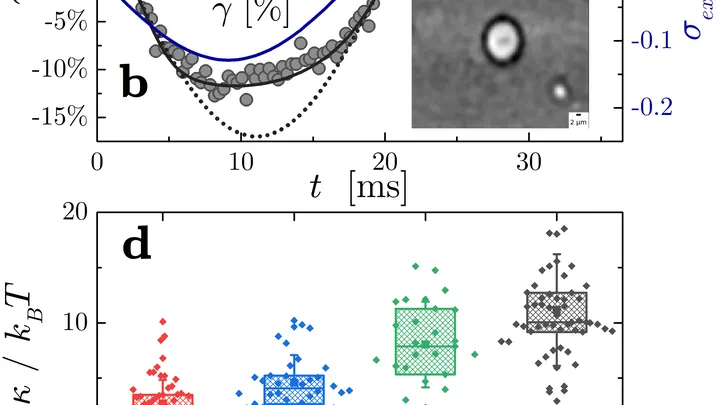
A microscopic gel bead or a tiny oil droplet squeezes through a narrow channel whose walls rhythmically contract and relax. The particle flattens and then recovers its shape, and by how quickly it does so, you can infer its internal elasticity and viscosity.
Time flows slower near the ground than on the roof: this was predicted by Einstein in his theory of relativity. To spot the tiny difference, physicists propose using a pair of photons, linked like voices in a duet.
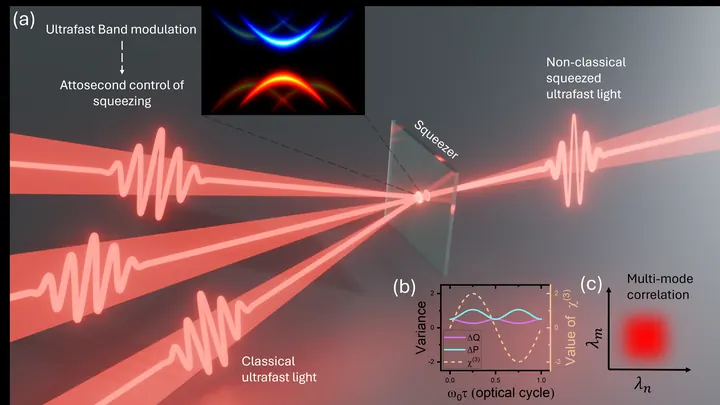
Ordinary light always jitters a bit: its brightness and color fluctuate, like the air in a balloon after a tap. In 'squeezed' light, these fluctuations are redistributed — as if you squeeze the balloon from one side, making it thinner here and thicker there, but the total volume stays the same.
A beam of visible light enters a cloud of billions of rubidium atoms cooled to near absolute zero, and emerges on the other side already in the telecom range.
A ruler made of light: that's one way to describe a new method for measuring tiny time delays. In 1987, Chong Ki Hong, Zhe-Yu Ou, and Leonard Mandel noticed that when two indistinguishable photons hit a beam splitter simultaneously, they always exit together from the same port.
Tuning a string: higher harmonics help hold the pitch without drowning out the fundamental note. In an optical microcavity, a tiny resonator made of two mirrors, light bounces between the reflective surfaces, and any jitter in the spacing knocks it off resonance.