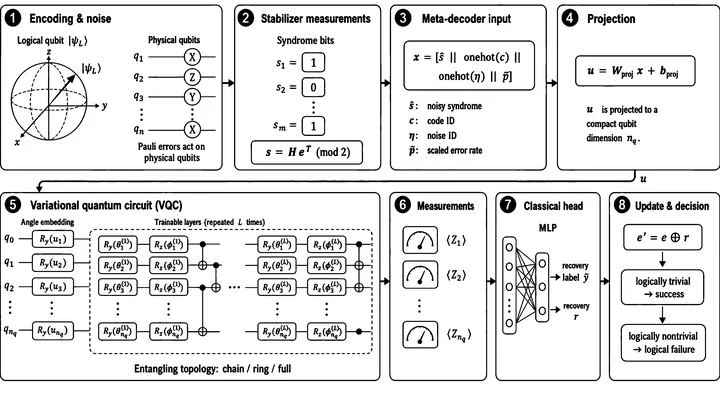
Quantum error correction is a set of methods that protect logical qubits (units of quantum information) from noise and decoherence (loss of quantum properties) by distributing information across redundant physical qubits. Unlike classical copying, nonlocal correlations are used here. Errors are detected by measuring stabilizers—special operators for which the code state is an eigenstate; such measurement does not destroy the encoded superposition. The simplest Shor code corrects any single error—bit flip or phase flip. The five-qubit code achieves the theoretical minimum for correcting a general error.
History
The concept arose from the realization of the fragility of quantum states and the impossibility of copying them (no-cloning theorem, 1982). In 1995, Peter Shor, using an analogy with classical codes and entanglement, proposed a nine-qubit code. Soon Andrew Steane developed a seven-qubit code based on linear algebra. Generalization led to the stabilizer formalism (Daniel Gottesman, 1996) and a family of codes, including topological ones, underlying fault-tolerant quantum computers.
How it works
QEC uses code distance d: the minimum number of errors that turn one codeword into another. A code with distance d corrects any combination of errors of weight t ≤ (d−1)/2. Stabilizer formalism: the set S — an abelian subgroup of Pauli operators on n qubits without −I. The code space is the common eigenspace with eigenvalue +1. An error E either commutes or anticommutes with the generators; anticommutation changes the sign and is detected. Measuring the generators yields a syndrome, by which the error is recovered up to a stabilizer. Error correction condition: for any two correctable errors E_a, E_b, the projector P satisfies P E_a† E_b P = c_{ab} P. CSS codes are often used, combining classical codes for bit and phase flips.
In practice
The foundation of reliable quantum computers; without it, algorithms like Shor's factoring would drown in noise.
Fun fact
The smallest code that corrects any single error uses only five qubits – and this is the theoretical limit; no four-qubit code can do it.
Picture a vast hall where thousands of janitors are sweeping the floor at the same time. Each one knows only their own patch and sweeps debris toward the nearest wall, without asking a manager. It used to be thought that such an approach was impossible for a quantum computer: too many errors, and you need a central brain that sees the whole picture.
Data zips through optical fibers at the speed of light, but the path isn't perfect: the signal gets muddled, like a voice echoing down a long hallway. The faster the speed and the longer the distance, the worse the distortion. Usually, electronics fix this, but they can't keep up with light.
A beam of light enters a glass cell filled with cesium vapor and changes the internal state of the atoms: this is how information is recorded. A moment later, another beam reads it out by how the atoms absorb light. It's not a hard drive, but rather a notebook that turns its own pages.
Eight such "pages" are created by an acousto-optic deflector — a device that bends light with sound.
A quantum state is like mountain weather: it changes with every glance. To estimate its uncertainty, physicists make copies and take measurements. Each copy is a thermometer that breaks after use.
Quantum systems made of many particles are the basis of future computers and secure networks. But the more particles there are, the harder it is to understand how they are arranged: the number of possible states grows like an avalanche. The usual approach, measuring everything, takes an incredibly long time.
In 1996, physicists asked: how much noise can a quantum channel withstand before it stops transmitting information? A phone call where every third word is replaced by random noise is still understandable. Up to what level of interference can the listener still grasp the meaning?
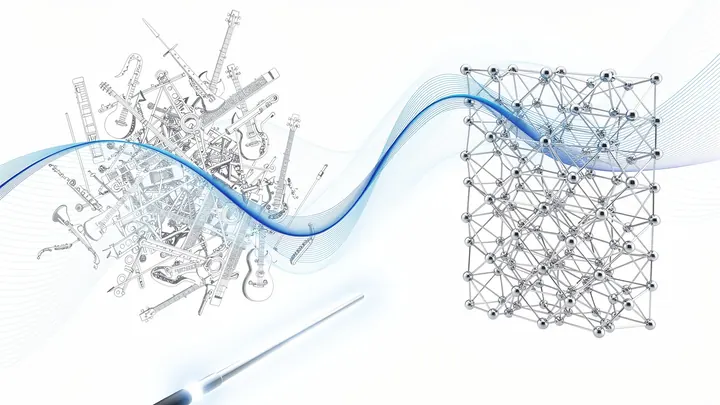
A quantum computer is like an orchestra where each instrument is a qubit and the conductor is the control processor. The conductor must not only set the tempo but also change the score on the fly if a soloist plays something unexpected.
Quantum computers make mistakes. Each qubit is like a ball balanced on the tip of a pencil: a slight tremor in the hand and it rolls off. To keep the balls from falling, you need someone to notice the wobble and correct it in time.
A quantum computer is like an orchestra where each musician, a qubit, plays their part but keeps hitting wrong notes. To keep the music from turning into cacophony, you need a conductor who instantly hears the off-key notes and corrects them.
A washing machine sometimes tears clothes. To get a whole shirt, you wash several and then piece one together from the survivors. A quantum computer treats 'magic states'—special ingredients without which complex computations are impossible — in much the same way.
These states are extremely fragile. The slightest noise, and the magic evaporates.
Alice prepares a quantum particle in one of several states and sends it to Bob. The channel the particle travels through isn't perfect: it's noisy, scatters, interacts with the environment. Bob receives the signal and tries to figure out what Alice actually sent. This is the classic "prepare-send-measure" scheme, and there's always a risk of losing something along the way.
Alice prepares a quantum particle in one of several states and sends it to Bob. The channel the particle travels through isn't perfect: it's noisy, scatters, interacts with the environment. Bob receives the signal and tries to figure out what Alice actually sent. This is the classic "prepare-send-measure" scheme, and there's always a risk of losing something along the way.
The quantum world does not forgive forgetfulness. Throw a stone into a pond — the ripples spread and vanish, the information about the impact dissipates without a trace. In quantum mechanics, everything is different: the evolution of a system is reversible, and the past is never completely erased.
The quantum world never stands still. Even in the most perfect resonator, a trap for particles of light, energy gradually leaks away, and information is erased. Physicists call this process decay, and it has its own rhythm: some 'notes' fade quickly, while others linger.
In the world of quantum particles, there are introverts — anyons. They are unlike familiar electrons or protons. If you swap two such introverts, they remember the maneuver, as if leaving an invisible trace.
A quantum computer is like a fragile snowflake resting on a warm palm. The slightest breath of heat or a gentle vibration, and it turns into a droplet. To keep the snowflake alive, you constantly adjust it, restoring its original shape. That's quantum error correction.
A quantum computer is like a fragile snowflake resting on a warm palm. The slightest breath of heat or a gentle vibration, and it turns into a droplet. To keep the snowflake alive, you constantly adjust it, restoring its original shape. That's quantum error correction.
A quantum computer is usually like an assembly line: operations proceed one after another, and each error accumulates. In the new work, physicists tried a different path — an architecture where the computation grows out of the measurement process itself. They took 56 ions in a trap and wove them into a three-dimensional cloud of entangled particles.
A quantum computer is like an orchestra where each musician-qubit easily loses the rhythm. The slightest noise, and the melody of computation turns into cacophony. To keep the orchestra playing in harmony, you need a conductor who instantly spots wrong notes and corrects them without stopping the performance.
A superconducting qubit is like a finicky musical instrument: until you tune it, you won't get a clean note. But even after tuning, the pitch drifts. The culprits are tiny defects in the material that physicists call two-level systems. They're like invisible cracks that appear and disappear, throwing off the processor's rhythm.
A quantum computer is like an orchestra where each musician-qubit easily loses the rhythm. The slightest noise, and the melody of computation turns into cacophony. To keep the orchestra playing in harmony, you need a conductor who instantly spots wrong notes and corrects them without stopping the performance.
A quantum computer based on neutral atoms is like a city where couriers, laser tweezers, physically carry packages between addresses. While one courier drags an atom across the entire chip, the others sit idle. This is slow and error-prone.
The new architecture replaces couriers with a shared radio wave.
In a noisy hall, an interpreter tries to catch every word, but rustles and echoes muddle the meaning. That's roughly how conventional computer methods handle complex quantum systems: the more particles and the stronger their correlations, the faster calculations drown in interference.
An electrical grid stuffed with power electronics resembles a huge orchestra without a conductor. Each converter, each line adds its own note, and sometimes the instruments start playing out of tune.
A phase transition is like the moment water turns into ice. In the quantum world, such transitions occur at absolute zero, and seeing them directly is nearly impossible. Usually, this requires building extremely complex computer models that demand enormous resources.
The Delta-VQE method offers a workaround.
A quantum annealer is like a smart oven: it searches for the lowest point in an energy landscape to find the answer. But many constrained problems, like "pick exactly three items"—can't be loaded directly into such an oven. They have to be translated into unconstrained quadratic formulas, usually by adding penalties.
After a hit, a black hole rings like a bell. But instead of sound, it emits gravitational waves whose frequency rapidly decays: these are called quasinormal modes. From such a 'ring,' you can infer the hole's mass, spin, and other properties.
Two dancers on stage must move in perfect sync, but if one hesitates, the whole routine is ruined. That's roughly how quantum computers with neutral atoms work: two atoms are entangled by putting them into a Rydberg state (as huge as a balloon compared to an ordinary atom), and then you wait for them to 'dance' their part.
A delicate watermark on wet paper, and a fogged-up glass before your eyes. That's roughly what reading quantum states of light looks like: fragile photon patterns get distorted by losses, and detectors catch only a small fraction of the signal.
A translator gets distracted by every rustle in the hall, and a one-hour meeting stretches into two. That's roughly how thermal noise disrupts quantum teleportation: the carrier particles lose synchronization, and the message gets corrupted.
Passive sensors communicate by reflecting radio waves, like an echo. The energy savings are clear, but many reflections turn into a jumbled mess. It's like a choir where each singer repeats their own part without a conductor.
A new approach assigns each sensor a specific rhythm — a digital code.
A quantum computer is like an orchestra where each musician is a fragile qubit. The slightest noise, and the melody falls out of tune. To keep the harmony, you need a conductor who instantly hears the false notes and brings the instruments back into line.
A quantum computer is like an orchestra without a conductor: each qubit is a musician, and the slightest slip throws off the entire symphony. To keep the music from turning into cacophony, quantum error-correcting codes were invented.
A quantum computer is like an orchestra where every musician must hit their note exactly. If one plays off-key, the melody falls apart. The musicians here are qubits, storing information.
Building a quantum computer capable of solving problems beyond classical machines requires reliable qubits. One of the most elegant ideas is to use Majorana zero modes as qubits: ghostly excitations that remember their entangled paths and aren't thrown off by thermal noise.
A quantum computer is like a finicky musical instrument: the slightest change in temperature, humidity, or string tuning, and the melody sounds different.
A metallurgical workshop piled high with aluminum scrap looks like an orchestra out of tune before a concert: each instrument is off-key in its own way. Offcuts of airplane wings, crushed cans, shavings from milling machines: each 'instrument' has its own metallicity, nonlinearly influencing the final 'melody' of strength and thermal conductivity.
The hunt for non-Abelian anyons is a quest for a quantum ghost that leaves only one clue: entropy. These particles live in two-dimensional systems at ultralow temperatures. Their exchange doesn't just flip the sign of the wavefunction — it entangles states, creating topological order.
Quantum computing suffers from 'false notes' — errors that arise from the slightest inaccuracy. Now they are eliminated with the precision of tuning a concert grand piano. The idea traces back to the dreams of pioneers — David Deutsch and Peter Shor — of flawless operations.