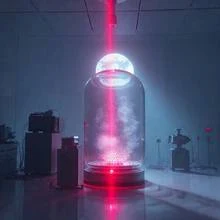
An optical fiber is a thin, flexible strand of glass or plastic that guides light along its length through total internal reflection. In the context of quantum networks, it serves as the physical medium for transmitting quantum information—typically encoded in single photons—between distant quantum processors. Unlike classical fiber-optic communication, which sends strong light pulses, quantum communication requires preserving fragile quantum states like superposition and entanglement over potentially long distances, making the fiber's low loss and low noise properties critical.
History
The concept of guiding light by refraction dates to the 19th century, but practical optical fibers emerged in the 1950s–1960s, with Charles Kao's 1966 work on low-loss glass fibers earning him the 2009 Nobel Prize. Quantum applications began in the 1990s with experiments in quantum cryptography over fibers.
How it works
Light injected into the fiber's core strikes the cladding boundary at an angle greater than the critical angle, causing total internal reflection. This confines the light to the core, allowing it to travel with minimal attenuation. For quantum signals, the fiber must maintain the photon's polarization or phasecoherence; special fibers with low birefringence or engineered dispersion help preserve these properties. In quantum networks, fibers connect nodes where photons are generated, manipulated, and measured, often with repeaters or entanglement-swapping stations to extend range.
In practice
Used in quantum key distribution (QKD) systems for secure communication, and in experimental quantum networks linking superconducting or trapped-ion processors across labs or cities.
Fun fact
A single optical fiber can carry quantum signals and classical data simultaneously, but quantum signals are so weak that they must be sent one photon at a time, making them vulnerable to background noise from even the fiber's own thermal vibrations.
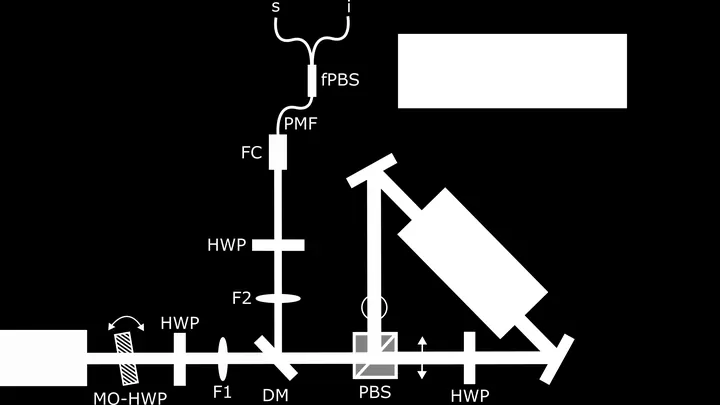
An assembly line spits out parts one by one per cycle. If the cycle is short and defects are few, the line runs fast. In quantum optics, a single-photon source plays the role of such a line: it must emit exactly one quantum of light per cycle, and the more cycles per second, the more photons go into the fiber.
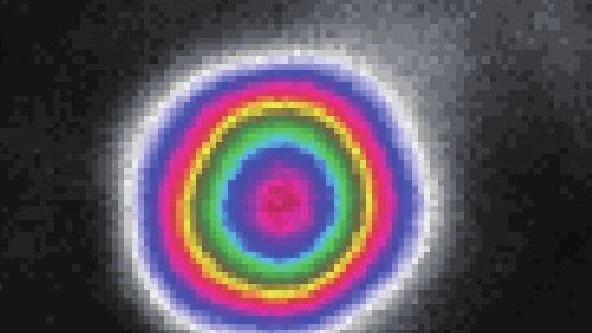
A slice of eucalyptus a tenth of a millimeter thick is placed under a polarized light microscope, and the wood suddenly blooms: blue, yellow, and pink bands twist into spirals, forming rings and swirls. This is not paint but the play of light: the cellulose fibers that make up cell walls transmit light differently depending on their orientation.
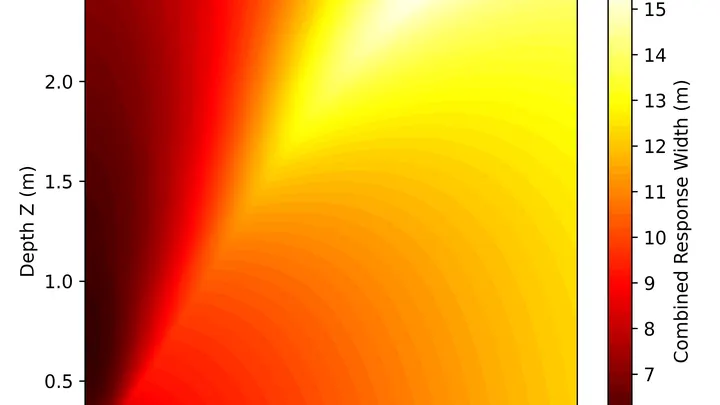
Light passing through a glass of murky water dims — some of it is absorbed. That's how many liquid-analysis instruments work: they measure how much light was lost and infer the composition from that. But if the liquid is heterogeneous, like soup with chunks, a single number isn't enough: you need to know where exactly more absorption happened.
Data on the internet travels at the speed of light through fiber optics. In classical networks, delays aren't critical, but for quantum communication, perfect synchronization is essential: particles of light with encoded information must converge at the detector in the same instant.
Light from an ordinary bulb seems utterly chaotic: its waves oscillate out of sync, like a crowd where everyone walks in their own direction. Such light is called incoherent. For a long time, it was believed that elegant topological structures (knots, rings, links) could only be created in coherent laser light, where all waves march in step.
A stone drops into a pond, and ripples spread across the water. If a protruding branch blocks the ripples' path, part of the wave reflects, and part bends around the obstacle. Gravitational waves, ripples in spacetime itself, behave similarly when passing by galaxy clusters or black holes.
Beneath city streets lies a web of fiber optics — hundreds of kilometers of glass threads carrying the internet. But accurate maps of this web are often lost or outdated. Finding a cable underground is like feeling for a wire inside a wall without knowing where it runs.
This new method turns the cable itself into an ear.
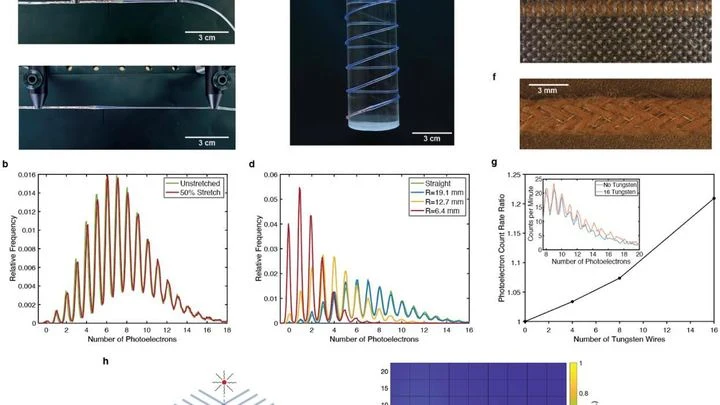
Inside an ultra-thin polymer thread are microscopic crystals — scintillators. When an invisible radioactive particle hits, they flash for a moment, like fireflies. A sensitive sensor catches each flash, turning the thread into a flexible detector.
Quantum computers and sensors operate at microwave frequencies, but transmitting their signals over long distances is conveniently done via optical fibers, which use light.
Quantum computers promise to solve problems that are beyond the reach of ordinary computers. But their components, quantum bits, are very sensitive. One type of quantum bit is an oscillating circuit that can exist in two states, like a pendulum swinging left or right. These states store information.
A laser flash lasting 50 femtoseconds is like a shot that lasts one billionth of a second. In that time, light travels only 15 micrometers — less than the thickness of a human hair. But if you send such a flash through an amplifier, it starts to stretch like a rubber band and loses its sharpness.
Fibers in composites, paper, or biological tissues are often hidden from view, but their orientation determines the strength and properties of the material. Previously, to see fiber directions, you had to take many images at different angles and assemble a three-dimensional picture, like slicing a loaf of bread into thin pieces. For thin samples, this approach doesn't work: you can't slice what isn't thick enough.
Light enters a tiny cavity with mirrored walls and hits an erbium atom hidden in a crystal. The atom absorbs the light and flips its nucleus into another state, like a toggle switch that clicks when pressed. But this switch is not ordinary: it obeys the laws of the quantum world and can be in two positions at once.
Standard optical fiber is like a glass thread that carries light. But when you send weak quantum signals (individual photons) and powerful classical laser light through it at the same time, trouble arises. The glass slightly scatters light: this is called Raman scattering.
Two photons fly out of a tiny box, and behave like twins who always wear matching outfits. Turn one, and the other instantly turns the same way, even if they are kilometers apart. This is no magic trick but quantum entanglement: a connection between particles that defies distance.
Researchers have built a compact source of such pairs.
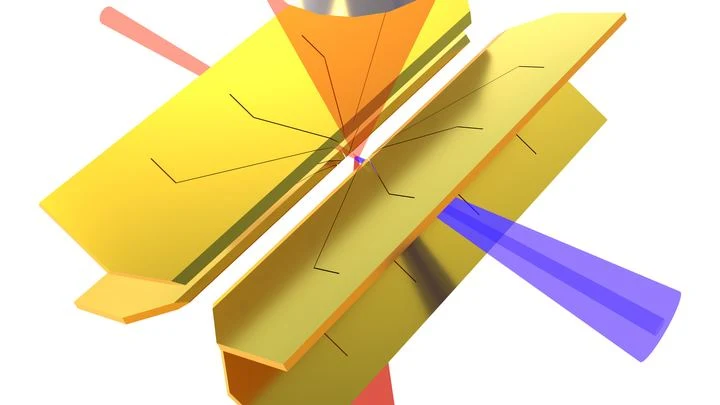
A grain-of-sand-sized device: a tiny mirror-dish holds a single rubidium atom and collects the glow it emits under a laser beam. The trapped light particles are sent into an optical fiber — the whole setup is precise and stays aligned even when shaken.
Inside a large particle accelerator, an invisible shower of gamma rays reigns, like leaving a glass thread under an X-ray machine switched on for years. Ordinary electronics there quickly fail, yet data from the detector still needs to get out. The solution is optical fiber: a thin glass core that carries light.
The theory of gravity by Einstein — general relativity — rarely intersects with quantum physics in direct experiments. Here, scientists built a 50-kilometer glass labyrinth on a table and sent single photons through it.
A turnstile lets you through only forward, and not a step back. Physicists have implemented a similar principle on a tiny semiconductor chip for single photons — particles of light.
Regular quantum communication is like a postal service that sends letters strictly one at a time. If the route is long, you have to wait an indecently long time for a reply. Physicists sped up the process by dispatching ten 'postal trucks' — light pulses — into a single optical fiber, but in different time windows.
When light passes through biological tissue or frosted glass, it scatters and loses the image. Researchers at the Paris Institute of Nanosciences have shown that a scattering medium can be tuned to transmit images encoded in the correlations of entangled photons while remaining opaque to classical light.
A beam of visible light enters a cloud of billions of rubidium atoms cooled to near absolute zero, and emerges on the other side already in the telecom range.
In a dark room, a resonator catches light the way a spiderweb catches dew drops. A laser pulse bursts in, and the mechanical membrane starts to vibrate in sync, leaving a trace in the very fabric of the system. That is how memory is born: not in a silicon cell, but in the dance of photons and phonons.