Cavity quantum electrodynamics (cavity QED) studies the interaction between single atoms or other quantum emitters and photons trapped in a small optical or microwave resonator. The key feature is strong coupling: the emitter and the photon exchange energy back and forth many times before decoherence sets in. This makes the system behave as a single quantum object, with hybrid atom-photon states called polaritons. Cavity QED is a fundamental testbed for quantum mechanics and a building block for quantum information processing.
History
The field was pioneered in the 1980s by Serge Haroche and colleagues at ENS Paris, who used Rydberg atoms in microwave cavities. Haroche shared the 2012 Nobel Prize in Physics for this work.
How it works
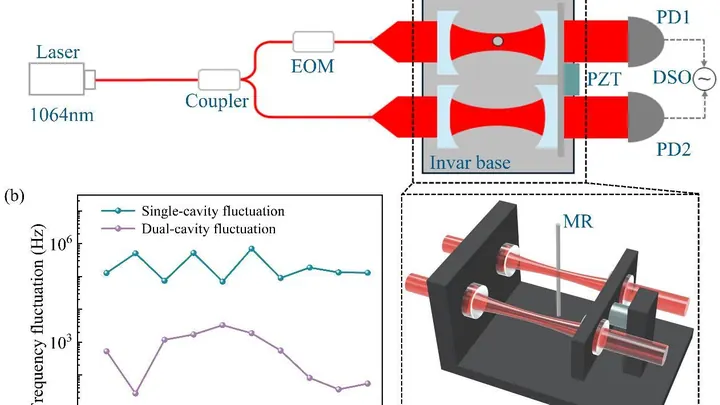
A quantum emitter, such as an atom or a superconducting qubit, is placed inside a cavity with a high quality factor, meaning photons bounce back and forth many times. The emitter's transition frequency is tuned to match a cavity resonance. When the coupling rate exceeds both the cavity decay rate and the emitter's spontaneous emission rate, the system enters the strong-coupling regime. In this regime, the energy levels split into two (vacuum Rabi splitting), and the system can coherently exchange a quantum of energy between the emitter and the field.
In practice
It is used to build quantum memories, quantum gates, and to generate entangled states for quantum communication and computation. It also underpins circuit QED, the microwave version used with superconducting qubits.
Fun fact
In cavity QED, a single atom can act as a switch for a single photon, turning the transmission of light through the cavity on or off.
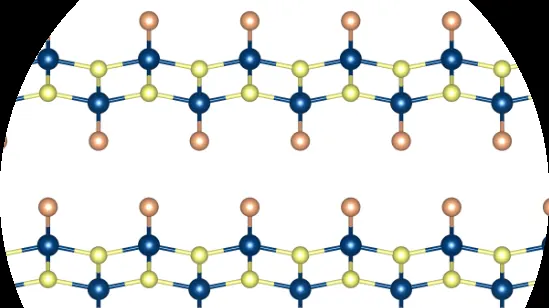
On the table lies a layered cake of hexagonal boron nitride flakes, a material similar to graphite but made of boron and nitrogen atoms. One flake is carefully transferred onto another, and at the spot where they overlap, after heating in oxygen, bright single light sources are born.
A librarian in a rare-book archive takes a volume from the shelf and puts it back without waking the cat dozing nearby. That is roughly how the new quantum memory works: it catches a photon, tucks it into the mechanical vibration of a tiny silicon bridge, and returns it on request.
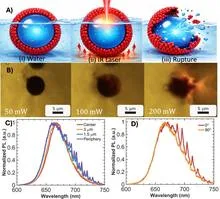
A tiny capsule, like a soap bubble but with a shell of glowing crystals, behaves like a laser. While its wall is intact, light circulates, amplifies, and escapes as a narrow, bright beam. Once the wall bursts, the beam turns into a dim spot. Such a capsule is a colloidosome, and it can change its glow on command.
A courtroom interpreter must relay every word without being distracted by noise in the room. In the quantum world, a superconducting resonator plays that role, losing photons on schedule without straying into spurious effects.
Data zips through optical fibers at the speed of light, but the path isn't perfect: the signal gets muddled, like a voice echoing down a long hallway. The faster the speed and the longer the distance, the worse the distortion. Usually, electronics fix this, but they can't keep up with light.
In the first instants after the Big Bang, the universe expanded faster than light could cross it. Like an inflating balloon, but instead of rubber, it was space itself. On this balloon, ripples inevitably formed — tiny compressions and rarefactions from which all galaxies and stars later grew.
A weak laser beam falls onto a tiny structure — a hybrid cavity made of metal and glass. Inside is trapped a single light-emitting molecule. Normally, such light only slightly changes color as it scatters off thermal vibrations of atoms.
In a pot of boiling water, steam bubbles appear and disappear — a similar struggle takes place in two-dimensional materials. Here, electrons both create magnetism and try to extinguish it.
Each positron annihilation is like the birth of a pair of dancers, connected by an invisible thread of polarization. Two gamma quanta fly apart, but their states remain entangled: measuring one instantly determines the other — as if one partner senses every movement of the other, no matter the distance.
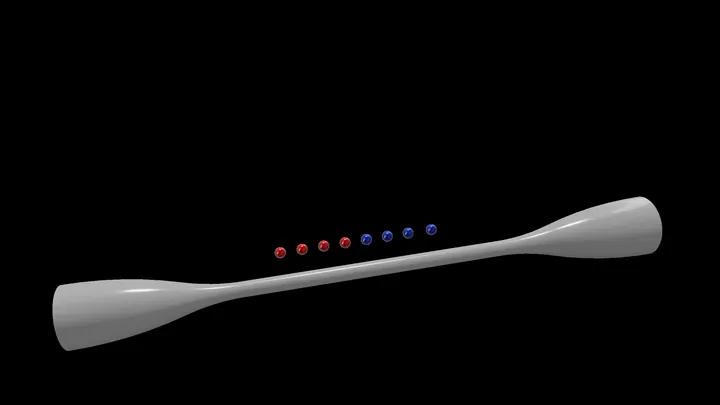
An orchestra without a conductor, where musicians hear each other through a shared wall. That's roughly how the new type of laser works: a few atoms (emitters) sit along a waveguide — a thin track for light on a chip. Light from each atom runs along this track and affects its neighbors.
A black hole is not a dead object. After a disturbance, such as merging with another hole, it rings like a bell. This ring is not just a sound but a complex set of damped oscillations called quasinormal modes. Their frequency and damping rate depend on the hole itself: its mass, charge, and spin.
Quantum computers of the future will likely communicate via light. An atom stores information, and a photon carries it across the network. But an atom doesn't hang still: it jitters and oscillates, and this motion can corrupt the signal.
Previously, engineers could only calculate for a stationary atom.
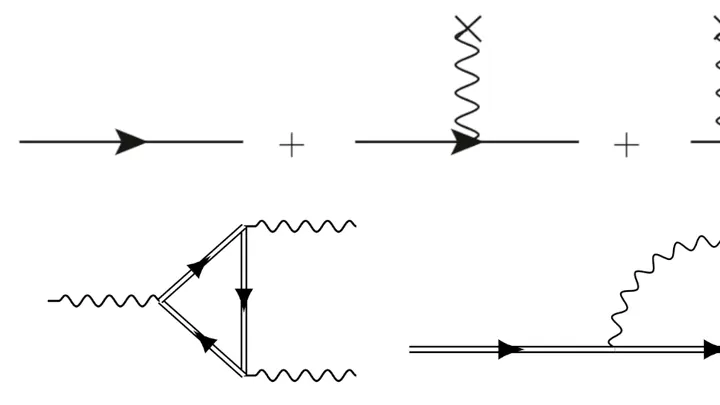
Quantum electrodynamics, or QED, describes how light interacts with charged particles — for example, electrons. It is one of the most precise theories in history: its predictions match experiment to the eleventh decimal place.
Two pendulums hang from the same crossbar. A push, and they start swinging, gradually falling into and out of sync. In a topological qubit, Majorana particles, special excitations that can store quantum information, play the role of these pendulums.
A well-coordinated orchestra of electrons in a superconductor is easily thrown off rhythm. Thermal jolts destroy the fragile order, and resistance returns. For decades, scientists have sought ways to strengthen this ensemble — mostly by changing the material's composition or compressing it to unimaginable pressures.
A guitar string is stretched between two mirrors. A beam of light bounces back and forth between them, and the string shudders at every touch. Sometimes the light loses energy — the string takes it and dissipates it as heat, like a fading sound. Other times, the string shifts the pitch of the light itself, changing its color but barely dimming it.
A single camera shot stores both a normal picture and a hidden map of how light rippled through the scene. Quantum entanglement makes this possible. Pairs of linked photons are generated: one visits the object, its twin takes a detour. Later, measuring the twin one way pulls out the brightness information.
A typical photon source can be likened to a club entrance with a single bouncer. He tries to let people in one at a time, but occasionally couples sneak past. Physicists call this the purity problem: photons must arrive strictly solo, otherwise quantum computing breaks down.
Light is a stream of photons. In a special waveguide, resembling a narrow corridor, a 'gatekeeper' atom usually lets them through one at a time. This phenomenon is the domain of single-particle spectroscopy.
The atom is like a conductor, and the light in the resonator is the orchestra. Their energy exchange, known as the Jaynes–Cummings interaction (part of the Standard Model), lets the atom use “baton” strokes to change the rhythm and timbre of the oscillations.
Ordinary batteries lose charge like tea cools down. A quantum battery works differently: its heart is a tiny cavity with darting photons. If you illuminate it with special photon pairs, energy flows into a chain of qubit cells instantaneously — much like a swing gets a boost from strong pushes.
An ordinary battery in a phone stores energy in chemical bonds — slowly, with heat and wear. A quantum capacitor works differently: it charges not with matter but with rhythm. A swing that is pushed in time with its motion accumulates energy in the motion itself, without friction.
Light in an optical fiber runs along the core, barely escaping outside. But if you get very close, you can feel a faint trembling of the field at the surface — the evanescent wave. It is in this 'light fog' above the surface of a tiny silicon ring that physicists have caught a single rubidium atom.
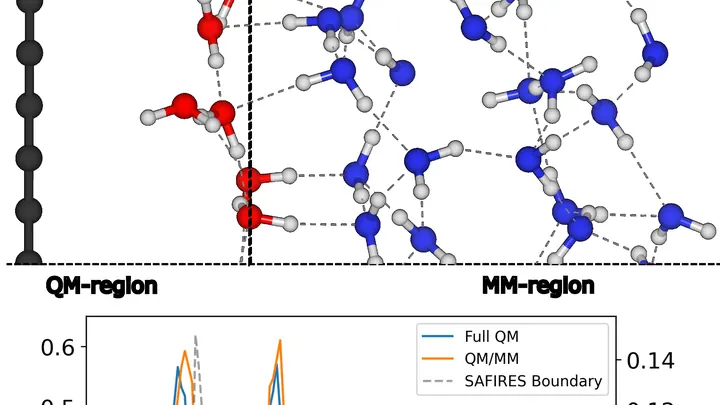
Imagine a huge swimming pool. In one corner, a chemical reaction is underway that needs to be calculated with jeweler-like precision. But the surrounding water is not just decoration: its molecules jostle, attract, and influence the reaction. How do you account for this endless dance of particles without drowning in calculations?
Sunlight hits a silicon wafer, and a current flows in the circuit. That's the familiar work of a solar cell: light knocks out electrons, and a p–n junction (the boundary between two layers with different conductivities) forces them to move in one direction. But in some crystals, current arises differently — without any junctions, purely from the material's internal structure.
Picture a crowded hall where each person is a molecule, and their private conversation is the motion of electrons within it. Normally, everyone talks to themselves, and the overall buzz is chaotic. But if a bright spotlight is turned on in the center, it begins to conduct the crowd: people synchronize their movements, even though the light merely reflects off the walls.
Two musicians in separate rooms play the same note. The sound must be so identical that a listener can't tell who is playing. In the quantum world, these musicians are single-photon sources — particles of light that must be indistinguishable from one another.
The nucleus of a thorium-229 atom is like a taut guitar string: it vibrates at a strictly defined frequency. To 'pluck the string', a precise strike is needed — a laser beam of a very specific color.
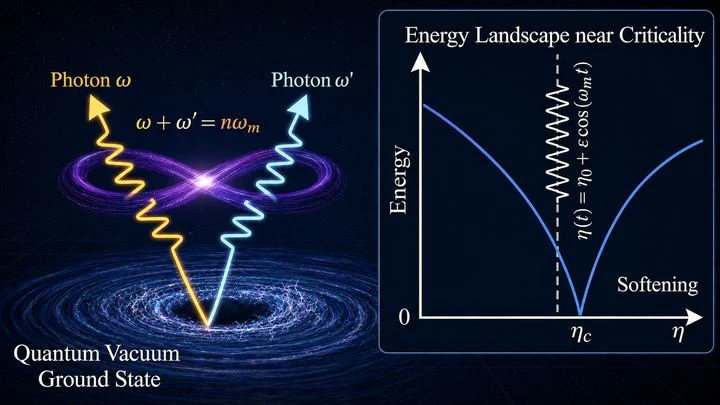
The quantum vacuum is not emptiness, but a tautly stretched string, where particles constantly appear and vanish. Abruptly changing conditions, like shifting the mirrors of a microcavity, causes the 'string' to emit real photons.
A freshly polished niobium surface shines like a mirror. But within minutes, a dull oxide film, invisible to the eye, forms on it. For a superconducting qubit, this film is like sand in an hourglass: it causes the quantum state to decay prematurely.
In a dark room, an invisible lamp flashes. Its light is unlike anything familiar: it has no steady brightness, only rare but powerful bursts. This is bright squeezed vacuum — a state of light with no ordinary wave but strong quantum fluctuations. It is with such light that physicists bombarded xenon atoms.
Two pendulums on a stable table swing independently. If you place them on a shaky surface, vibrations synchronize their motion. The same principle worked on a silicon chip with photons.
Scientists created two sources of light that emit pairs of particles.
A regular laser is a light amplifier in which atoms, after receiving energy, collectively emit waves of a single frequency. A maser does the same thing, but for microwaves — the invisible radiation that heats food in a microwave oven and carries signals in phones.
Imagine a tap that doesn't pour a stream but releases water strictly one drop at a time: that's the single-photon source the authors describe. In ordinary light, photons travel in a crowd, like water from an open tap.
Quantum computers and sensors operate at microwave frequencies, but transmitting their signals over long distances is conveniently done via optical fibers, which use light.
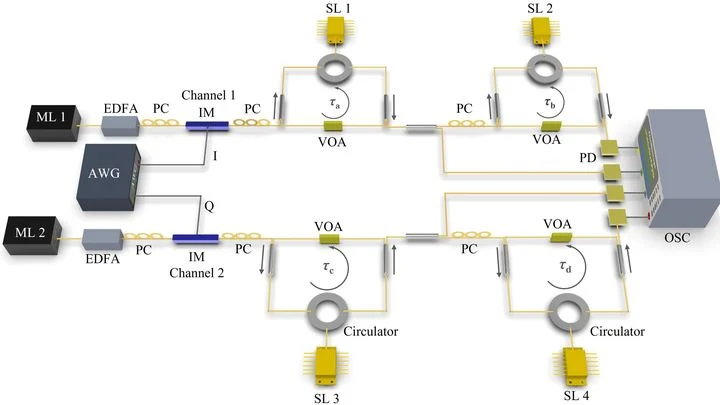
Light in a fiber-optic ring usually dies out within hundreds of microseconds. Each lap, some energy is lost, and the pulse weakens. But physicists figured out how to give light a boost on every turn: they added gain along the entire ring, acting like a tailwind for a runner. Now light can circulate in the ring thousands of times longer.
This gain is called Raman.
A secret key is like a password that two parties need to know, but no one else can peek at. In quantum communication, it's sent using single photons: any attempt to intercept inevitably disturbs them and exposes the spy. Until now, such systems were assembled from many separate components — bulky and expensive.
The light an atom emits is not just a flash. It carries an imprint of the atom's state at the moment of emission. Physicists took a superconducting qubit, an artificial atom the size of a microchip, and made it glow into an open waveguide, like a bulb in a long corridor.
A magnetar is a neutron star with a magnetic field hundreds of millions of times stronger than Earth's. If you brought an ordinary magnet near such a field, it would instantly lose its magnetism, and atoms would stretch into thin filaments.