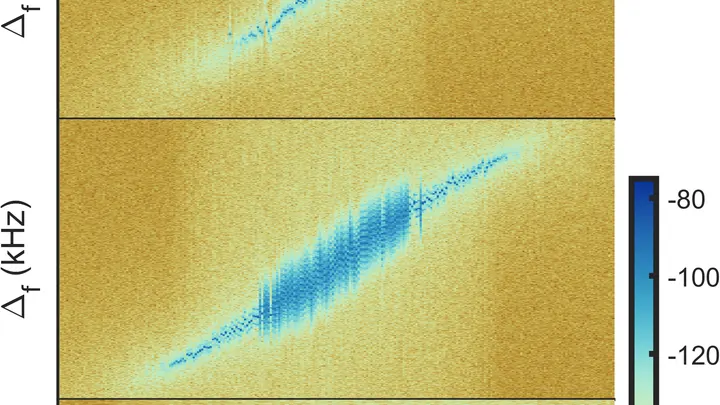
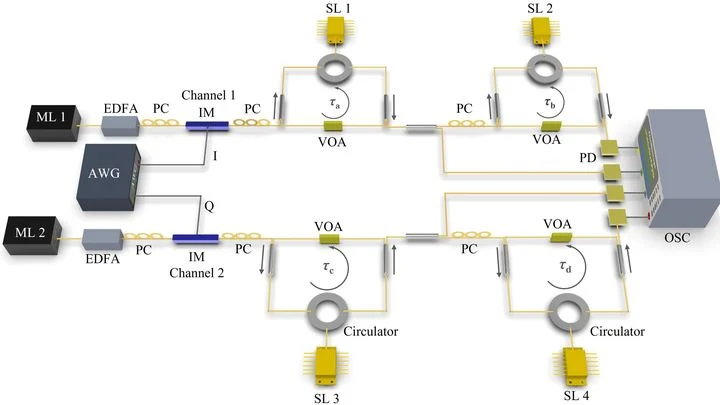
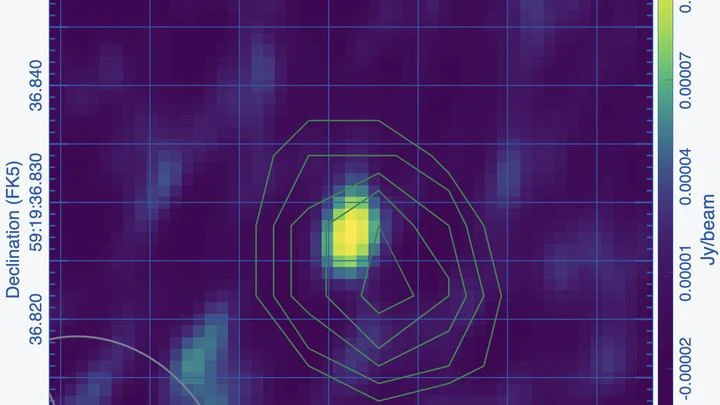
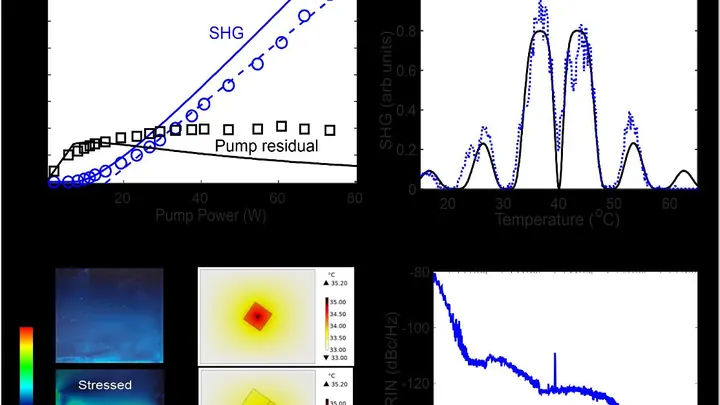
A frequency comb is a laser source whose spectrum consists of a series of discrete, equally spaced frequency lines, like the teeth of a comb. It acts as a precise 'ruler' for measuring the frequency of light, linking optical frequencies (hundreds of terahertz) directly to microwave frequencies that can be counted with electronic clocks. This capability has revolutionized precision measurement, enabling optical atomic clocks that keep time with extraordinary accuracy and opening new avenues in spectroscopy, ranging, and quantum optics.
History
The frequency comb was developed in the late 1990s, with key contributions by Theodor Hänsch and John Hall, who shared the 2005 Nobel Prize in Physics for this work. The technique was enabled by the discovery of photonic crystal fibers for spectral broadening.
How it works
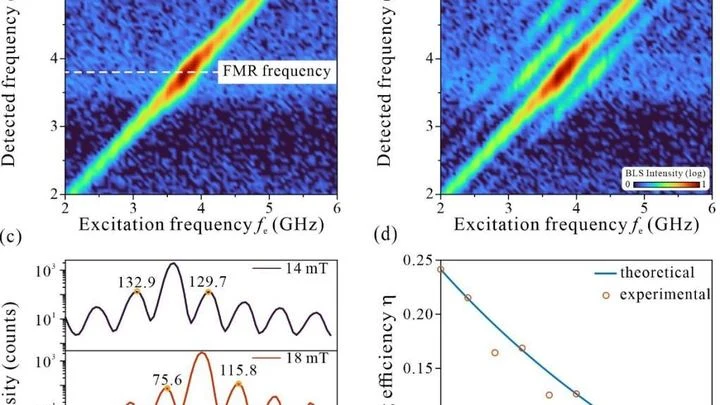
The comb is generated by a mode-locked laser emitting a train of ultrashort pulses. In the frequency domain, this pulse train corresponds to a series of equally spaced spectral lines. The spacing is exactly the pulse repetition rate, and the entire comb is offset from zero by a carrier-envelope offset frequency. Stabilizing both these frequencies against a reference (like an atomic clock) makes the comb a grid of known, countable frequencies. The titles in the corpus highlight applications: using a comb as a thermometer (measuring temperature via optical frequency shifts), generating squeezed light for quantum communication, and even creating 'combs' for magnetic waves.
In practice
Frequency combs are used in optical atomic clocks, high-precision spectroscopy, LIDAR for atmospheric sensing, and as calibration standards for astronomical spectrographs searching for exoplanets.
Fun fact
A frequency comb can measure the frequency of light so precisely that it would detect a change in the length of a ruler by less than the width of a single atom over a distance of a kilometer.
An orchestra without a conductor: each musician tunes to a neighbor, and out of that comes a well-coordinated melody. In the world of microscopic magnets, the role of that orchestra is played by a tiny neodymium sphere levitating above a superconducting film.
Surf doesn't roll onto the shore as an even front. It comes in tongues of foam that merge and split apart. Magnetic fields inside materials behave much the same way: they breathe in waves, and until now nobody had seen them whole.
Tuning a string to the right note: the laser pulse is adjusted so that harmonics play in unison at kiloelectronvolt frequencies.
Visible light oscillates at hundreds of trillions of times per second.
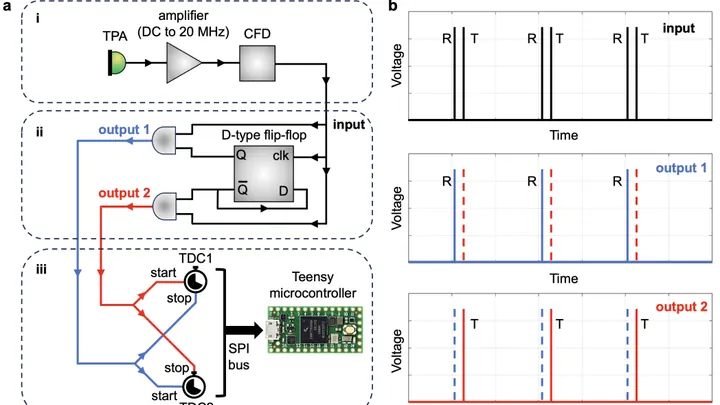
An assembly line spits out parts one by one per cycle. If the cycle is short and defects are few, the line runs fast. In quantum optics, a single-photon source plays the role of such a line: it must emit exactly one quantum of light per cycle, and the more cycles per second, the more photons go into the fiber.
An ordinary lamp shines steadily, while a lighthouse flashes. Scientists in London have made a tiny diamond work like a lighthouse, but not for light — for radio waves. To do this, they added a bit of nitrogen to the crystal and then shone a green laser on it.
Data zips through optical fibers at the speed of light, but the path isn't perfect: the signal gets muddled, like a voice echoing down a long hallway. The faster the speed and the longer the distance, the worse the distortion. Usually, electronics fix this, but they can't keep up with light.
The night sky looks smooth, but it's actually clumpy — vast communities of galaxies that bend light from distant objects like lenses. When a short, powerful radio burst goes off somewhere in the universe, its path to an Earth telescope can pass near such a clump.
A flashlight beam cuts through fog. The denser the fog, the more the light scatters and the later it reaches your eye. A similar principle works with fast radio bursts — mysterious, super-powerful pulses from distant galaxies. As their radio waves travel through space, they interact with free electrons — particles stripped from atoms.
You're listening to the faint whisper of stars, and nearby someone keeps moving a chair. In gravitational wave telescopes, that role is played by scattered light: it reflects off trembling surfaces and creates false signals.
Low-frequency radio waves (from 30 to 300 kilohertz) carry information through water and earth. But catching them with an ordinary antenna is hard: the wavelength reaches several kilometers, and a small receiver barely feels such a field.
When a radio wave encounters a building in its path, it doesn't just reflect or get absorbed: it bends around it, much like ocean waves flowing around a rock, leaving calm water behind. In radiophysics, this phenomenon creates a radio shadow — a complex pattern of zones where the signal is amplified or attenuated, which scientists call a radio portrait.
A laser is like a tuning fork that rings at a single note. But even in complete silence, its sound trembles slightly. Previously, it was thought that this tremor, random kicks from spontaneous emission of light by atoms inside the laser, was the main limit to precision.
Light waves are never perfectly smooth — they are constantly jittered by quantum ripples. These almost invisible nudges were studied by Nobel laureate Roy Glauber, who laid the foundations of quantum optics. Now physicists have learned to freeze these ripples.
A pendulum that almost nothing can knock off balance (not shaking, not heat, not magnetic fields) because it is hidden in the very heart of the atom. That is the kind of pendulum physicists used when they first switched on a nuclear clock. Previously, the best clocks, optical ones, relied on electron transitions.
Light can be more than just a beam: it can be a precision ruler. If you take very short pulses, shorter than a fly's wingbeat, and fire them one after another, you get an optical comb: a set of colors spaced at exactly equal intervals, like the teeth of a comb. This rainbow lets you measure distances, time, and the composition of materials with unimaginable accuracy.
A pendulum swings with such precision that, had it been counting seconds since the Big Bang, it would have drifted by only half a second by today. That is the stability of the new portable ultraviolet laser — the heart of aluminum atomic clocks.
An ordinary rain gauge collects water in a bucket and shows the total volume of precipitation. But the new device is like a sensitive palm that feels every falling drop and keeps count, even when the drops number in the thousands.
That's exactly what physicists have built.
In the basements of four European institutes stood seven devices: each can be compared to a tuning fork of unimaginable precision. But instead of sound, they emit 'ticks' made of light: oscillations of a laser locked to a specific frequency by atoms of strontium, ytterbium, or mercury.
An ordinary laser emits narrow lines, like a string that sounds only one note. For spectroscopy, this is inconvenient: if a substance absorbs light between the lines, you might miss it.
A typical atom trap works like a funnel: laser light and a magnetic field slow atoms down and gather them at the center. But the funnel has a limit: it only catches atoms moving within a certain speed range.
A quantum memory node is a tiny diamond with a defect that can store and emit single photons. But its light has a wavelength of 637 nanometers, the same red as a ruby, and is almost completely absorbed after just a few meters of standard optical fiber.
Radio telescopes have caught a signal that repeats like a beacon in the fog. It's a fast radio burst — a brief flash of radio waves from a distant galaxy. Nearby, astronomers search for a persistent source — a faint glow that lingers after the burst, like embers after fireworks.
The laser based on diamond converts almost half of the pump energy into bright yellow light — an efficiency of 47.7%, a record for such devices. But the main advantage is not the power, but the exceptional purity of the color: the beam is so monochromatic that it can be compared to a musical instrument playing just one note without the slightest wavering.
A regular camera captures the world as a series of frames: twenty-four, sixty, or even a hundred images per second. That's enough for filming a falling drop, but inside a living cell, events unfold a thousand times faster. Protein molecules carry cargo, membranes bubble, ions slip through channels — all in fractions of a millisecond.
A steady laser beam is like a taut string: if it vibrates even a little, the music turns into cacophony. In a quantum computer, the laser holds atoms in a trap, and any frequency jitter ruins the computation. That's why laser setups used to occupy entire tables, and tuning took weeks.
A standard laser rangefinder works like a stopwatch on a 100-meter dash: it times how long light takes to run to the target and back. But such a stopwatch has a limit: it ticks in steps of tens of picoseconds (trillionths of a second). In that step, light travels about a centimeter, so finer details are invisible.
A cloud of cesium atoms was made to behave like a single quantum string. By shining a laser and letting the particles interact, scientists launched self-sustaining oscillations — a rhythm emerged without an external conductor.
Radio waves acted like frets on a fingerboard: it was possible to smoothly vary the sounding frequency.
Two laser beams, like two pencils, draw an invisible scale on the wall. One tip moves slightly faster than the other, and by the way their strokes alternately coincide and diverge, you can calculate the distance to the wall with an accuracy down to the thickness of a spider's thread.
In the new work, physicists made these two beams work continuously, without pauses.
Ordinary white light is a jumble of all colors at once, like the noise of a crowd where everyone speaks at their own frequency. But scientists need light where frequencies are aligned with ruler-like precision, like piano keys, where each note sounds distinct and exact.
The laser in question is not a thin beam but a whole running track for light. Inside the optical fiber, two ultrashort pulses race: one clockwise, the other counterclockwise. Each pulse is a single flash lasting billionths of a second.
An ordinary free-electron laser is like a musical instrument with a single string: it can play only one note until you change its design. To get a different wavelength, you have to retune magnets or accelerate electrons harder. That's expensive and bulky.
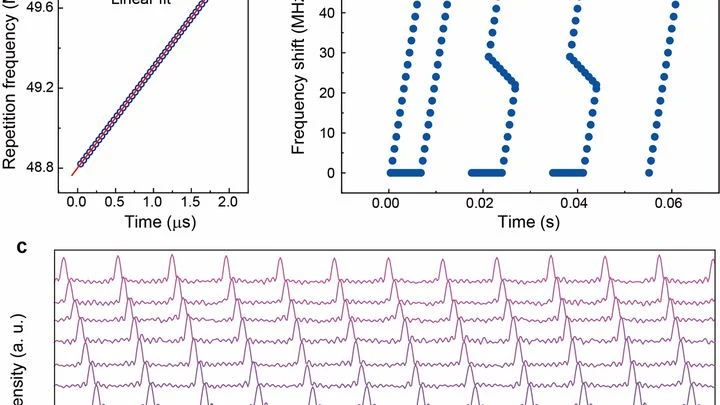
An ordinary comb parts hair into even strands. A laser 'comb' does the same to light: it emits not one color but thousands, spaced at exactly equal frequency steps. Such a tool has already helped measure time to billionths of a second and peer inside atoms.
A laser beam usually quivers slightly, like a plucked string. In optical clocks, that quiver turns into timing errors. Engineers swapped the shaky light for steady light, and rubidium vapor clocks started ticking five times more evenly.
An ordinary laser emits a single color, like a single note on a piano. But to find molecules in the air, you need an instrument that quickly sweeps across many colors, like a musician playing a scale. Such a laser is called tunable, and the faster it changes color, the faster you can 'sniff' the air.
Light can be combed like hair. Instead of hair, we have frequencies; instead of a comb, a laser. The result is a comb made of thousands of even 'teeth'—frequencies. Such an optical comb helps study molecules and measure time with precision down to quadrillionths of a second.
An ordinary comb has teeth spaced evenly apart.
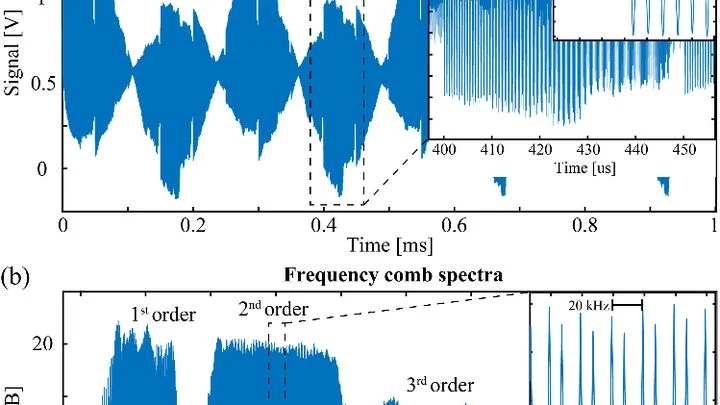
Waves in magnets resemble the vibrations of a string: if you pluck a string, it sounds a single note, but with a strong pluck, overtones appear — sounds at multiple frequencies.
A random fiber laser is a thin glass thread through which light travels, but instead of reflecting off mirrors, it reflects off the tiniest irregularities in the fiber itself. Such a laser doesn't produce a steady beam: its light flickers and flares like a candle flame in a draft.
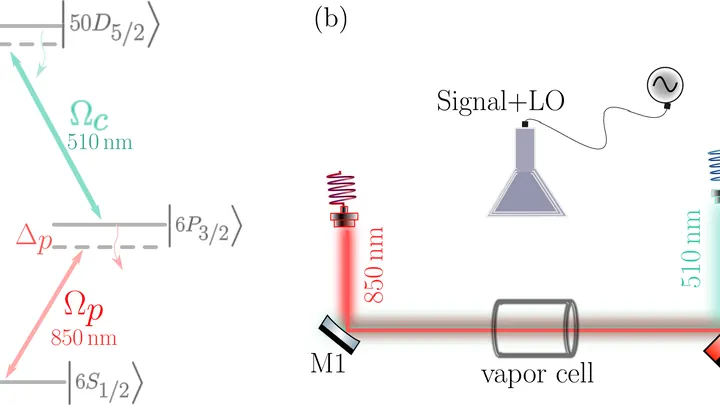
A laser beam passes through a glass cell containing rubidium vapor, and by how the atoms absorb light, you can determine their temperature. This is like measuring the speed of cars by the blur in a photograph: the faster the atoms move, the wider the absorption line becomes.
A beam of visible light enters a cloud of billions of rubidium atoms cooled to near absolute zero, and emerges on the other side already in the telecom range.