How to Hear the Ocean Beneath Triton's Ice ✛
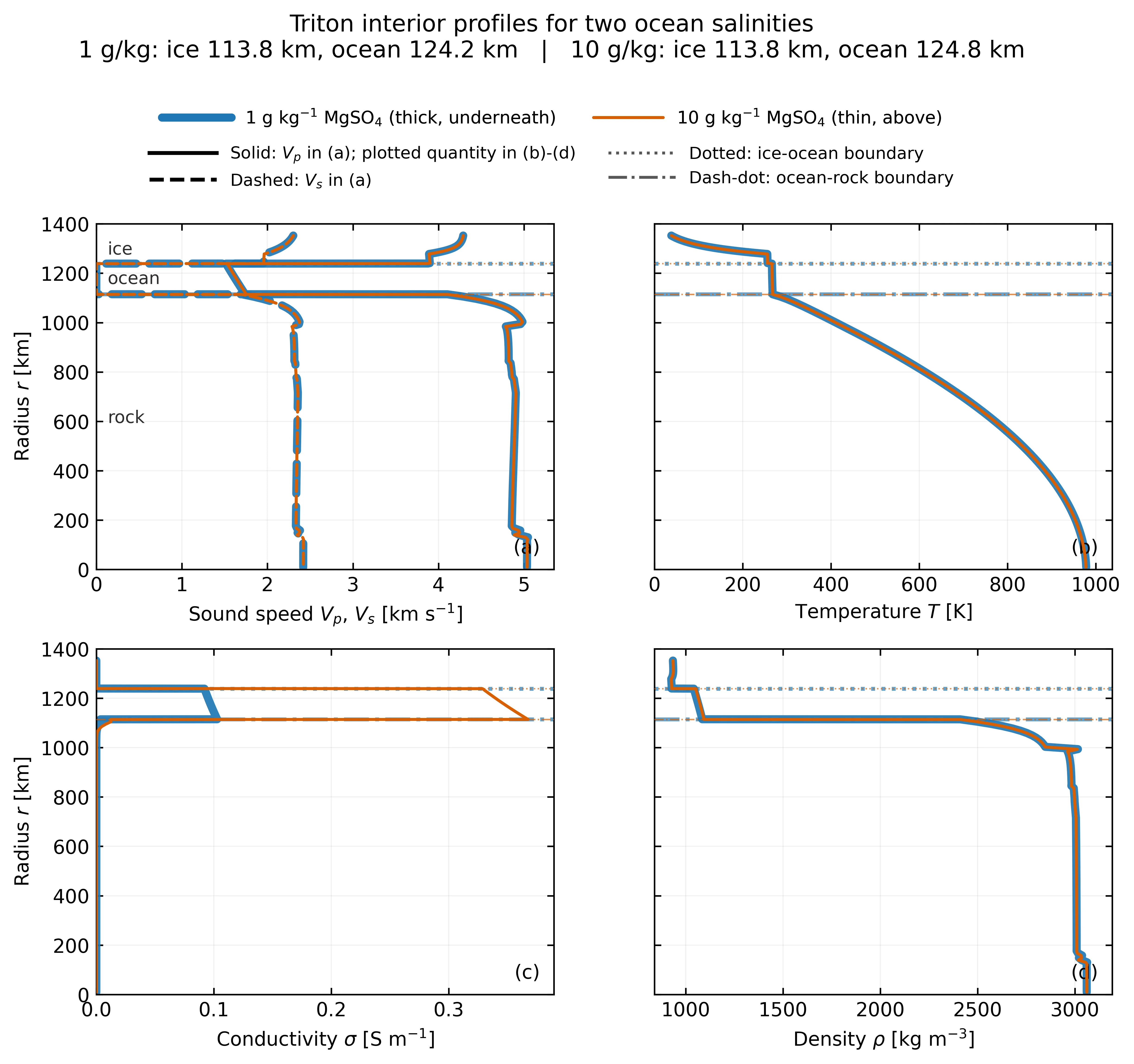
Triton's icy crust is like a locked door, behind which water sloshes. We can't open it, but we can press our ear to it and listen: how Neptune's magnetic field resonates through the moon's interior, how the ice trembles from distant impacts. Scientists built a model of Triton: an icy crust on top, a salty ocean beneath it, and a rocky core at the center. Then they calculated how this structure responds to the planet's magnetic field.
It turned out that the magnetic response is almost independent of ocean thickness, but strongly depends on its conductivity, that is, how much salt is dissolved in the water. But there's a catch: currents in the surrounding plasma create magnetic fields comparable to the useful signal. It's like trying to hear a quiet conversation through a wall while a fan is roaring nearby. To remove the noise, scientists added seismics: the ice tremors from impacts revealed where the boundaries between ice, ocean, and rock lie. Together, these two methods give a clear picture: the ocean exists, and we know its thickness and salinity. This method is already helping to plan future missions to icy moons.
Triton orbits Neptune in the opposite direction, and because of this, the synodic period (the time between two 'meetings' with the same point in the magnetosphere) is only 14.45 hours, almost like an Earth day. It is this rapid change in the magnetic field that 'rocks' the ocean's induction response.
In Stanislaw Lem's novel 'Fiasco', the heroes try to make contact with a civilization on the planet Quinta, hidden beneath clouds. Triton, with its hidden ocean beneath the icy crust, resembles such a closed system: we cannot see the water directly, but we can 'hear' it through magnetic and seismic signals.