Muon tomography is a non-invasive imaging technique that uses cosmic-ray muons, heavy cousins of electrons, to probe the internal structure of large objects or the atmosphere. Because muons are highly penetrating, they can pass through kilometers of rock or building material, and by measuring their absorption or deflection, scientists can construct three-dimensional images of hidden structures, from volcanic interiors to ancient pyramids.
History
The technique was first proposed in the 1950s by physicist E.P. George, who used muons to measure the overburden of rock in a tunnel. It gained prominence in the 2000s with applications in volcanology and archaeology, such as the scanning of the Great Pyramid of Giza.
How it works
Cosmic rays constantly bombard Earth's atmosphere, producing showers of muons that rain down on the surface. When these muons pass through matter, they lose energy and are absorbed or scattered depending on the density and thickness of the material. Detectors placed around or beneath the target measure the flux and direction of incoming muons; regions with higher density absorb more muons, creating a shadow that reveals the internal structure.
In practice
Muon tomography is used to monitor volcanic activity, inspect nuclear reactors and waste containers, search for hidden chambers in archaeological sites, and even study atmospheric density profiles for weather prediction.
Fun fact
Muon tomography was used in 2017 to discover a previously unknown large void inside the Great Pyramid of Giza, a finding that captured worldwide attention.
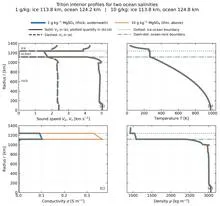
Triton's icy shell is like a locked door to a basement where water sloshes behind the wall. We can't open it, but we can press our ear to it and listen for echoes of footsteps: how Neptune's magnetic field responds within the moon's interior, how the ice trembles from distant impacts.
Gamma rays are the most energetic light in the Universe. But one part of them, the medium-energy range, long remained invisible: instruments couldn't catch them, leaving a gaping hole in the sky. Scientists call it the "MeV gap," named after the unit of energy these rays carry.
The new camera works like a three-layer detective.
Light that never reaches the camera still leaves its mark on it. That's how the new imaging method works: you illuminate the object with one color, and the picture is assembled from another. Inside the crystal, light waves mix, and information about the invisible transfers to a visible beam.
In the experiment, they used a silver thiogallate crystal.
A shipping container is a steel safe the size of a room, packed with goods. X-rays struggle to see through it: thick walls and dense cargo block the rays. Enter muons — particles born high in the sky that constantly rain down on Earth. They can pass through even lead, but they veer slightly off course when they encounter something heavy.
The Moon is an airless sphere of dense rocky grit called regolith. When fast particles from space slam into it, muons are born in the soil — unstable relatives of electrons, but two hundred times heavier. Most fly downward and fade away in the depths. But those that pop upward into the vacuum can travel tens of kilometers before decaying.
In a small Petri dish sits a droplet of liquid the size of a pinhead. An ordinary scanner wouldn't even notice it: the signal is too weak. But bring a tiny magnetic field sensor close to the droplet, and the picture changes.
Every second, about a hundred invisible particles, muons, pass through your body. They are born high in the sky when cosmic rays collide with air atoms, raining down on Earth. These particles are so penetrating that they can pass through a multi-story building, but they slightly change direction when they encounter dense material, such as lead or uranium.
When you need to see inside the brain, you usually lie in a tight tube of an MRI scanner or get zapped with X-rays. Both methods are costly, bulky, and not always available.
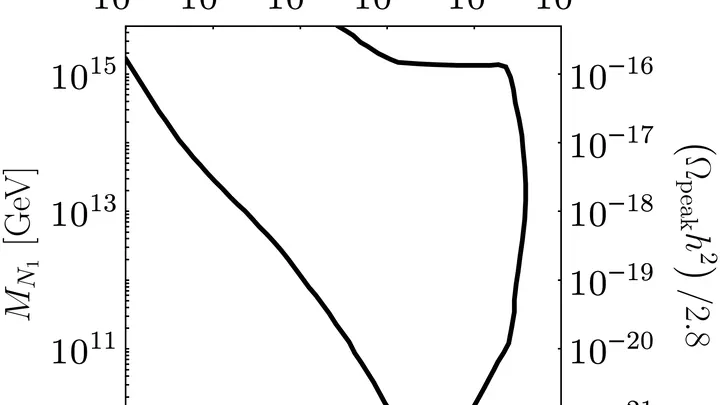
In the very beginning, moments after the Big Bang, the universe was ridiculously symmetric: particles and antiparticles in equal measure. But a tiny imbalance occurred, like one extra grain of sugar in a kilogram, and the entire familiar world, stars, planets, people, arose from that surplus. How nature created this imbalance remains a mystery.
When the first stars ignited, their ultraviolet light began stripping electrons from hydrogen atoms. The universe transformed from a neutral fog into transparent plasma. This process, cosmic reionization, proceeded unevenly: slowly at first, like a fire catching in damp wood, then faster as the flames spread through dry tinder.
Every galaxy floats in an invisible cloud of gas, like fruit in syrup. This gas is the leftover building material from which stars were assembled, and it is constantly replenished by fresh supplies from intergalactic space. Seeing it directly is nearly impossible: it is too tenuous and too cold.
A tiny gold star melts under the beam of an electron microscope, its points slowly rounding off. In the past, such a process could only be seen in snapshots taken with long pauses, and the probing beam itself would alter the sample.
During a thunderstorm, the sky acts like a giant battery: charge builds up in the cloud, and a lightning bolt discharges it. That charge is invisible, but cosmic particles (muons, which constantly rain down on Earth from space) can sense it. As a muon flies through a charged cloud, it speeds up or slows down slightly, and these changes reveal the voltage inside the cloud.
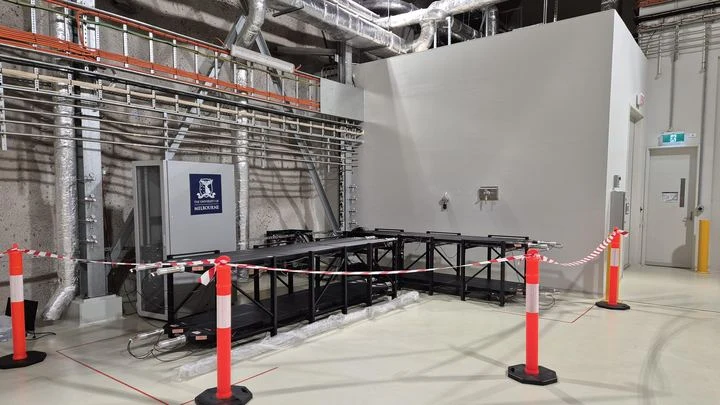
Deep underground, in a former gold mine in Australia, stands a laboratory where silence is broken only by rare flashes of light. These flashes are the traces of cosmic particles that punch through hundreds of meters of rock. Eight plastic panels, resembling large glowing sheets, catch these particles.
In collisions of heavy nuclei, a fireball of thousands of particles is born. Among them are pions and kaons, two kinds of light particles that look very much alike. To understand what happens in this fireball, physicists need to know exactly how many of each particle flew out.
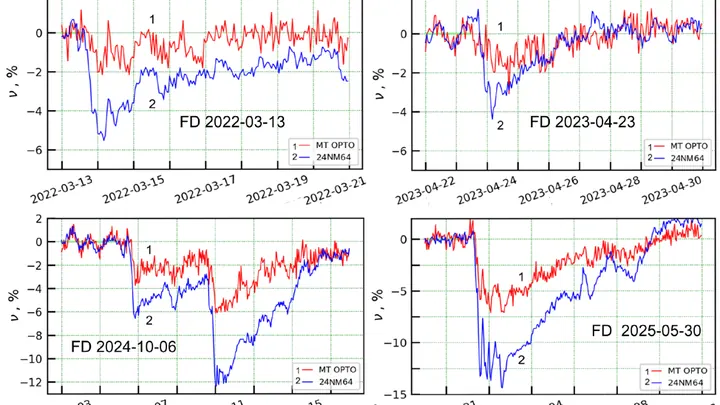
A storm is brewing somewhere far away, and the Geiger counter is already clicking more often. That's how cosmic rays, a stream of charged particles from deep space, make themselves known. When they slam into the atmosphere, they create showers of secondary particles, including muons: heavy cousins of electrons that can reach the ground.
Quantum light is not just a stream of particles but an intricate pattern woven from space and time. A single photon can be stretched, squeezed, smeared across different directions.
The tip of a tunneling microscope hovers above a surface at a distance smaller than the diameter of an atom. Usually, it feels out the topography like a finger reading a page of Braille. Now, that same tip has learned to listen to how a membrane the size of a fingernail trembles.
In the 1930s, Fritz Zwicky, observing the Coma cluster, noticed anomalously high galaxy velocities: their motion pointed to a huge hidden mass gravitationally binding the system.