Conductivity is a material's ability to allow electric current to flow. In the context of modern physics, conductivity is often studied alongside magnetism, as in the case of superconductors—materials that conduct electricity with zero resistance below a critical temperature. The interplay between conductivity and magnetism is central to many quantum phenomena, including the quantum Hall effect and spintronics, where the electron's spin is used alongside its charge.
History
The concept of conductivity was formalized in the 19th century with Ohm's law. Superconductivity was discovered by Heike Kamerlingh Onnes in 1911, and the theory explaining it (BCS theory) was developed in 1957 by Bardeen, Cooper, and Schrieffer.
How it works
In a conductor, free electrons move in response to an electric field, carrying current. In a superconductor, electrons pair up into Cooper pairs that condense into a single quantum state, allowing lossless current flow. Magnetic fields can disrupt this state, but certain superconductors (type-II) allow magnetic flux to penetrate in quantized vortices, leading to complex behaviors like flux pinning and the 'magnetic field heats superconductor' effect mentioned in the corpus.
Some materials become superconducting at temperatures warmer than the boiling point of liquid nitrogen, though the mechanism in these 'high-temperature' superconductors is still not fully understood.
A tiny black hole flies through a hydrogen cloud and stretches atoms like taffy. That is what a superconductor looks like when it traps a persistent current: a material in which electricity flows without losses turns into a miniature permanent magnet.
A metal made of five different atoms is like a soup with bits of carrot, peas, potato, onion, and meat floating in it. Each bit is its own element: chromium, vanadium, titanium, niobium, and tantalum. Such an alloy is called high-entropy: there is no single order, and the atoms are mixed almost randomly.
In a narrow corridor, people walk in rows rather than as a crowd. The number of rows depends on the width of the passage. In graphene, this corridor is a quantum point contact — a constriction where electrons move ballistically without scattering.
A superconductor pushes out a magnetic field like a sponge squeezing out water. This Meissner effect has been known for nearly a century, but it's usually calculated in a flat world — without gravity. In the strong field of a black hole or at enormous speeds, the picture changes.
A molecule works like a marketplace: electron shoppers enter through two gates (contacts) and head for stalls with the most attractive goods — the chemically active spots. Previously, current was thought to spread evenly, but it turns out up to 90% of all flow rushes through these 'hot spots'. Reactive centers become superconducting highways inside the molecule.
A quantum computer is like an orchestra where each musician, a qubit, must play their part accurately and on time. Usually, musicians are seated in fixed positions and connected by conductors' consoles. But what if we let them move freely across the stage and turn the movement itself into part of the music?
In the crystal CsV3Sb5-xSnx, which becomes a superconductor at low temperatures, current does not flow as a uniform stream but along narrow, winding paths. A scanning microscope with a sensitive magnetic field sensor helped reveal these paths: it picks up the faintest currents, much like a sonar probes the seafloor.
A thin film of yttrium barium copper oxide warms under a stream of infrared light, and suddenly stops dissipating energy. That's superconductivity: electrons pair up and move as a single quantum swarm. But in underdoped samples, the harmony breaks long before the pairs fall apart. The pairs are there, but the collective rhythm isn't.
An ordinary diode in electronics works like a one-way street: current flows in only one direction. In superconductors, where electricity flows without resistance, such behavior has long been elusive — current is usually symmetric.
The authors of the new work found a way to create a perfect superconducting diode using light.
A tiny magnet levitates in a magnetic trap, like a weightless needle. Its magnetized axis is like a stubborn compass needle that is prevented from turning. An invisible wall rises before it. But in the quantum world, particles can seep through barriers — this trick is called tunneling.
A superconductor is like a perfect electron dance: electrons move in pairs without losing energy, like dancers who never miss a beat. But add a few magnetic impurities, and strangers crash into the dance, disrupting the synchronized motion. The temperature at which this dance begins drops.
In familiar metals like copper, electrons move almost independently, like cars on an open highway. Resistance arises from rare collisions and can be described by simple formulas.
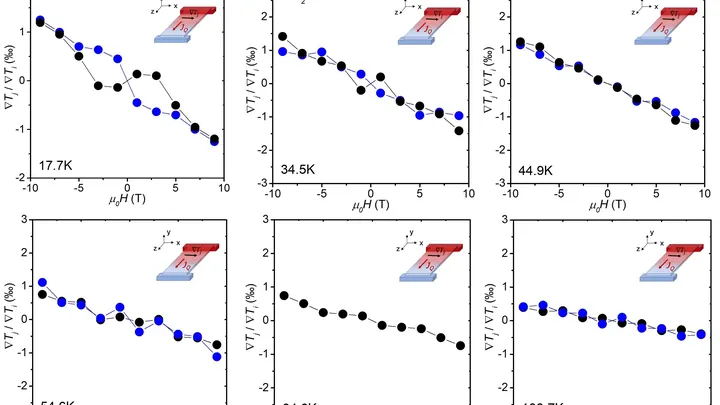
In an insulating crystal, heat usually flows from the hot end to the cold end. But when you switch on a magnetic field, part of the heat flow veers sideways, like water running down a slope that drifts to the side when the wind pushes it. This behavior is called the thermal Hall effect.
In the cold heart of a pure crystal, electrons flow like a viscous fluid — an idea predicted by Lev Landau. But the vortices of this fluid remained invisible, like a painting inferred from the noise of a crowd. Now scientists have created a nanostring: a semiconductor tuning fork with a circular cavity.
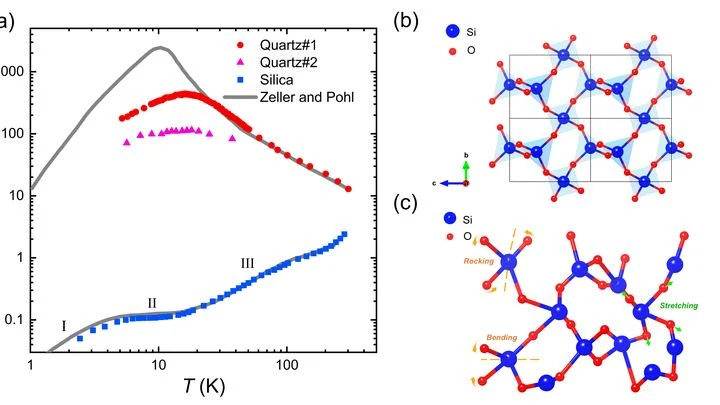
If you push heat through a piece of quartz, it usually goes straight, like water through a pipe. But switch on a magnetic field, and the flow veers slightly sideways, as if the pipe suddenly grew a side branch.
A tiny superconductor, levitating above a magnet, is like a cork on the surface of an invisible ocean. The slightest breath of dark matter makes it shudder. Scientists examined two kinds of such 'wind'. The first – gravitational waves, which stretch and squeeze space itself, like ripples on the fabric of the cosmos.
A piece of silver antimony telluride is like a sponge: it readily soaks up heat and turns it into electricity. Such materials are called thermoelectrics, and they already work in space probes and car refrigerators. But if you squeeze this sponge, it starts behaving like a superconductor — current flows with zero resistance.
The crystal Co2SeO3Cl2 resembles a layered cake, with each layer being a buckled honeycomb grid of cobalt atoms. When cooled to 25.4 K (−247.75 °C), the magnetic moments of the atoms begin to align like compass needles, but not all at once — rather in four steps, at 25.4, 16.8, 11, and 3 K. Each step brings a new pattern of magnetic order.
Superconductivity is the ability of a material to conduct electricity without losses. Ordinary wires heat up, and some energy is lost as heat, but a superconductor carries current with zero resistance.
The quantum Hall effect has long been suspected of superfluidity — the ability to flow without friction. Imagine a cook following a recipe: for each unit of magnetic flux, he must add exactly a certain number of electrons.
Ordinary computer memory constantly uses energy to store ones and zeros. Superconductors, on the other hand, carry current with zero loss — if you could build memory from them, it would barely draw any power. The catch is that superconductors can't remember: their state changes too easily.
Uranium ditelluride crystals turned out to be the exception.
A thin wire made of a special material, a topological insulator, behaves like a city street: the interior is empty, and all traffic runs along the edges. Electrons in such a wire move only along the surface, like pedestrians on a sidewalk, never stepping onto the roadway.
Inside a fuel cell, protons must race through a solid material like commuters through turnstiles at rush hour. If the turnstiles are sparse and narrow, the current is weak. In the past, to find a material with good proton conductivity, chemists had to screen compounds almost blindly, one by one.
An ordinary superconductor is like a squad of soldiers marching in pairs: electrons pair up, and their spins (internal 'tops') point in opposite directions. A magnetic field easily flips such pairs, destroying superconductivity.
In UTe₂, things are different.
In a thick metal, electrons are like a discordant orchestra: each instrument plays on its own, the overall sound is noise. But roll the metal into a film just a couple of atoms thick, and electrons suddenly begin to "play" in harmony, conducting current without dissonance. Even John Bardeen explained that in superconductors, electrons form pairs — duets that move unimpeded.
In a conventional superconductor, electrons team up into pairs that stay put: their total momentum is zero. But sometimes it's different: pairs gain a shared momentum and start moving, like a school of fish swimming against the current. This state is called a pair density wave, and it's very finicky: it needs special conditions.
In a dark room, a tiny diamond glows red when a green laser hits it. This glow isn't just for show: it's a signal: its brightness changes when a magnetic field is nearby. Inside the diamond sit defects — nitrogen atoms with an empty neighboring site. They act like sensitive needles that rotate under the influence of a magnet.
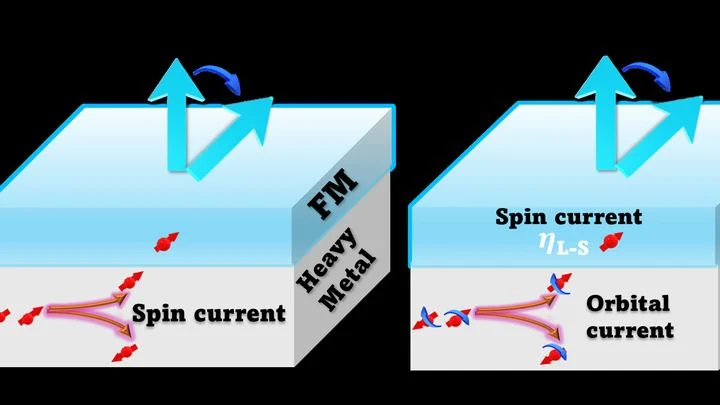
Usually, to flip a magnet in a memory device, heavy metals like platinum or tungsten are used. When current flows, their electrons are deflected sideways, like a crowd on an escalator, and this deflection imparts a rotational torque to the magnetic layer. But heavy metals are expensive and lose a lot of energy as heat.
In disordered materials, such as organic semiconductors or inks made from two-dimensional materials, electrons don't move smoothly like water through a pipe. Instead, they hop from one spot to another, like a ball bouncing across a rough surface. This kind of motion is called hopping transport.
At 78 K, a crystal of Mn₃Si₂Te₆ turns into an inductor that needs neither copper wire nor a superconductor. The electrons inside it spontaneously organize into closed vortices with a definite sense of rotation: chiral orbital currents.
A stone falls into water, and ripples spread outward. In the quantum world, a magnetic impurity (that pebble) in a metal perturbs the surrounding electrons, and they form a special cloud around it. This is called the Kondo cloud. Like ripples on water in the dark, it long remained elusive.