Triton: How to Read an Ocean Under the Ice ✛
Triton's icy shell is like a locked door to a basement where water sloshes behind the wall. We can't open it, but we can press our ear to it and listen for echoes of footsteps: how Neptune's magnetic field responds within the moon's interior, how the ice trembles from distant impacts. All along, we've been trying to figure out what lies beneath the surface, and now we have a way not just to guess, but to measure.
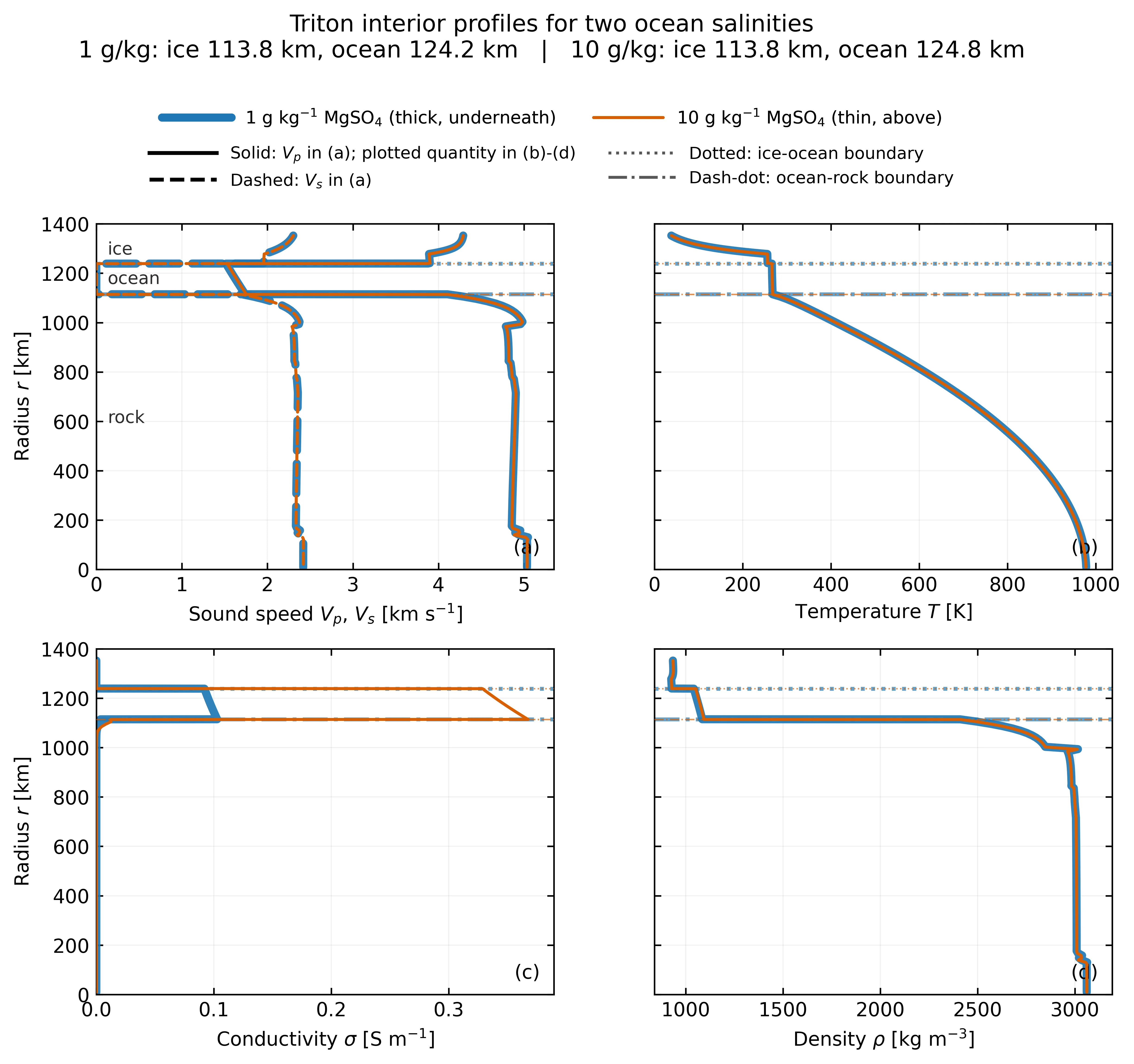
To understand what's happening under the ice, scientists built a unified model of Triton. It specifies a layered structure: an icy crust, an ocean of magnesium sulfate solution, and a rocky core. Then they calculated how this conductive structure responds to Neptune's varying magnetic field, how the ionosphere and atmosphere interact with the magnetosphere, and how seismic waves travel through all the layers. It turned out that the magnetic response barely distinguishes oceans of different thicknesses: if the ocean is thicker than a few tens of kilometers, the signal changes only slightly. But it is very sensitive to the water's conductivity, that is, how much salt is dissolved in it.
But there's a catch: currents in the surrounding plasma generate magnetic fields comparable in strength to the useful signal from the ocean. It's like trying to hear a quiet conversation through a wall while a fan hums nearby. Fortunately, seismology helps separate the two. A synthetic test with five stations on the surface recovered the ice thickness with an error of +8.4% and the ocean thickness with an error of -12.5%. At a conservative noise level, the minimum detectable magnitudes were 3.8–4.6 at distances of 100–1000 km from the epicenter.
So neither magnetic induction nor seismology alone gives a definitive answer, but together they remove the ambiguity. It's as if we're listening to footsteps in a locked room: one sound might deceive, but if we hear both the steps, the creaking floorboards, and the jingle of keys, the picture becomes clear. This approach is already suitable for designing future missions to icy moons: it sets requirements for instruments and shows which measurements need to be taken simultaneously.
Triton orbits Neptune in the opposite direction, and because of this, the synodic period (the time between two 'meetings' with the same point in the magnetosphere) is only 14.45 hours, almost like an Earth day. It is this rapid change in the magnetic field that 'rocks' the ocean's induction response.
In Stanislaw Lem's novel 'Fiasco', the heroes try to make contact with a civilization on the planet Quinta, hidden beneath clouds. Triton, with its hidden ocean beneath the icy crust, resembles such a closed system: we cannot see the water directly, but we can 'hear' it through magnetic and seismic signals.