The mantle is the thick, rocky layer that sits between a planet's thin crust and its metalliccore. Unlike the iron-rich core, the mantle is composed mostly of silicates — minerals built from silicon and oxygen — with smaller amounts of magnesium, iron, and other elements. It is the largest layer of a rocky planet by volume, and its slow, churning motion drives plate tectonics on Earth, volcanism, and the recycling of surface materials.
History
The concept of a layered Earth with a distinct mantle emerged in the early 20th century, notably through the work of geophysicist Beno Gutenberg and others who used seismic waves to map the planet's interior. The term 'mantle' itself was popularized by geologist Eduard Suess in the late 1800s.
How it works
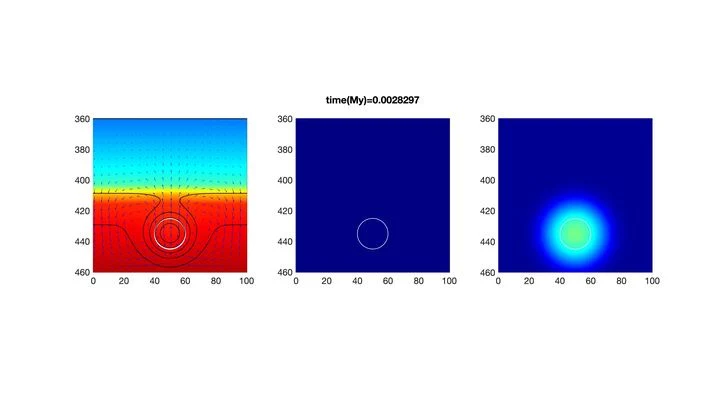
The mantle behaves like an extremely viscous fluid over geological timescales. Heat from the core and radioactive decay within the mantle itself create convection currents: hot, less dense material rises, cools near the surface, and sinks back down. This circulation moves tectonic plates, fuels volcanic hotspots, and gradually mixes the planet's interior. The mantle's composition also influences what melts and rises to the surface, shaping the chemistry of volcanic rocks and the atmosphere.
In practice
Understanding the mantle is crucial for predicting volcanic hazards, locating mineral resources like diamonds (which form deep in the mantle), and interpreting seismic data for earthquake early warning systems.
Fun fact
The Moon is thought to have formed largely from debris blasted off Earth's mantle after a giant impact, which explains why lunar rocks have a strikingly similar chemical composition to Earth's mantle.
Inside Earth, at depths from 660 to 2,900 kilometers, lies a layer known as the lower mantle. There, pressures reach 1.3 million atmospheres, and temperatures rival the surface of the Sun. Under these conditions, the mineral davemaoite exists as the third most abundant mineral in the lower mantle.
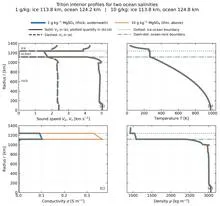
Triton's icy shell is like a locked door to a basement where water sloshes behind the wall. We can't open it, but we can press our ear to it and listen for echoes of footsteps: how Neptune's magnetic field responds within the moon's interior, how the ice trembles from distant impacts.
A river drawn on a map is always a single line. But stand on the bank, and you will see that within the channel there are faster currents, eddies, and branches that merge and split. The cosmic web is like that river, but made of dark matter, and until recently astronomers drew it as a single line.
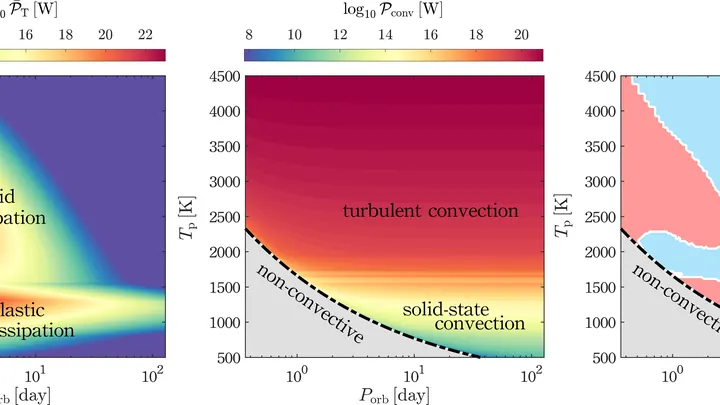
Deep inside a sub-Neptune, where pressures reach a hundred thousand bars and temperatures hit four thousand degrees, rock behaves like boiling soup. Heavy vapors of silicon and magnesium rise, cool, and fall back as a rain of solid particles.
When the JWST telescope breaks the light of a distant exoplanet into a spectrum, it reads a chemical chronicle. But this chronicle is not a monolithic truth; it's an atmosphere constantly rewritten by the star's radiation.
The mystery of the radius valley — a sharp drop in the number of exoplanets with radii ~1.8 Earth — haunts astronomers. JWST, transit surveys like Kepler and TESS draw a clear gap: rocky super-Earths and gaseous sub-Neptunes are separated by almost a chasm.
For almost a century, seismology has been the planet’s chief X-ray, probing the interior through elastic waves. But neutrinos, ghost particles predicted by Wolfgang Pauli, offer a different perspective.
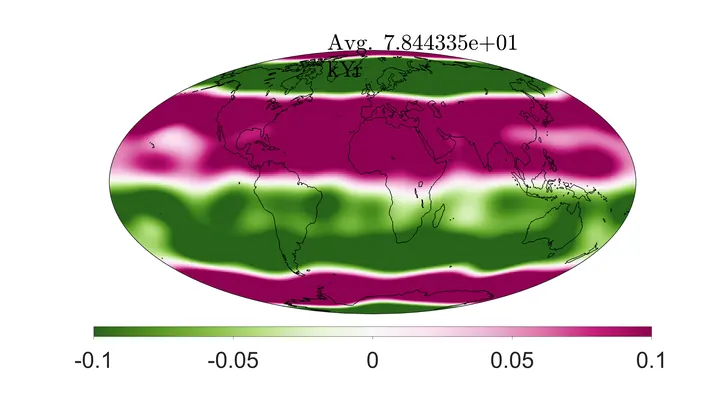
Earth's magnetic field is like an invisible shield that protects us from cosmic radiation. But if you look closely at its long-term averaged pattern, you'll notice that this shield isn't perfectly smooth: it has its own "seams" and "patches." New research using computer simulations of the geodynamo shows that…
Hundreds of light-years away, there's a planet that looks like a giant mirror. LTT9779b reflects most of the light that hits it — far more than you'd expect from a Neptune-sized body. Astronomers have long debated what makes it so shiny: a thick carbon-rich haze or a layer of clouds.
The James Webb Space Telescope has helped settle the debate.
A scorching rocky planet is like a pot of boiling soup, except its lid is the atmosphere. Gases escape from the magma, wrap the world in a thick blanket, and in turn influence how quickly the celestial body cools. For GJ 1132 b, which orbits so close to its star that a year lasts just one and a half Earth days, this connection is especially important.
Young Earth was a boiling sphere of liquid rock, while Theia, which crashed into it, had had time to cool and solidify. It’s like dropping a chunk of cold butter into a pot of soup: the soup splashes out, but the butter barely moves. Similarly, Earth’s interior spewed into space, forming a cloud of cosmic dust and debris.
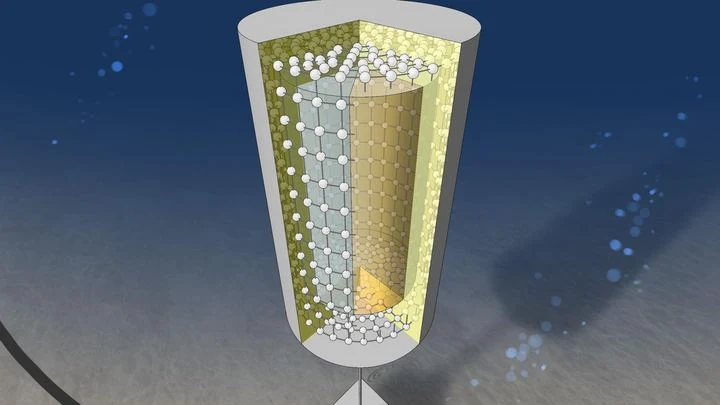
In the depths of the ocean, where light never reaches, a plan is taking shape to capture particles that barely interact with anything. Geoneutrinos, tiny messengers from the scorching mantle, are emitted during the decay of uranium and thorium. Their flux carries information about how much heat lies hidden beneath our feet.
Deep beneath our feet, in the scorching mantle, iron leads a double life. It can be divalent or trivalent, like a coin that lands heads or tails. Which side dominates determines how much oxygen stays in the planet's rocky shell and how much sinks into the core.
The young super-Jupiter TWA5B, a scorching ball 25 times Jupiter's mass, floats just fifty light-years away. Its faint infrared glow long hid its chemical makeup. Now, high-resolution spectroscopy with CRIRES+ has registered the ghostly trace of SiO — silicon monoxide.
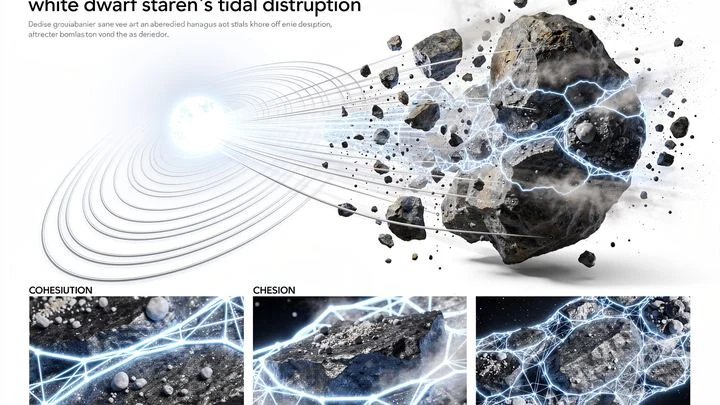
When a telescope catches the light of a distant white dwarf, the spectrograph sometimes fishes out heavy elements — calcium, iron, magnesium. These metals could not have stayed in the thin atmosphere of the stellar remnant; they are the traces of recently fallen planetary debris.
If you don’t stir a layered cocktail, the heavy syrup sinks to the bottom. A young planet is much the same — a seething ocean of molten rock. As it cools, minerals crystallize: some, like iron, get heavy and sink, while others float. You’d think a dense layer would pile up at the core.
Astronomers aimed JWST at the rocky exoplanet LHS 3844 b — a world orbiting another star, where a year lasts just 11 hours. The planet is tidally locked: one side always faces the star, with a permanent scorch of 770°C, while the night side is plunged into icy darkness.
A planet's magnetic field is like an invisible shield: it catches charged particles from the solar wind and stretches out behind the planet into a long tail, like a fluttering scarf.
When a baker kneads dough, the grains of flour can tell you which mill they came from. It's the same with Earth: the composition of iron in its depths preserves a memory of where the pieces that assembled the planet were born.
In its youth, Earth resembled a beehive: it grew by sticking together from countless rocky chunks. When the main construction was over, a late swarm of meteorites rained down on the young planet — the so-called late veneer. These impacts, scientists thought, brought platinum, gold, and other rare metals to Earth's upper layers.
Planets are born from dust. In a disk around a young star, tiny dust grains collide, stick together, and gradually grow like a snowball rolling down a hill. But there's a catch: the gas in the disk moves faster than the dust and drags on it, preventing it from clumping into large chunks.
For dust to stick together, there needs to be enough of it.
Deep beneath us, hundreds of kilometers down, lies a layer that can absorb water like a sponge. The minerals there, wadsleyite and ringwoodite, can hold up to 1–2% water by weight within their crystal lattices.
The Kepler telescope William Borucki's caught the faint twinkling of distant stars and discovered thousands of planets around other suns. Among them gapes a gap: almost no worlds sized between rocky balls and puffy water giants.
Deep beneath our feet, at the very center of Earth, lies a solid iron core. But it's not pure iron — there are lighter elements too, such as hydrogen. Exactly how hydrogen is distributed within the core has long been a mystery.
Just as Water changes phase, freezing into ice or evaporating into vapor, forsterite, a key mineral of Earth's mantle, under pressures of hundreds of thousands of atmospheres, reassembles its crystal lattice.
Titan, discovered by Christiaan Huygens in 1655, resembles a canvas that is constantly being repainted. Impacts from cosmic dust and asteroids leave crater marks on it. But an invisible artist, the moon's own forces, time and again covers everything with a fresh layer, erasing old strokes.
An exoplanet — a planet outside our solar system — follows a slightly elongated orbit. With each revolution, it swings closer to its parent star and then farther away.
The most common type of planet in our Galaxy — rocky worlds around other stars, or exoplanets, shrouded in the simplest gas hydrogen. Their innards remained a mystery until scientists recreated the conditions of the interior in the lab.
A young sub-Neptune is a pressure cooker where hydrogen and rock simmer in the same pot. Six Earth masses, three percent hydrogen by mass, and interior temperatures above 4000 K. At that heat, silicate melt and hydrogen don't just coexist: they mix completely, forming a single supercritical fluid. There is no boundary between core and envelope.
The Moon harbors a secret that has puzzled planetary scientists for decades: its isotopic composition is almost indistinguishable from Earth's. According to the canonical giant impact model, the Moon should have inherited most of its material from the impactor Theia, a Mars-sized planet that slammed into the young Earth.