Triton: How to Read an Ocean Under the Ice ✛
Context
Icy moons like Europa and Enceladus have already hinted at subsurface oceans, but Triton stands apart: its retrograde orbit, young surface, cryovolcanoes, and dense ionosphere make it a tempting target. Nearby in the archive are works on neutrino tomography of Earth, gravitational resonances of the Moon, and seismology of distant planets, all seeking ways to peer into interiors without direct drilling. This work continues that line, but for a moon of Neptune, where the giant planet's magnetic field creates unique conditions for probing.
Methods
The authors built a single chain of four calculations. First, the PlanetProfile code defined a layered model of Triton: an icy crust, an ocean of magnesium sulfate solution, and a rocky core. Then MoonMag computed the response of this conducting structure to Neptune's time-varying magnetic field at rotation, orbital, and synodic periods. The multi-fluid SWMF simulation reproduced the interaction of Triton's ionosphere and atmosphere with the magnetosphere, and a Poisson reconstruction in the Coulomb gauge isolated magnetic fields from space currents. Finally, the TritonSeis package performed three-dimensional seismic modeling and hierarchical travel-time inversion to determine the depths of the ice-ocean and ocean-rock boundaries.
Results
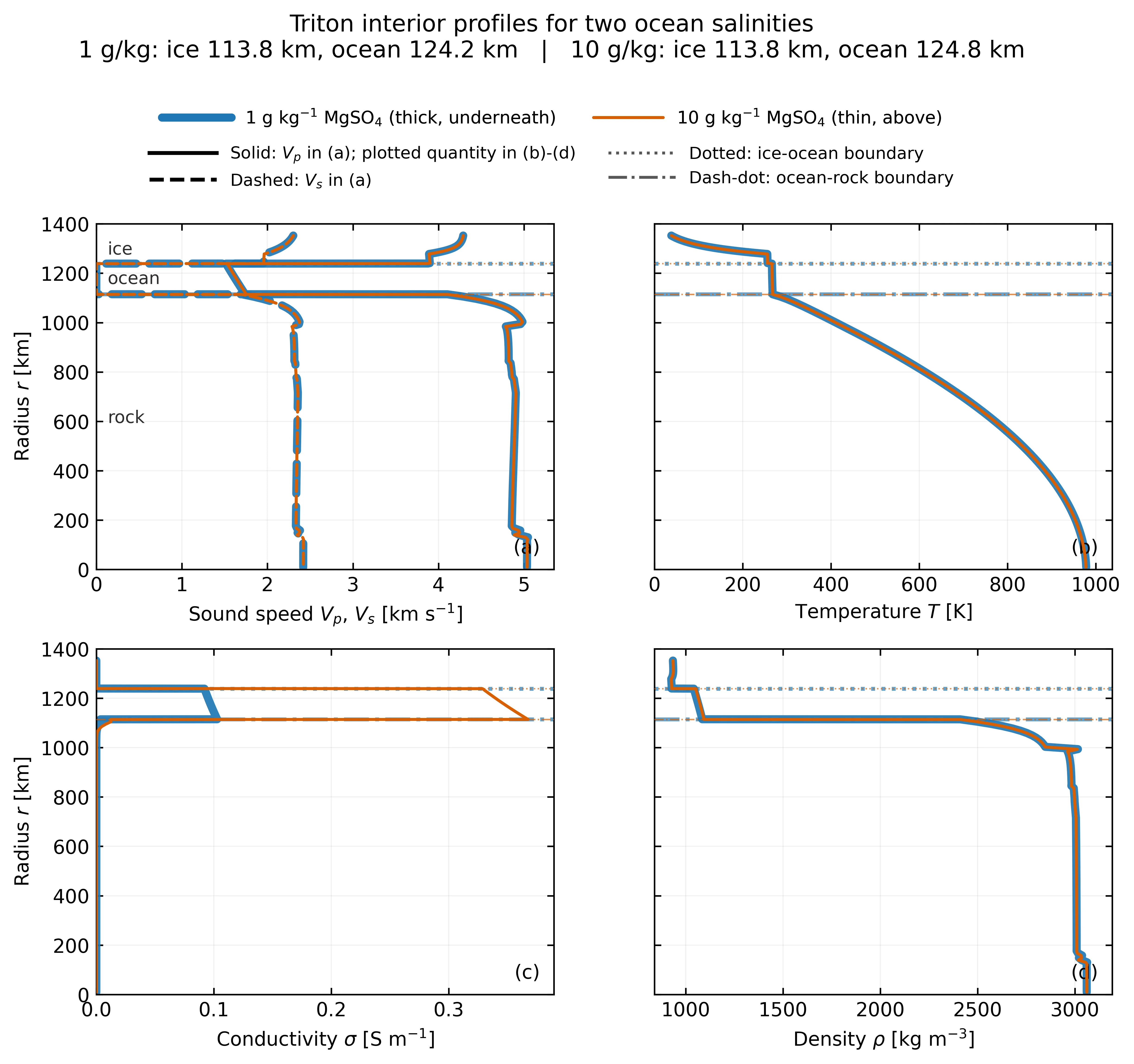
For the reference model with 10 g/kg MgSO4, the ice crust thickness was 113.75 km, the ocean thickness 124.80 km, and the ocean conductivity 0.348 S/m. Magnetic induction proved notably more sensitive to ocean conductivity than to its thickness: for thicknesses of tens of kilometers, the response barely changes. Fields from space currents are comparable in amplitude to the internal induction signal, creating significant interference. A synthetic test with five stations recovered ice thickness with an error of +8.4% and ocean thickness with -12.5%. At a conservative noise level, minimum detectable magnitudes were 3.8-4.6 at epicentral distances of 100-1000 km.
Implications
This work adds a new contribution compared to neighbors in the archive: those studied neutrinos, gravitational waves, or seismology separately, while here, for the first time for Triton, it is quantitatively shown how magnetic induction, plasma currents, and seismic reflections complement each other. The Poisson reconstruction and the end-to-end recovery of seismic boundaries are the first such demonstrations for this moon. This is not just a sum of methods but a common framework where the same internal structure profile links electrical and elastic properties.
Future development
In the future, one could add gravity and tidal measurements: they would provide independent constraints on mass distribution and the rigidity of the icy crust. There is already a technical possibility to calculate Love numbers via the PlanetProfile-pyalma3 interface, but this requires additional assumptions about the rheology of ice and rock, which are still poorly known for Triton. It is also worth conducting ensemble tests with different source mechanisms, lateral heterogeneity of ice, and realistic noise to turn rough estimates into reliable mission requirements.
Impact
The results will directly influence the planning of future missions to icy moons: they set requirements for magnetometer accuracy, plasma instrument suites, and seismometer sensitivity thresholds. The methodology is also applicable to other ocean worlds, such as Europa or Titan.
Next steps
The next step is trajectory calculations for specific flyby or orbital mission scenarios to optimize altitude and measurement timing. In parallel, the properties of seismic noise on Triton and the possible frequency of icequakes need to be refined.
Key open problems
For the planetology of icy moons, the unresolved question remains how to distinguish a thin ocean with high conductivity from a thick one with low conductivity. This work shows that neither magnetic induction nor seismology alone provides a unique answer, but their joint interpretation lifts the degeneracy. This is a step toward a universal protocol for probing subsurface oceans without direct contact.
The knowledge machine's view
This section is addressed to the author of the paper and their colleagues. Neighbouring works were found by meaning-based search across our archive, not by word overlap. We do not review: we show the field around the work.
What the work does
The study combines models of internal structure, magnetic induction, interaction with the magnetosphere, and seismic waves to estimate the thickness and conductivity of Triton's subsurface ocean. It is shown that the magnetic response depends more strongly on ocean conductivity than on its thickness, and that currents in the surrounding plasma produce noise comparable to the useful signal. Joint analysis of magnetic, plasma, and seismic data can resolve the ambiguity and help plan a future mission.
Where its strength is
For the first time on Triton, it is quantitatively demonstrated how magnetic induction, plasma currents, and seismic reflections complement each other within a unified framework linking electrical and elastic properties. The Poisson reconstruction and full-wave seismic boundary recovery are the first such demonstrations for this moon.
Where it could go next
- Neutrino tomography methods developed on Earth with IceCube could be adapted to probe Triton's deep interior, especially if a future mission delivers detectors to its surface or orbit.based on: The Earth’s Neutrino Confession: IceCube Reads the Planet in the Language of Weak Interactions arXiv:2607.02644
- Experience from seismic studies of Enceladus, including analysis of the icy crust and ocean, could be transferred to Triton to refine layer boundaries and properties using data from future landers.based on: How to See Beneath Enceladus's Ice arXiv:2605.09052
- Approaches to studying internal magma oceans on Uranus and Neptune may suggest how to account for the influence of overlying highly conductive layers on Triton's magnetic signals.based on: Inside Uranus and Neptune Lie Oceans of Magma arXiv:2606.18219
Worth trying
- Test neutrino tomography for Triton using response models from IceCube and assuming a hypothetical detector in orbit.
- Compare seismic profiles of Triton and Enceladus to identify common features in the structure of icy moons with oceans.
- Investigate how the presence of a magma layer in Neptune's interior affects the background magnetic field that must be accounted for in induction sounding of Triton.
Why this may matter
Further development of these approaches could turn Triton into a testbed for combined methods of probing the deep interiors of icy moons, which is important for the search for habitable environments beyond Earth.
Nearby works in our archive
- How to Peer into the Depths of Distant Planetssimilarity 0.50
- Worlds with Eternal Magma Oceanssimilarity 0.50
- How Giant Planets Hide Hydrogen Insidesimilarity 0.50
- A Volcanic Planet Breathes Hydrogensimilarity 0.49
- How to See Beneath Enceladus's Icesimilarity 0.49
- Inside Uranus and Neptune Lie Oceans of Magmasimilarity 0.49
- The Earth’s Neutrino Confession: IceCube Reads the Planet in the Language of Weak Interactionssimilarity 0.48
The archive is sparse around this work: the closest review is only 0.50, against a usual 0.64. It looks like few have drilled nearby.
Triton orbits Neptune in the opposite direction, and because of this, the synodic period (the time between two 'meetings' with the same point in the magnetosphere) is only 14.45 hours, almost like an Earth day. It is this rapid change in the magnetic field that 'rocks' the ocean's induction response.
In Stanislaw Lem's novel 'Fiasco', the heroes try to make contact with a civilization on the planet Quinta, hidden beneath clouds. Triton, with its hidden ocean beneath the icy crust, resembles such a closed system: we cannot see the water directly, but we can 'hear' it through magnetic and seismic signals.
Key numbers
- ice crust thickness: 113.75 km
- ocean thickness: 124.80 km
- ocean conductivity (MgSO4 10 g/kg): 0.348 S/m
- minimum detectable magnitude (100 km): 3.8
- ice thickness recovery error: +8.4%