How Nanoparticles Fix or Break Layered Polymers ✛
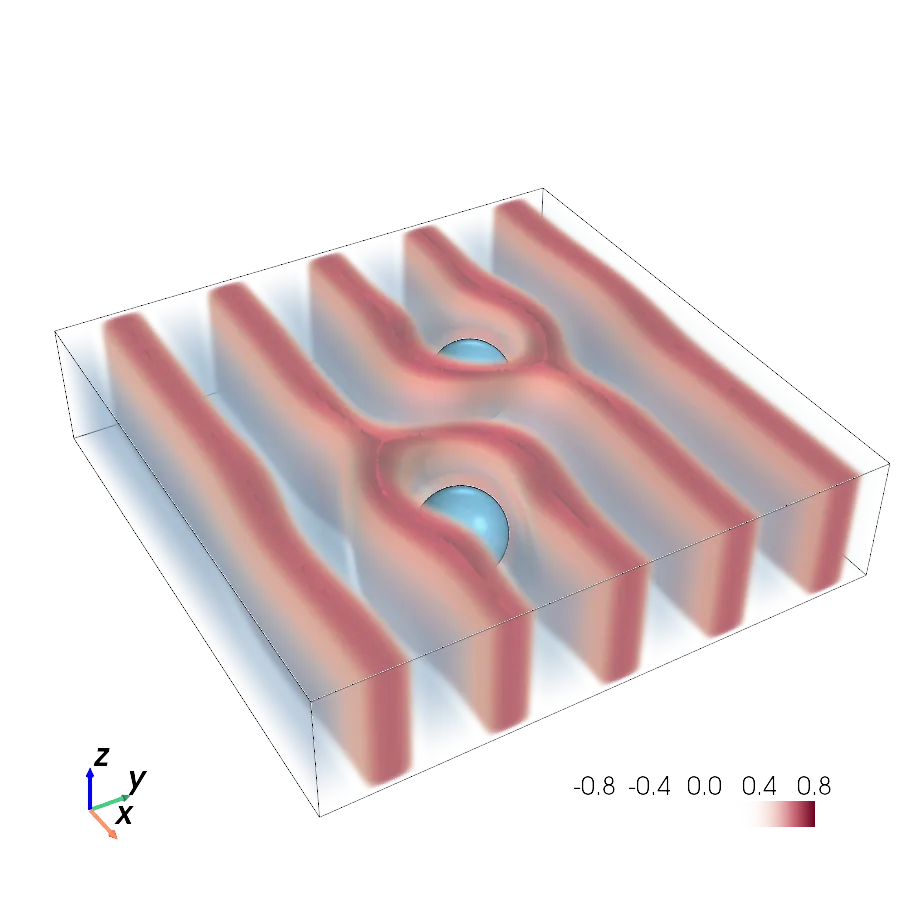
Think of a layered polymer as a multi-story building where each floor is painted a different color. Sometimes the floors shift, creating a defect, like a crack in the wall. Scientists have found a way to control such defects using tiny particles. Some particles act like putty, filling the crack and strengthening it. Others, conversely, make the crack energetically unfavorable, so it disappears.
In a computer model, two types of particles were considered. Uniform particles, coated with a substance that prefers one of the layers, embed themselves in the defect and lower the energy required for its existence. Particles with two different surface halves cannot satisfy both layers at once, so they raise the energy and destroy the defect. This is like a worker who only likes blue paint easily patching a crack in a blue wall, while a worker who likes both blue and yellow cannot choose and leaves the crack.
A-type and B-type particles stabilize dislocations differently: at the same size, the energy shift for A-selective particles is almost twice that for B-selective ones, due to the polarity of the defect core.