Nanoparticles as Architects of Defects in Layered Polymers ✛
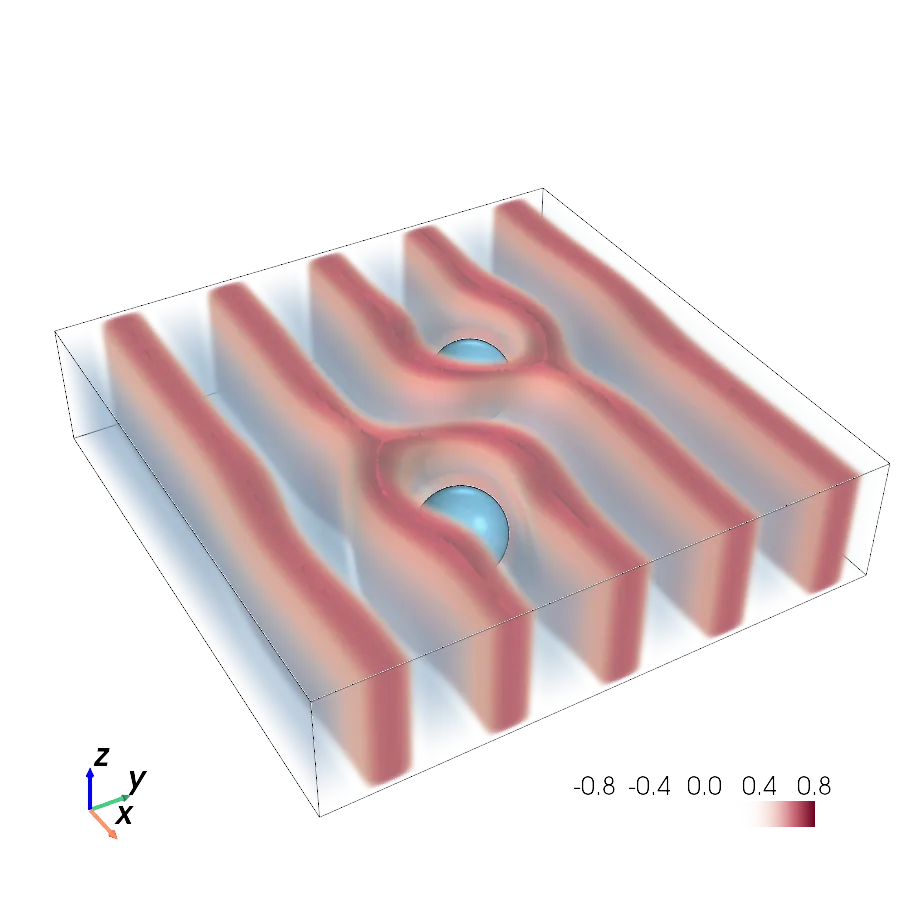
Layered polymers resemble a multi-story building where each floor is painted a different color, and sometimes cracks appear between floors. These cracks are dislocation pairs, which are periodic irregularities that spoil the material. Engineers have long sought ways to control such defects without rebuilding the entire structure. It turns out that tiny particles can act as architects: some reinforce weak spots, while others, conversely, undermine them.
The researchers built a computer model in which a layered polymer interacts with two types of nanoparticles. Homogeneous particles, coated with a substance that prefers one of the layers, behave like crack fillers: they embed into the defect and lower the energy required for its existence. Janus particles, with two different surface halves, cannot satisfy both layers simultaneously in the curved defect core, so they increase the formation energy and make the defect less favorable.
For homogeneous particles larger than the layer thickness, the effect was significant: the energy shift reached −63.8 kBT for particles preferring layer A and −37.9 kBT for those preferring layer B. This means such particles actively stabilize dislocations by replacing strained polymer in the defect core. Janus particles, in contrast, raised the energy by a few kBT, especially when the two surface halves were equally balanced.
The key result: the binding energy of a particle to the dislocation core is linearly related to the shift in formation energy, with a slope of 1.00 ± 0.01. This means that by knowing how strongly a particle adheres to a defect, one can predict whether it will stabilize or destabilize it. Such a simple law allows designing materials with the desired number of defects without costly parameter sweeps.
Previously, it was known that additives could accumulate in defective regions, but there was no quantitative link between particle properties and dislocation energy. Now that link is established: homogeneous large particles strengthen defects, while Janus particles weaken them. This paves the way for the targeted design of nanostructured materials where defects are not flaws but functional elements, for instance, in photonic crystals or membranes.
A-type and B-type particles stabilize dislocations differently: at the same size, the energy shift for A-selective particles is almost twice that for B-selective ones, due to the polarity of the defect core.