How Nanoparticles Control Defects in Block Copolymers ✛
Context
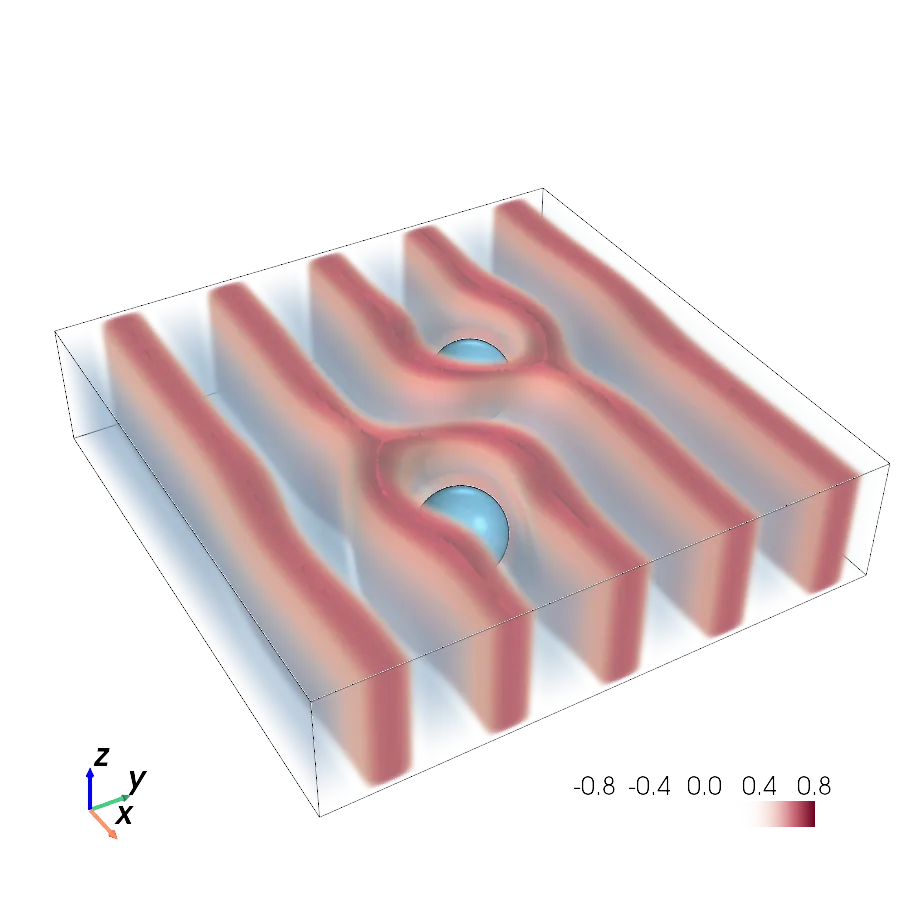
Topological defects in block copolymers affect the structural perfection, mechanical properties, and optical properties of materials. Defect control is typically achieved by annealing, which promotes global relaxation but does not allow control over individual defects. An alternative approach is to introduce additives that locally modify the free energy. This work stands apart: the closest neighboring studies examine defects in pure block copolymers or nanoparticle stabilization of grain boundaries, but a quantitative link between particle properties and dislocation energy had not been established before.
Methods
The authors used a hybrid model combining the time-dependent Ginzburg–Landau equation for the block copolymer order parameter with Brownian dynamics for explicit colloidal particles. They considered homogeneous particles selective to either the A or B block, and Janus particles with a specified surface domain ratio. The formation energy of a dislocation pair was computed as the free energy difference between states with and without the defect at the same particle number. Finite-size scaling allowed extrapolation to the thermodynamic limit, eliminating periodic image effects.
Results
Homogeneous particles larger than the lamellar domain thickness (2R0/ℓ0 > 1) increasingly stabilize dislocation pairs with size: at 2R0/ℓ0 = 1.69, the formation energy shift is δ = −63.8 ± 3.0 kBT for A-type particles and −37.9 ± 2.8 kBT for B-type. Janus particles, in contrast, raise the formation energy by several kBT, with the effect maximal near balanced coverage (α = 0.5). Surface patterning has little effect for particles smaller than one domain, but for large particles the energy change reaches 69 kBT. The binding energy of particles to the dislocation core is linearly related to the formation energy shift: δ = ΔF_bind^∞ with a slope of 1.00 ± 0.01.
Implications
This work is the first to quantitatively link the properties of colloidal additives to the formation energy of dislocations in lamellar block copolymers. Unlike neighboring studies, which either considered pure systems or limited themselves to qualitative observations of grain boundary stabilization, here thermodynamic limit values are obtained and a simple dependence on binding energy is revealed. This allows predicting which particles will stabilize or destroy defects without expensive parameter sweeps.
Future development
The model can be extended to anisotropic particles, mixed particle types, finite concentrations, and other defect types. The dependence on the surface domain ratio opens a path to active defect control: particles with switchable surface chemistry could reversibly transition from stabilization to destabilization, allowing control over defect nucleation, pinning, and release.
Impact
The results are applicable in nanolithography, photonic crystals, and membranes, where controlled defects are used as functional elements. They are also important for understanding the mechanical properties of nanocomposites.
Next steps
Collective effects at finite particle concentrations need to be investigated, including cooperative pinning and clustering. The influence of a substrate and free surface in thin films should also be considered.
Key open problems
This work directly addresses the unresolved problem of predicting defect relaxation pathways in soft condensed matter. It shows how local free energy perturbations can alter dislocation annihilation kinetics, which remains an open question for many self-assembling systems.
The knowledge machine's view
This section is addressed to the author of the paper and their colleagues. Neighbouring works were found by meaning-based search across our archive, not by word overlap. We do not review: we show the field around the work.
What the work does
This work explores how colloidal particles alter the energy required to form dislocation pairs in lamellar block copolymers, using a hybrid Ginzburg–Landau model with Brownian dynamics. Formation energies are computed in the thermodynamic limit for both homogeneous and Janus particles. The results show that homogeneous particles larger than the domain stabilize dislocations, while Janus particles increase the formation energy.
Where its strength is
For the first time, the properties of colloidal additives (size, selectivity, Janus pattern) are quantitatively linked to the dislocation formation energy in lamellar block copolymers. A simple linear relationship is found between the binding energy of a particle to the defect core and the shift in formation energy, which allows predictions without exhaustive parameter sweeps.
Where it could go next
- It might be interesting to compare the obtained formation energies with results for more complex defect structures, such as disclinations in hexagonal phases, which are considered in a neighboring work on tiny islands and invisible barriers.based on: Tiny Islands and Invisible Barriers arXiv:2603.03783
- Nearby is a work on a rigid shell around nanoparticles, which investigates the shell's influence on interaction with the matrix; one could transfer this approach to particles with a soft shell to control the binding energy to the dislocation core.based on: A rigid shell around nanoparticles arXiv:2607.23768
- In the archive there is a work on stabilizing grain boundaries with nanoparticles; one could examine how particles with different selectivity affect the interaction between dislocations and grain boundaries, using your method for calculating energies.based on: Quantum pendulum probes reality arXiv:2606.22707
Worth trying
- Test whether the linear relationship between binding energy and formation energy shift holds for particles with a soft shell, varying its thickness and permeability.
- Use finite-size scaling to estimate the formation energy of disclinations in the hexagonal phase with particles.
- Consider mixtures of particles of different sizes to uncover possible synergistic effects in defect stabilization.
Why this may matter
Quantitative prediction of how additives affect defects paves the way for the rational design of nanostructured materials with tailored mechanical and optical properties, as well as for controlling self-assembly processes.
Nearby works in our archive
- Tiny Islands and Invisible Barrierssimilarity 0.53
- A rigid shell around nanoparticlessimilarity 0.52
- The Wire That Refuses to Trap Electronssimilarity 0.50
- How a Neural Network Sharpens Focus in Particle Showerssimilarity 0.50
- Quantum pendulum probes realitysimilarity 0.50
- Space modules heal wounds without commandssimilarity 0.49
The archive is sparse around this work: the closest review is only 0.53, against a usual 0.64. It looks like few have drilled nearby.
A-type and B-type particles stabilize dislocations differently: at the same size, the energy shift for A-selective particles is almost twice that for B-selective ones, due to the polarity of the defect core.
Key numbers
- formation energy of a dislocation pair in a pure block copolymer: 48.57 ± 0.01 kBT
- energy shift for A-type particles at 2R0/ℓ0 = 1.69: −63.8 ± 3.0 kBT
- energy shift for B-type particles at 2R0/ℓ0 = 1.69: −37.9 ± 2.8 kBT
- maximum energy change when varying the surface pattern: 69 kBT
- slope of the linear dependence of δ on binding energy: 1.00 ± 0.01