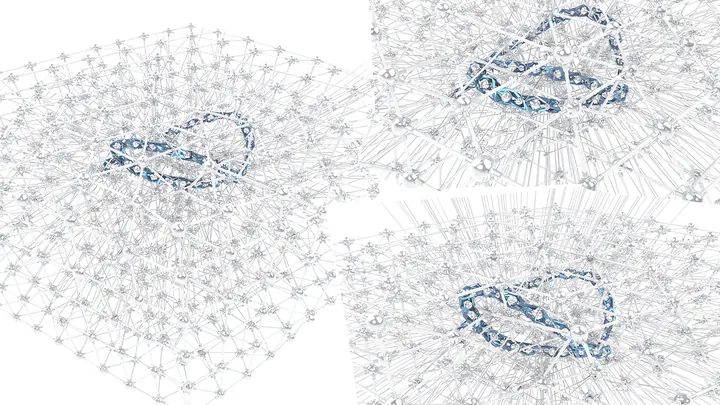
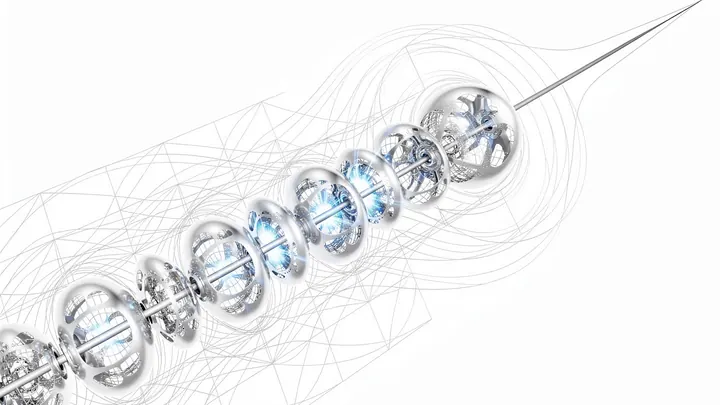
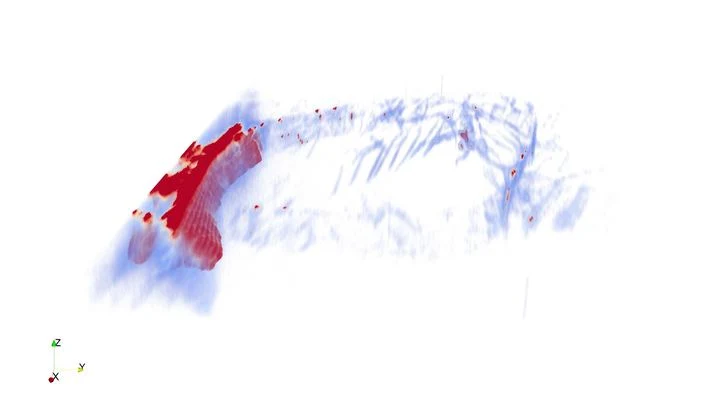
The crystal lattice is a three-dimensional pattern of atoms. A dislocation disrupts this pattern: it is the edge of an incomplete atomic plane wedged between full layers. Around the dislocation line, the crystal is strained. This stress allows the dislocation to move under load, rearranging atomic rows step by step. Thus the metalflows rather than cracks. In fact, any piece of metal contains billions of dislocations per square centimeter; their tangled movement is plasticity.
History
The concept of dislocations was introduced in 1934 by Geoffrey Taylor, Egon Orowan, and Michael Polanyi to resolve the paradox of the low strength of real crystals compared to theoretical estimates. In the 1940s, Jacques Friedel developed the theory of dislocation networks. Direct observation of dislocations in a transmission electron microscope was achieved by Peter Hirsch and colleagues in 1956. Subsequently, William Lawrence Bragg contributed to the understanding of dislocation structure using X-ray diffraction.
How it works
Under shearstress, a dislocation moves in the slip plane, sequentially breaking and reforming interatomic bonds. The Peierls–Nabarro stress determines the lattice resistance to motion. Schmid's law relates the critical resolved shear stress to the plane orientation. When dislocations meet, they can interact elastically, form Lomer–Cottrell barriers, or annihilate. The Orowan equation relates the plastic strain rate to the density of mobile dislocations, their velocity, and the Burgers vector: dε/dt = ρ_m b v. With increasing temperature, dislocation climb becomes possible through vacancydiffusion, which is essential for creep.
In practice
Forging metal, rolling steel, and the strength of alloys rely on the skillful management of dislocations — without them, an aluminum fuselage would crack rather than bend.
Fun fact
The yellow color of gold is partly due to dislocations, which affect light absorption. Without them, gold might be silvery, like most metals.
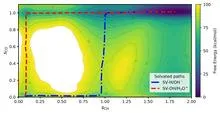
Picture a tiny hole in a sheet of graphene: a single missing carbon atom. It used to be thought that a water molecule splits apart at this defect only on its own, in dry gas. But if liquid water is sloshing all around, everything changes.
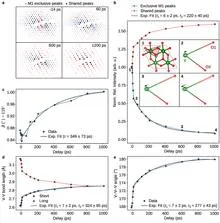
The camera captures not a race but a dance of atoms. In vanadium dioxide, the transition from an insulating to a metallic state occurs within trillionths of a second, yet until now no one had seen exactly how the vanadium and oxygen atoms move. Now, ultrafast electron diffraction has captured this route frame by frame.
A deck of cards in which each card is slightly rotated cannot lie flat: the backs and faces will never align. But if the cards are flexible, they will start to adjust, shifting by fractions of a millimeter to find the perfect match. Something similar happens inside crystals when two thick layers of MoS2 or MoS2 with WS2 are stacked with a twist of 1–2 degrees.
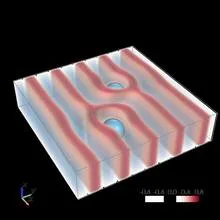
Layered polymers resemble a multi-story building where each floor is painted a different color, and sometimes cracks appear between floors. These cracks are dislocation pairs, which are periodic irregularities that spoil the material. Engineers have long sought ways to control such defects without rebuilding the entire structure.
A deck of cards in which each card is slightly rotated cannot lie flat: the backs and faces will never align. But if the cards are flexible, they will start to adjust, shifting by fractions of a millimeter to find the perfect match. Something similar happens inside crystals when two thick layers of MoS2 or MoS2 with WS2 are stacked with a twist of 1–2 degrees.
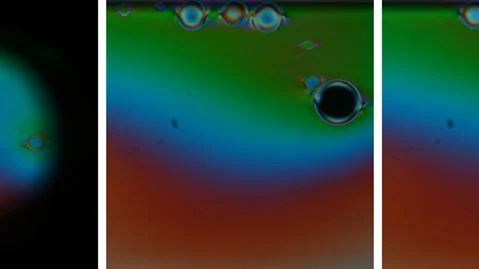
In a thin layer of liquid crystal, molecules usually lie like matches in a box — aligned in one direction but randomly oriented: some point up, others down. To make all the matches point the same way, you need a special molecular architecture. Scientists have found a chemical trick that does this almost automatically.
Inside a piece of aluminum, atoms are arranged in neat rows, like bricks in a wall. But sometimes a row ends before reaching the edge, and a "step" appears in the crystal, which physicists call a dislocation. These defects determine how strong, ductile, and how a metal behaves under load.
A drop of saltwater dries on a table. The salt doesn't settle just anywhere: crystals first appear at the rim, forming a ring, like coffee grounds at the bottom of a cup. Everyone who has seen the stain left by a dried droplet knows this behavior. But what if the droplet contains swimming bacteria?
Moiré patterns are familiar to everyone. Two combs with different spacing, placed on top of each other, show dark fringes. Something similar has emerged in time. Physicists took a cloud of Rydberg atoms, particles with unusually large electron orbits, and illuminated it with two lasers.
A solid under a microscope is not a monolith at all. In glass, polymer, or solidified resin, atoms are arranged randomly, and as a result, the material's properties vary from point to point. On large scales, we are used to describing them with smooth fields, like temperature or pressure in a room. But when you zoom down to a few atomic layers, that smoothness disappears.
A tuning fork struck once rings pure and long. But if you shake the fork itself while it sounds, the tone wavers and dies out quickly. Something similar happens to electrons in any piece of matter. Atoms in a lattice never stay put: thermal vibrations keep them jittering.
In water cooled to –40°C, a paradoxical pause sets in: perfect hexagonal ice is in no hurry to form. Instead, a disordered structure with interspersed cubic layers emerges — a real cradle for future symmetry, brimming with disorder yet already charged with hidden architecture.
Diamond is a symbol of perfection, but its true magic is revealed through flaws. Perfect lattice purity gives transparency and hardness, while defects, such as color centers, open a portal to the quantum world, becoming the foundation for quantum computers and quantum sensors.
Plastic deformation is the language through which materials tell the story of their internal stresses. For almost a century, its grammar has been the theory of dislocations: tiny linear defects gliding through the crystal lattice and carrying shear.
An ionic conductor resembles a crowded bus where passengers (ions) try to squeeze toward the exit. Previously, it was thought that fast exit could be achieved either by a gently swaying bus (soft lattice) or by passengers standing in chaotic order (geometric disorder). The new work shows these are not two different tricks but the same one.
Electrons in a crystal are like cars on city streets: some race down avenues, others get stuck in traffic jams. In certain lattices, motion freezes entirely — velocity stops depending on energy, and electrons become "flat." This isn't a traffic jam but a special rhythm of the network where waves cancel each other out.
Hot gas settles on a substrate, building up a transparent film layer by layer. But instead of a perfect mirror, the surface sometimes gets covered with tiny bumps, like frost patterns on glass in severe cold. Usually, people try to remove them because they get in the way of making smooth components. Physicists from Oxford and their colleagues did the opposite: they looked inside the bumps.
A crystal is like a row of soldiers on a parade ground: every atom is in its place, and electrons march through it in neat waves. An amorphous material is like a crowd at a train station, where there is no order, just a jostling throng. In such a crowd, an electron usually gets stuck quickly, like a person trying to push through a dense mass of people.
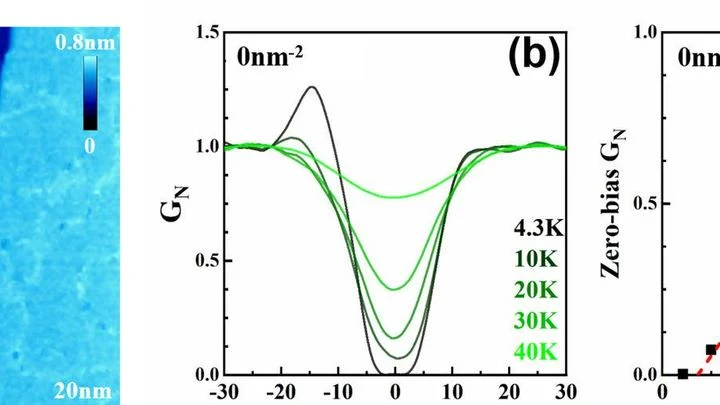
A superconductor is a material that, when strongly cooled, loses its electrical resistance: current flows through it without losses. Scientists took a layered crystal of PdTe2, similar to a stack of sheets of paper, and cooled it to temperatures below 1.8 kelvin (that's about -271°C).
When you pull on a piece of metal, it changes shape and simultaneously becomes stronger. The secret lies in tiny defects in the crystal lattice called dislocations. They are like wrinkles in a rug: moving a wrinkle shifts the rug more easily than dragging the whole rug.
Light can hold an atom in place, just like a jet of air holds a lightweight ball. But a dysprosium atom is no ordinary ball: inside it has many "gears" (electrons) that respond differently to light of different colors. To catch such an atom and keep it from slipping away, you need to know exactly how strongly the light pulls on it.
A metal filament as thin as a hair grows through the ceramic like a root through asphalt. In solid-state batteries, such filaments are called dendrites, and they appear when the charging current exceeds a critical threshold. The ceramic electrolyte is solid but brittle, like glass.
Molecules in a solution behave like a crowd in a square: they can jostle randomly or line up in neat rows. An aqueous solution of disodium cromoglycate is a well-known model for chromonic liquid crystals, where such 'rows' form spontaneously. But if you shine ultraviolet light on the solution, order collapses: molecules start breaking apart.
A time crystal is a system pulsing with a steady rhythm, like a metronome. A row of swings, pushed rhythmically, usually rocks in sync. But with a clever setup, they start a full cycle every two pushes. That is a discrete time crystal. The main obstacle is heating: continuous kicks destroy order, breeding chaos.
Cells on the surface of an embryo resemble grains of rice that can align in one direction. This order is called nematic. It arises when cells start acting in concert, like a school of fish swimming in the same direction.
Tearing apart an aluminum cube just a few nanometers wide is like trying to watch a droplet fall in slow motion when the camera itself is firing at machine-gun speed. Atoms inside the metal vibrate trillions of times per second, while real deformation in the lab takes minutes.
A crystal the size of half a matchbox was grown in a furnace, where a molten zone slowly crept along a rod, leaving perfectly ordered layers behind. Inside this crystal, copper ions sit at the nodes of a triangular lattice, but the triangles are slightly skewed, as if someone pressed on one corner. Each copper ion behaves like a tiny magnetic needle that can point up or down.
A superconductor carries current without loss, like a perfectly smooth road where cars glide with no friction. But what if you scatter rocks and potholes across that road? Scientists decided to find out by adding disorder to a superconducting material just one atom thick.
In a metal crystal, atoms line up in neat rows like bricks in a wall. Knock out a single brick, and you're left with a void — what scientists call a vacancy. Under irradiation, these voids multiply and start merging into large holes, sapping the metal's strength. It's like holes in a brick wall joining up into a gaping breach.
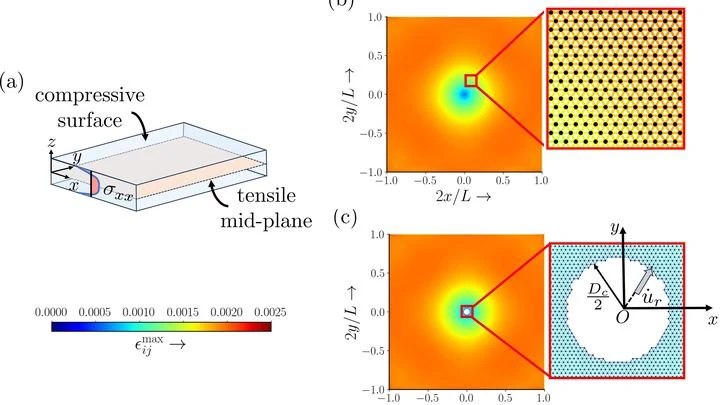
Glass is a material with attitude. It seems fragile, but powerful invisible forces can live inside it. In chemically strengthened glass, the surface is compressed like a stretched rubber band, while the interior is stretched. When a fast object hits such glass, that rubber band snaps in many places at once.
Scientists fired projectiles at glass and watched how it shattered.
A chain of red phosphorus atoms is like a train where the cars are atoms and the couplers are chemical bonds. Sometimes the couplers are stronger, sometimes weaker, and that affects how electrons run through the train.
Twisted layers of atoms in a material form a pattern of tiny regions, domains, each of which can be electrified in one of two directions, like a compass needle pointing north or south. Previously, such materials were studied only as a whole, measuring thousands of domains at once, and their collective behavior was like a choir where individual voices are not heard.
Lithium in a battery sometimes behaves like ivy on a building facade: instead of a uniform layer, it sprouts thin, sharp tendrils. These needles can pierce the separator inside the battery and cause a short circuit. So engineers are looking for ways to make lithium grow calmly.
One trick they've found is to put a thin silver film under the lithium.
A rubber band is stretched, and suddenly snaps. In the atomic world, a similar picture emerges: the string binding particles can break. In a new study, physicists took a chain of Rydberg atoms and tracked how such a string breaks.
Under weak tension, the string breaks completely, and the system splits into several independent pieces, as if a rubber band shattered into segments.
In a thin aluminum film, millions of tiny metal grains are packed together like grains in granite. Where three such grains meet, a triple junction arises — a line along which three boundaries intersect. Previously, it was considered merely a meeting point, but now, peering into the atomic scale, scientists have seen: it is an independent defect with its own personality.
A crowd of people in a subway station moves slower than individuals: everyone gets in everyone else's way. A similar picture emerges in a dense cloud of magnetic atoms exchanging energy. Previously, it was thought that the transfer rate depended only on the atoms' own properties.
Toss a handful of pebbles into a stream: some settle on the bottom, others get swept around. That's roughly how waves behave in a disordered medium — light in frosted glass, sound in porous material. Usually, disorder slows things down: the wave gets stuck, spreads out, loses direction. But in a new study, physicists built an acoustic lattice where things work differently.
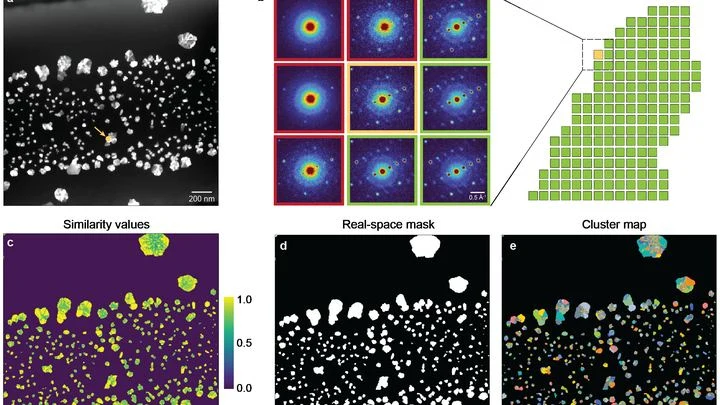
An electron microscope scans a sample and records how electrons scatter off atoms at each point. The result is a giant stack of images — one for every point. These images encode information about how atoms are arranged: in neat rows or with a tilt, the orientation of the crystal lattice, and whether there are internal strains.
Plasma in a fusion reactor is like a swarm of fireflies that you need to keep inside an invisible jar. It used to be thought that the jar's walls had to be perfectly smooth, or the fireflies would find a crack and escape. New work shows that the jar can be glued together from pieces with noticeable seams, and the swarm will still stay inside.
A handful of lead sulfide nanocrystals coated with charged molecules spontaneously assembles into a perfect crystalline lattice. Each nanocrystal is like a brick just a few nanometers across, while the charged molecules on its surface act as the mortar.