Disorder-inducedlocalization is a phenomenon where waves or particles stop spreading through a medium and instead become trapped in a small region, purely because of random imperfections in the material. In a perfectly ordered crystal, electrons or light waves can travel freely, but if you introduce impurities or irregularities, their paths can scatter so strongly that they cancel each other out, leaving the particle stuck. This effect, known as Anderson localization after physicist Philip Anderson, is one of the most fundamental mechanisms limiting how well materials conduct electricity or transmit light.
History
Philip Anderson introduced the concept in 1958 in his paper 'Absence of Diffusion in Certain Random Lattices', for which he shared the Nobel Prize in Physics in 1977.
How it works
When a wave travels through a disordered medium, it scatters off each imperfection. Normally, scattered waves interfere destructively and the wave continues on average. But in a strongly disordered system, the scattered waves can interfere constructively in a way that creates a standing wave pattern, effectively trapping the wave in a finite region. For particles like electrons, this means their quantum wavefunction becomes exponentially localized around a single point, so they cannot carry current. The key is that this happens even without any energy loss — it is purely an interference effect.
In practice
It is used to design materials with controlled conductivity, such as in semiconductor devices, and to understand why some disordered materials are insulators while others conduct.
Fun fact
Anderson localization was originally developed for electrons in dirty metals, but it also applies to light, sound, and even matter waves in ultracold atomic gases.
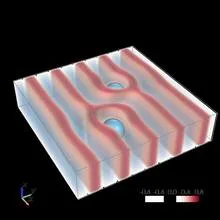
Layered polymers resemble a multi-story building where each floor is painted a different color, and sometimes cracks appear between floors. These cracks are dislocation pairs, which are periodic irregularities that spoil the material. Engineers have long sought ways to control such defects without rebuilding the entire structure.
Crystals fascinate us with their perfect spatial order: atoms frozen at lattice points, like beads on an invisible string. But what if the same symmetry unfolds in time? Time crystals are systems that, without any external cue, start repeating their states cyclically — clocks wound by nature itself. Inside this tireless rhythm, disorder seems to have no place.
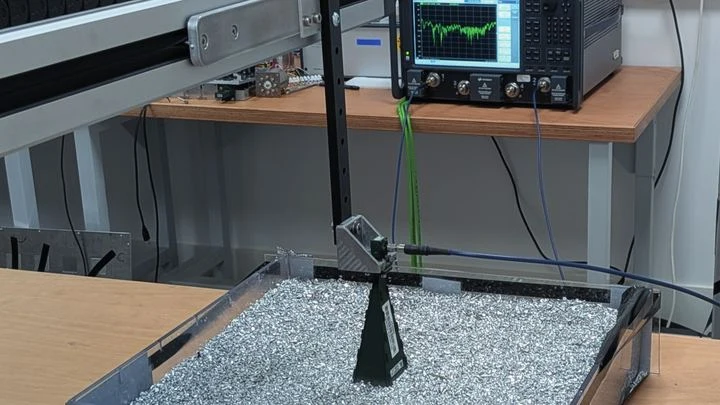
Physicists have achieved three-dimensional Anderson localization of electromagnetic waves — a phenomenon where waves become permanently entangled in a random labyrinth of metal particles and cease to propagate.
A crystal is like a row of soldiers on a parade ground: every atom is in its place, and electrons march through it in neat waves. An amorphous material is like a crowd at a train station, where there is no order, just a jostling throng. In such a crowd, an electron usually gets stuck quickly, like a person trying to push through a dense mass of people.
In a disk of gas and dust around a young star, dust particles behave like sand grains in a stream of water: the gas flows faster, the dust lags behind, and friction arises between them. This friction can rock the magnetic waves that run through the disk. The galaxy is full of such disks: it is precisely in them that planets are born.
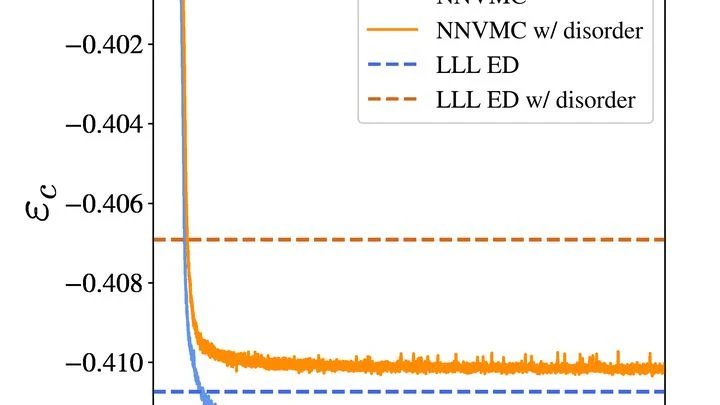
In a strong magnetic field, electrons trapped in a thin layer sometimes arrange into a regular pattern, like guests at a crowded party who find a spot where no one jostles them. This order is called a crystal, although it is not ice or salt, but the electrons themselves, frozen in place.
When light passes through a turbid medium, like a glass of milk or frosted glass, it scatters in all directions. But sometimes, instead of spreading out, it gets trapped in tiny 'pockets' inside the material. Physicists call these pockets localized modes: light falls into them as if into a trap and cannot escape.
A particle wanders through a medium scattered with obstacles. Sometimes it pushes them aside like a snowplow, and it was thought that this pushing is what eventually stops the motion. But in three-dimensional space, that mechanism doesn't work.
It turns out that stopping arises from rare events: every so often, a particle randomly finds itself in a trap, and all exits close, as if doors slam shut.
A thin wire made of a special material, a topological insulator, behaves like a city street: the interior is empty, and all traffic runs along the edges. Electrons in such a wire move only along the surface, like pedestrians on a sidewalk, never stepping onto the roadway.
In a tokamak, plasma is like a crowd on a narrow street: once someone starts running, everyone takes off at once. In a stellarator with a non-circular cross-section, the street is winding, with dead ends and pockets. The crowd can't gather into a single wave — people get stuck in different corners.
Terahertz radiation sits between microwaves and infrared light. It passes through clothing, paper, and plastic, but not through metal or water. That's why it's used in security scanners and medical imaging. To see the polarization of such radiation, you need a detector.
Toss a handful of pebbles into a stream: some settle on the bottom, others get swept around. That's roughly how waves behave in a disordered medium — light in frosted glass, sound in porous material. Usually, disorder slows things down: the wave gets stuck, spreads out, loses direction. But in a new study, physicists built an acoustic lattice where things work differently.
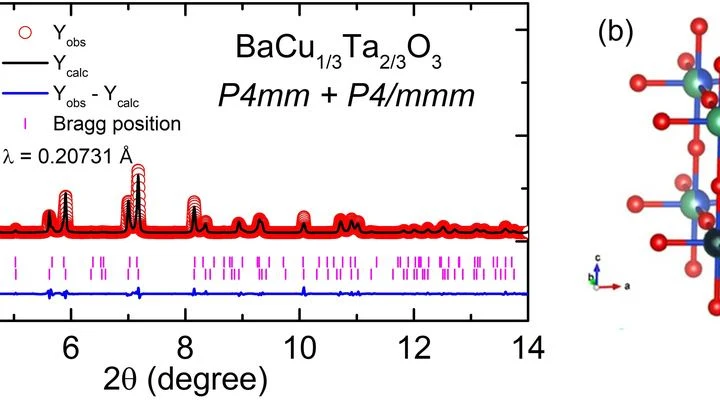
Atoms in a crystal usually sit in their designated spots, like passengers on a plane with assigned seats. But in this material, copper and tantalum have taken their places randomly, as if the tickets got mixed up. Scientists peered into the crystal using X-rays and saw that the disorder is not just on paper but in the actual arrangement of atoms.
Toss a handful of peas into a pot of semolina porridge — the peas quickly sink, pushing the grains aside. But if you make the porridge very thick and sticky, the peas get stuck. That's roughly how light lithium atoms behaved in a cloud of heavy potassium atoms at temperatures just a few millionths of a degree above absolute zero.
Sound in a thin plate behaves like ripples on water: it travels, reflects off edges, and changes shape. But sound has a peculiar trait: it can pass through places where waves are forbidden to exist. It's as if ripples on a pond suddenly vanished before a stone barrier and reappeared on the other side, without going around it.