Photonic crystaldefect modes are localized states of light or sound that exist within a photonic crystal—a material with a periodic variation in refractive index—when a structural imperfection is introduced. These defects break the perfect periodicity, creating allowed energy levels within the photonic band gap, where light or sound is normally forbidden. The result is that light or sound can be trapped at the defect site, confined to a tiny volume, and manipulated with high precision. This concept is fundamental to the design of optical cavities, waveguides, and filters that are essential for modern photonics and telecommunications.
History
The concept of photonic crystals and their defect modes was pioneered by Eli Yablonovitch and Sajeev John in 1987, who independently proposed that periodic dielectric structures could control light in ways analogous to how atomic crystals control electrons.
How it works
In a perfect photonic crystal, the periodic structure creates a band gap—a range of frequencies that cannot propagate through the material. When a defect is introduced, such as a missing rod or a change in spacing, it acts like a localizedperturbation that supports a mode within the gap. This mode is exponentially localized around the defect, meaning its energy is concentrated in a small region. The defect can be engineered to have specific properties, such as a particular resonance frequency or a chiral response, by controlling its geometry and material composition.
In practice
Defect modes are used in photonic crystal fibers, optical microcavities for lasers, and sensors that detect minute changes in refractive index, as well as in acoustic metamaterials for sound manipulation.
Fun fact
A single defect in a photonic crystal can trap light in a volume smaller than the wavelength of the light itself, enabling extreme light-matter interactions that are impossible in free space.
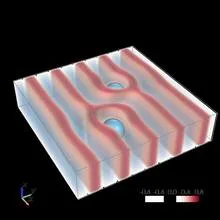
Layered polymers resemble a multi-story building where each floor is painted a different color, and sometimes cracks appear between floors. These cracks are dislocation pairs, which are periodic irregularities that spoil the material. Engineers have long sought ways to control such defects without rebuilding the entire structure.
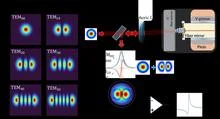
A string sounds perfectly pure until a draft touches it. That's roughly how a superradiant laser works: a beam of atoms, pre-charged with energy, flies through a room made of two mirrors — an optical resonator (a trap where light bounces back and forth).
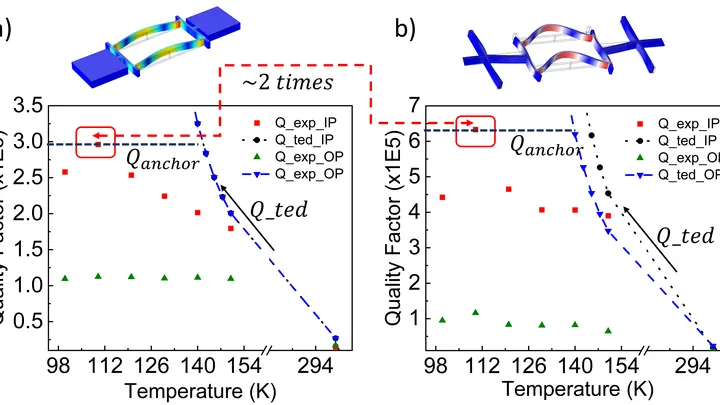
Imagine a long corridor with an uneven floor: bumps here, pits there. If you roll a toy car along it, it will get stuck in the deepest pit, not where you gave it a push. That's roughly how sound behaves in a phononic crystal — a material made of periodically arranged elements that controls the propagation of elastic waves.
A drummer beats a rhythm, and the drumhead vibrates in time. If you strike often enough, the vibrations overlap, and a nearly stationary zone, a node, forms at the center. A similar effect occurs with microwaves in a material whose properties change over time. When the changes resonate with the wave, its motion freezes.
Infrared light is invisible to the eye, but it's everywhere: from TV remotes to the heat of the human body. Catching it requires special materials. Conventional detectors are bulky, rigid, and not easily tuned to specific wavelengths.
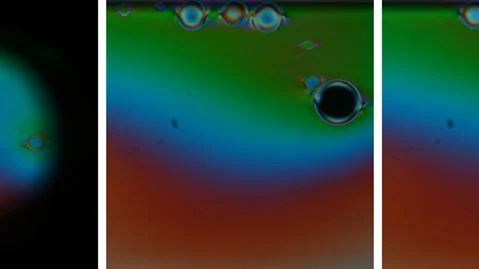
Molecules in a solution behave like a crowd in a square: they can jostle randomly or line up in neat rows. An aqueous solution of disodium cromoglycate is a well-known model for chromonic liquid crystals, where such 'rows' form spontaneously. But if you shine ultraviolet light on the solution, order collapses: molecules start breaking apart.
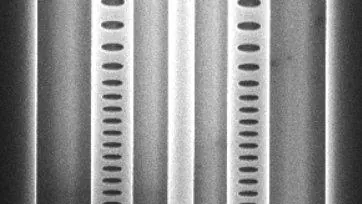
Sound in a solid is waves of compression and rarefaction rippling through atoms, like ripples across a spring mattress. If you place obstacles with just the right spacing, waves at certain frequencies can't pass: they bounce back. Such a periodic structure is called a phononic crystal, and it works for sound the way a multilayer mirror works for light.
In a metal crystal, atoms line up in neat rows like bricks in a wall. Knock out a single brick, and you're left with a void — what scientists call a vacancy. Under irradiation, these voids multiply and start merging into large holes, sapping the metal's strength. It's like holes in a brick wall joining up into a gaping breach.
Light can get stuck inside tiny structures, like sound in a perfectly tuned bell: the energy does not escape, even though there are no walls around. Such states are called 'bound states in the continuum'—light is trapped but not confined in a box. Until now, they were produced in ordinary crystals, where left and right directions are indistinguishable.
In the world of microchips, where streams of photons, quanta of light, carry information, a fundamental problem arises: light passing through matter inevitably heats it. This heating spawns thermal fluctuations — chaotic, unpredictable jostling of atoms that disrupts precise device operation.
Tuning a string: higher harmonics help hold the pitch without drowning out the fundamental note. In an optical microcavity, a tiny resonator made of two mirrors, light bounces between the reflective surfaces, and any jitter in the spacing knocks it off resonance.