The Crystal That Is Its Own Magnet ✛
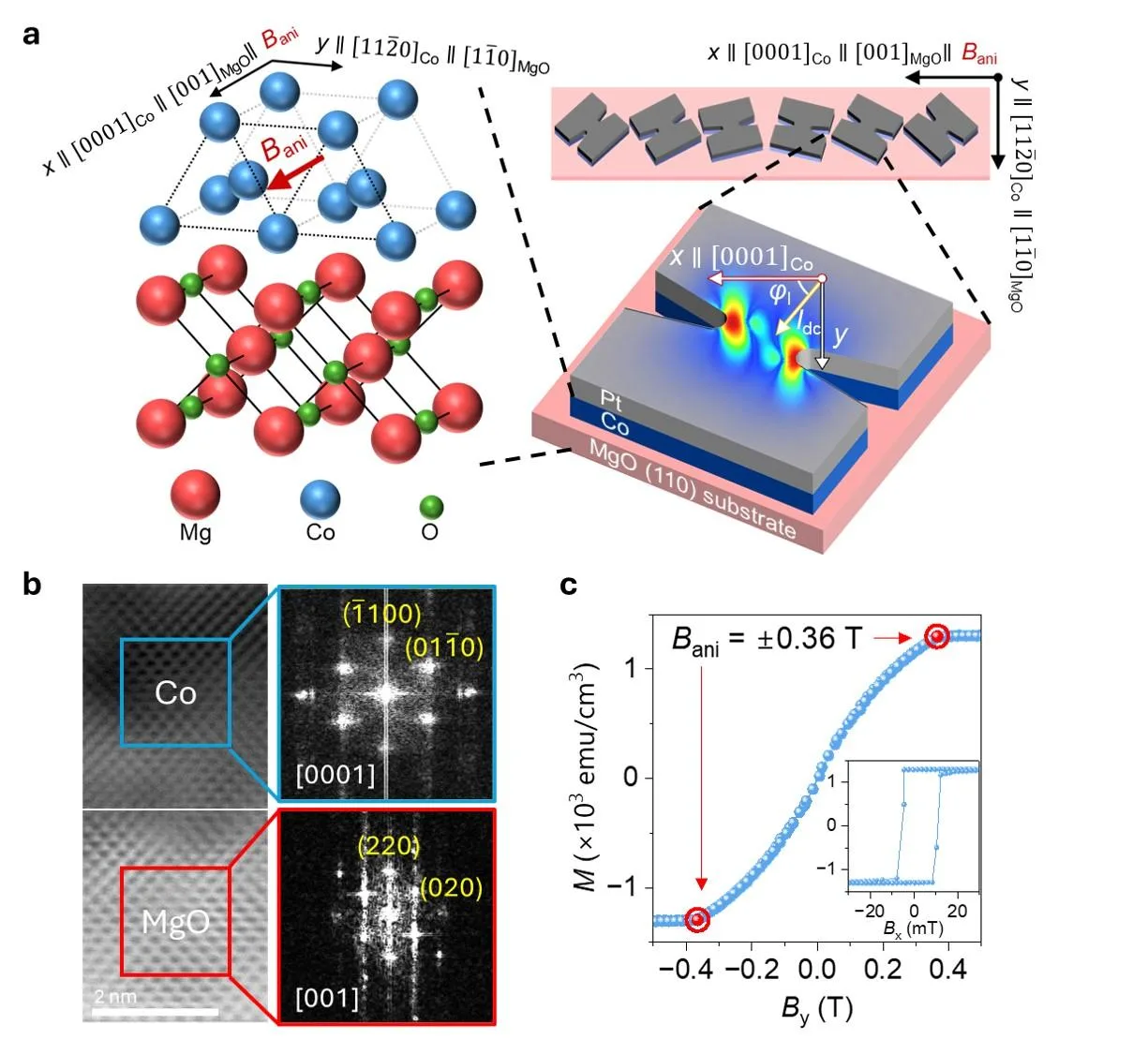
A tiny microwave generator is like a compass whose needle always points in one direction. Previously, such generators could not work without an external magnet: it was the magnet that set a common direction for all the elements. Without a magnet, the oscillations fell apart.
Scientists grew a cobalt film on a substrate so that the crystal lattice itself became a magnet. It creates a field that holds the magnetization in the required direction. This field turned out to be 7000 times stronger than Earth's magnetic field. Now the generator works without an external magnet and delivers frequencies above 10 GHz.
Such a generator can be used in chips that mimic the work of neurons, and in communication devices where bulky magnets have no place.
The anisotropy field of 0.36 T is about 7000 times stronger than Earth's magnetic field, and the auto-oscillation frequency above 10 GHz falls in the range used by radars and satellite communications.
The idea of tunable oscillators without an external field echoes the concept of 'neuromorphic chips' from William Gibson's novel Neuromancer, where computing networks mimic biological neurons.