Microwaves in this context are electromagnetic radiation with frequencies typically between 30 and 60 GHz, a band that is crucial for both astrophysical observations and quantum technology. In astrophysics, this frequency range is used to study cosmic microwave background radiation, molecular clouds, and the emission from various celestial sources. In quantum computing, microwaves are the control signals that manipulate superconducting qubits, driving transitions between their energy levels.
History
The use of microwaves in quantum computing dates to the early 2000s with the development of superconducting qubits, while their astronomical application began with the discovery of the cosmic microwave background in 1965.
How it works
Microwave photons carry energy that matches the energy splitting between qubit states (typically a few gigahertz). By applying resonant microwave pulses, researchers can rotate the qubit state on the Bloch sphere. In astrophysics, microwave detectors measure the faint thermal radiation from cosmic sources, revealing their temperature, composition, and motion via Doppler shifts.
In practice
Microwaves are used in superconducting quantum processors for gate operations and readout, and in radio telescopes to map the universe's microwave emissions.
Fun fact
The cosmic microwave background, a faint microwave glow from the Big Bang, has a peak frequency around 160 GHz, but ground-based observatories often observe at lower frequencies to avoid atmospheric water vapor absorption.
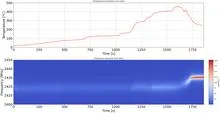
A tantalum film two hundred nanometers thick sits on a quartz substrate. Within it lies hidden future light: if you heat the metal properly, it turns into a transparent oxide through which light from an implanted LED can pass. The problem is that conventional heating methods are either too harsh or too slow.
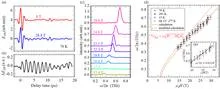
A taut string sounds higher when you pull it tighter. Magnetization in an antiferromagnet behaves similarly: the stronger the external field, the faster it oscillates. But in chromium oxide crystals, something goes awry.
In fields from 20 to 30 tesla, the resonance frequency grows more slowly than it should.
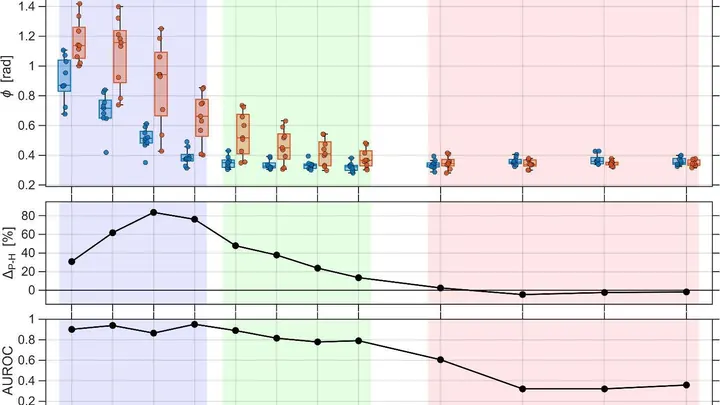
A bowl of jelly trembles but holds its shape when given a gentle shake. Thick syrup, in response to the same motion, sloshes and spreads. A healthy liver is like jelly, but an inflamed one at low frequencies becomes more like syrup.
Researchers built a device that shakes the liver at twelve different frequencies — from five to eighty oscillations per second.
At the heart of a dying star, as its core collapses into a neutron sphere, an invisible storm is born. Trillions of neutrinos, particles that barely interact with matter, race through the scorching plasma. There are so many of them that they begin to influence each other, changing their 'flavors' (electron, muon, tau) like chameleons.
A bell rings not from the strike but from a fleeting shudder of space. A gravitational wave, like ripples on a pond, passes through a massive magnet, and it deforms ever so slightly. That deformation can be turned into an electrical signal.
The enigma of fast radio bursts (FRBs) is not just a question of 'what exploded?' It’s a drama of energy transfer under extreme conditions, where the slightest stumble leads to collapse.
Pulsars are dead stars spinning with flawless rhythm. Their radio blips are more precise than atomic clocks. However, gravitational waves — ripples in the fabric of spacetime, predicted by Einstein — disrupt that rhythm.
A fundamental string plucked at the moment of the Big Bang doesn't just hum a single note — waves run along it, and occasionally tiny loops peel off. These loops, like tuning forks, begin to ring at their own frequency, producing a very high-pitched sound.
An ordinary camera captures light reflected from objects and builds a picture from it. But if the object is hidden behind an obstacle or does not reflect light, radio waves come to the rescue: they pass through walls and fog, and a computer reconstructs the image from scattered signals.
Quantum computers and sensors operate at microwave frequencies, but transmitting their signals over long distances is conveniently done via optical fibers, which use light.
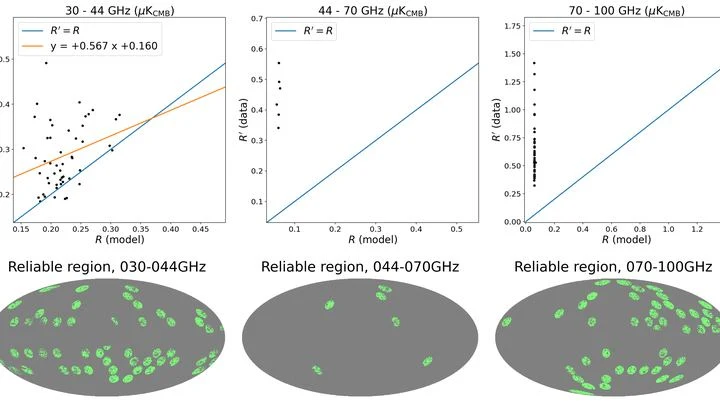
Astronomers are trying to capture the radio echo of the Big Bang — a faint glow that fills the entire universe. But the receiver is choking with noise: our Galaxy is packed with glowing interstellar dust, whose emission can easily be mistaken for a signal from the distant past.
You can squeeze light between two mirrors like a spring in a vise. It bounces back and forth, growing denser: that's how you get ultra-bright beams. But there's a limit: at too high a brightness, the mirrors start to shake. The light rocks them the way wind rocks a swing, and some energy leaks into that jitter.
In the Coma galaxy cluster, about 320 million light-years away, an invisible cloud stretches out. It shines in the radio band: this is a radio halo, a giant collection of charged particles accelerated to nearly the speed of light.
Any device, from a toaster to a smartphone, heats up when operating. This is the inevitable result of energy conversion — there's always a heat trace left, like a hot stove burner after cooking.
The Moon is not just a rocky sphere, but a giant bell. Passing through it, gravitational waves cause it to vibrate almost imperceptibly. This tremor was predicted by Einstein, and Weber was the first to try to hear it with Earth-based detectors.