Crystal anisotropy drives oscillators without an external field ✛
Context
The work sits on the outskirts of the neighborhood map: almost no one nearby, with the nearest neighbor at a distance of 0.517. The thematic group of neighbors is quantum algorithms, error correction, quantum information and quantum computers, but this article is not about quantum computing; it is about spintronic oscillators. Much has already been done around controlling magnetization dynamics: resistance draws the secret angles of the magnetic dance, superconducting resonators demonstrate the effects of small currents, a string changes stiffness in chromium oxide, gravitational-wave polarization reveals patterns of space, spin from bending twists sound, sound in a crystal becomes more precise than quartz, the spin signature of a black hole shows up in polarization ripples, and a microwave oven for a proton holds spin automatically. All these works in one way or another concern the control of oscillations, spins or waves, but none solves the problem of field bias for spin Hall nano-oscillators. This article fills the gap: it shows how the crystal anisotropy of epitaxial Co/Pt creates a built-in field sufficient for auto-oscillations without an external magnet.
Methods
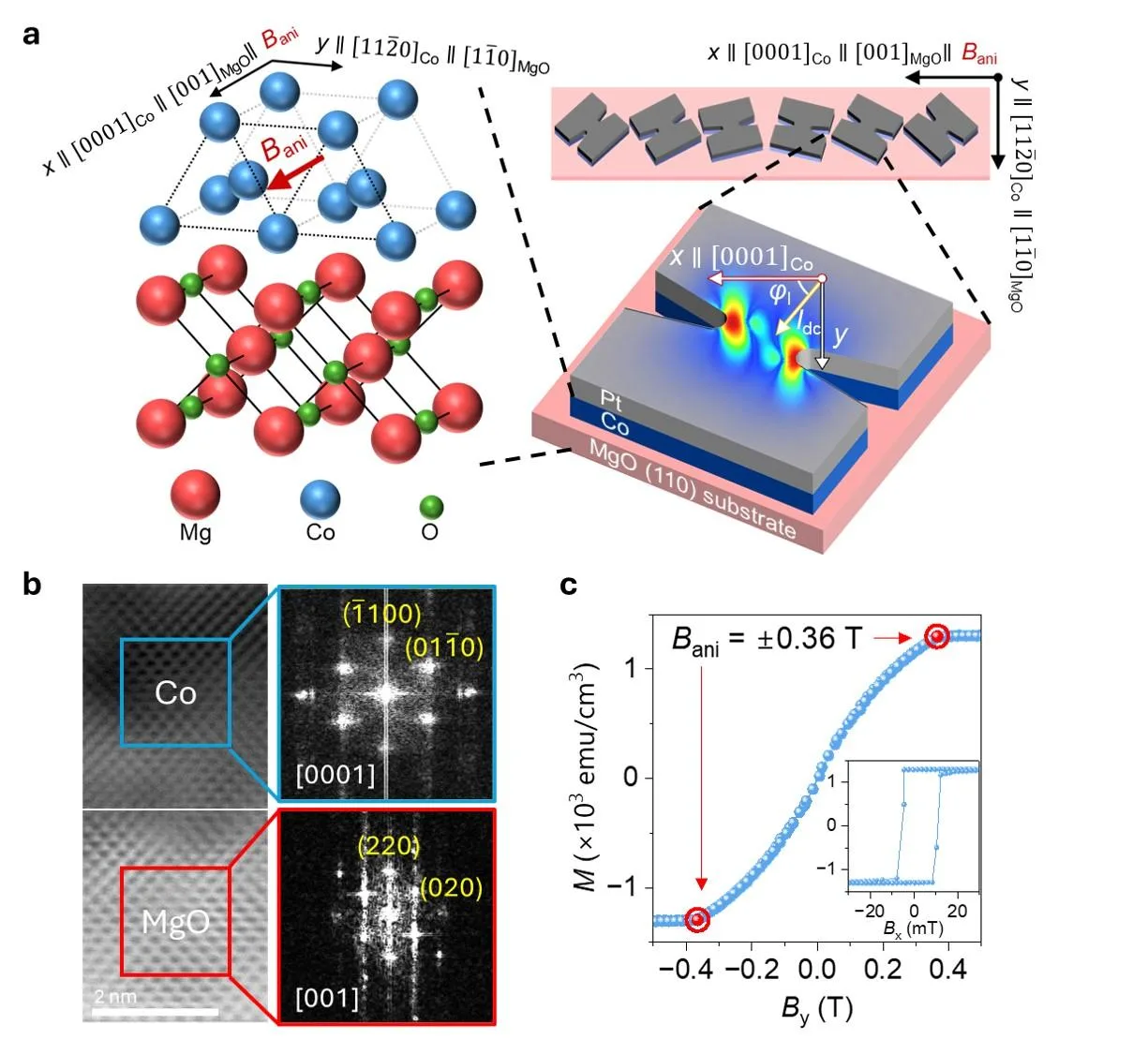
Co(8 nm)/Pt(8 nm)/AlOx(2 nm) films were grown by magnetron sputtering on an MgO(110) substrate in ultrahigh vacuum. The substrate was annealed at 850 °C in oxygen to obtain an atomically smooth surface. Cobalt was deposited in two stages: 4 nm at 250 °C and 4 nm at room temperature, to ensure epitaxial growth with the c-axis in the plane. The structure was confirmed by transmission electron microscopy with fast Fourier transform. Nanostructures with a 150 nm wide constriction and a 50 nm radius were fabricated by electron-beam lithography and ion etching. Magnetic hysteresis loops were measured on a vibrating sample magnetometer. Dynamics were studied by spin-torque ferromagnetic resonance (STFMR) and micro-focused Brillouin light scattering (µ-BLS) with a 532 nm laser and a 300 nm spot. Micromagnetic simulations were performed in MuMax3 with parameters from the experiment.
Results
The anisotropy field from the hysteresis loop was 0.36 T, and from fitting the resonance frequencies with the Kittel formula it was 0.337 T, confirming that the crystal anisotropy is preserved after lithography. At zero external field and remanent magnetization along the x-axis, auto-oscillations appeared above a current threshold and remained at frequencies above 10 GHz. Reversing the direction of the remanent magnetization changed the polarity of the current at which oscillations arise. Micro-focused BLS showed that the intense mode f1 is localized in the constriction region, while the weaker and broader mode f2 is distributed over the device and is close to ferromagnetic resonance. The threshold current decreased with increasing angle between the current and the anisotropy axis, following the law Ith = Ith,0 / sin φI. At angles of 105°, 120° and 135°, two spectral branches gradually merged into one dominant branch, indicating mutual synchronization of edge modes. Current pulses of 70 µs duration in the presence of an auxiliary field switched the remanent magnetization, and extrapolation of the switching boundaries gave zero fields at currents of ±17 mA. Micromagnetic simulations reproduced switching at zero field and higher current density.
Implications
The work differs from its neighbors in that it uses the crystal anisotropy of an epitaxial film as a built-in source of effective field, rather than an external magnet or a complex heterostructure. Neighboring works in spintronics and magnonics investigate resonances, polarization or automation, but do not offer field bias integrated into the material itself. Here it is shown for the first time that the epitaxial symmetry of Co/Pt gives a field of 0.36 T, sufficient for auto-oscillations above 10 GHz without an external field, and at the same time provides nonvolatile switching of the state via remanent magnetization. This is a step toward locally programmable oscillator arrays, where each element carries its own bias and can be initialized independently.
Future development
Further development may go toward reducing the constriction size to increase current density and lower the switching threshold, in order to achieve fully field-free programming. It is also promising to combine many oscillators into networks, where dipolar or spin-wave interaction will allow the creation of collective states encoding computational variables. Controlling the angle between the current and the crystal axis opens the way to gradient arrays with different thresholds and frequencies on a single chip.
Impact
The results will influence the development of neuromorphic computing systems, microwave generators for wireless communications, and oscillator Ising machines, because they eliminate the need for external magnets and allow local switching of elements.
Next steps
The immediate steps include fabricating nanoconstrictions with improved current endurance to test fully field-free switching and creating arrays of several oscillators to study mutual synchronization without an external field.
Key open problems
The work connects to the unsolved problem of scalability of spintronic oscillators: how to provide individual control of elements in a large network without a global magnetic field. Crystal anisotropy offers a local solution, but questions remain about the stability of remanent magnetization at high currents and the reproducibility of epitaxial growth on industrial substrates.
The knowledge machine's view
This section is addressed to the author of the paper and their colleagues. Neighbouring works were found by meaning-based search across our archive, not by word overlap. We do not review: we show the field around the work.
What the work does
The work demonstrates how an epitaxial cobalt layer on MgO(110) generates an anisotropy field of 0.36 T, sufficient for auto-oscillations above 10 GHz in zero external field. Controlling the angle between the current and the crystal axis, as well as the direction of the remanent magnetization, allows tuning the threshold and polarity without an external magnet.
Where its strength is
The built-in anisotropy field replaces external bias, paving the way to locally programmable oscillator networks. The demonstration of switching current polarity by the direction of the remanent magnetization provides a concrete mechanism for field-free control.
Where it could go next
- It might be interesting to look at the interaction of such oscillators with mechanical resonators: in our archive there is a nearby work on a duet of graphene and silicon nitride, where two strings exchange vibrations. Transferring this approach to magnetic oscillators could yield new ways of synchronization or readout.based on: Graphene and Silicon Nitride: Two Strings in Perfect Duet arXiv:2608.16372v1
- For integration into neuromorphic networks, it is useful to consider automatic stabilization of the operating point: the archive contains an analysis of microwave control of a proton spin with feedback. A similar scheme could maintain auto-oscillations under changes in temperature or current.based on: A Microwave for the Proton: How Automation Keeps the Spin arXiv:2604.10447
- The idea of local programming of networks echoes the work on a neuron made of light and motion, where an optical implementation of a neuromorphic element is proposed. Perhaps combining optical readout with magnetic oscillators will provide a fast interface for such networks.based on: A Neuron Made of Light and Motion arXiv:2601.11857
Worth trying
- Check whether synchronization is preserved when the direction of the remanent magnetization is changed in an array of oscillators.
- Use µ-BLS to map the spatial mode profile when the current polarity is switched.
- Assess the effect of temperature on the anisotropy field and, consequently, on the auto-oscillation frequency.
Why this may matter
Field-free spin-Hall nano-oscillators with switchable polarity could become the basis for energy-efficient neuromorphic chips, where each element is programmed locally without external magnets.
Nearby works in our archive
- How Sound in a Crystal Became More Precise Than Quartzsimilarity 0.50
- How Gravitational Wave Polarization Reveals Hidden Patterns of Spacesimilarity 0.49
- Magnetic Mosaic: How Aperiodic Patterns Trap Quantum Wavessimilarity 0.48
- Uneven Tunnel Chain: How Gravity Rewrote the History of the Early Universesimilarity 0.47
- Heavy seed in a magnetic cocoonsimilarity 0.47
- A Microwave for the Proton: How Automation Keeps the Spinsimilarity 0.47
- A Neuron Made of Light and Motionsimilarity 0.46
- Graphene and Silicon Nitride: Two Strings in Perfect Duetsimilarity 0.46
The archive is sparse around this work: the closest review is only 0.50, against a usual 0.64. It looks like few have drilled nearby.
The anisotropy field of 0.36 T is about 7000 times stronger than Earth's magnetic field, and the auto-oscillation frequency above 10 GHz falls in the range used by radars and satellite communications.
The idea of tunable oscillators without an external field echoes the concept of 'neuromorphic chips' from William Gibson's novel Neuromancer, where computing networks mimic biological neurons.
Key numbers
- Anisotropy field: 0.36 T
- Auto-oscillation frequency: above 10 GHz
- Constriction width: 150 nm
- Threshold current at zero field (extrapolation): ±17 mA
- Switching pulse duration: 70 µs