Magnetization is the vector field that quantifies the density of magnetic moments in a material, indicating how strongly a region is magnetized. It defines the magnetic state of a material, whether ferromagnetic (like iron), paramagnetic, or diamagnetic. Understanding magnetization is essential for designing magnets, data storage, and interpreting magnetic fields in astrophysical and laboratory plasmas.
History
The concept of magnetization was developed in the 19th century, with key contributions from James Clerk Maxwell, who unified electricity and magnetism, and later by Pierre Curie, who studied the temperature dependence of magnetic susceptibility.
How it works
Magnetization arises from the alignment of atomic or electronic magnetic moments, which can be intrinsic (electron spin) or orbital (electron motion). In ferromagnetic materials, exchange interactions align moments in domains, and an external field can reorient these domains, producing a net magnetization. The response of magnetization to an applied field is described by susceptibility, which varies with temperature and material structure.
Two dancers on one stage: one pulls the partner in one direction, the other in the opposite. In the crystal Cu2(OH)3Br, known as botallackite, copper atoms form chains where the spins (magnetic moments) of neighboring ions align either parallel, as in a ferromagnet, or antiparallel, as in an antiferromagnet.
An orchestra without a conductor can sound harmonious if the musicians feel the common rhythm. In the world of solids, phonons play that role: quanta of crystal lattice vibrations. When atoms in a substrate start moving in circles, they can transfer their rotation to a magnetic layer on top and flip its magnetization.
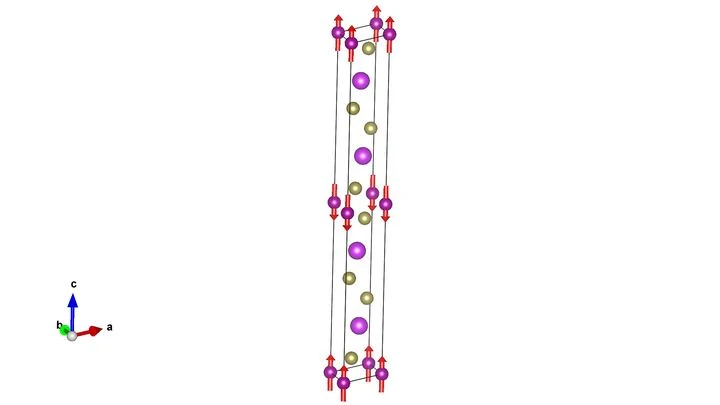
In the layered crystal CrSBr, the magnetic moments of atoms are arranged like notes in a score: within each layer they point in the same direction, but between layers they point in opposite directions. This antiferromagnetic melody plays up to 132 kelvin, beyond which thermal motion destroys the order.
Inside a solar flare, magnetic field lines snap like stretched rubber bands and reconnect — releasing in minutes enough energy to power humanity for millions of years. In the lab, this process, magnetic reconnection, could long be triggered but not stopped. Now physicists have a switch.
The magnetic framework of the EuMnSb2 crystal resembles scaffolding: manganese atoms form rigid vertical pillars, while europium atoms act as movable crossbars. Until now, there was no consensus on the angle at which these crossbars rest and how they rotate when a magnetic field presses on the scaffold.
Electricians working with high voltage are like divers: they need to see what's happening deep underwater without going down themselves. What's needed is a sensor that stays away from the dangerous current and relays information to the surface. Usually, light is used: a beam passes through a transparent crystal, and the electric field slightly rotates it.
Ion current through a membrane is like a queue at a turnstile. Sometimes the turnstile is free — ions pass through quickly. Sometimes it gets stuck — the flow drops. A weak magnetic field, it turns out, doesn't push ions from behind; it simply changes the number of open turnstiles.
An inflatable balloon with magnetic field lines drawn on it with a marker is a simple model of how a weak magnetic field behaves in an expanding universe. While the balloon is small, the lines lie obediently on the rubber and don't hinder its stretching. That's roughly how a field fills ready-made space without arguing with its geometry.
In the vast clouds of rarefied gas that fill the space between stars, something is always churning. Supernova explosions, colliding streams — all of it shakes the plasma. And in this rippling, as it turns out, hides the mechanism that gives birth to magnetic fields.
Plasma is a gas in which electrons are stripped from atoms.
In the world of magnetism, a simple dichotomy long reigned: ferromagnets, where spins point in one direction, and antiferromagnets, where they line up in a checkerboard pattern, canceling each other out. But a recent 'third player' — altermagnets — forced a rewrite of the rules.
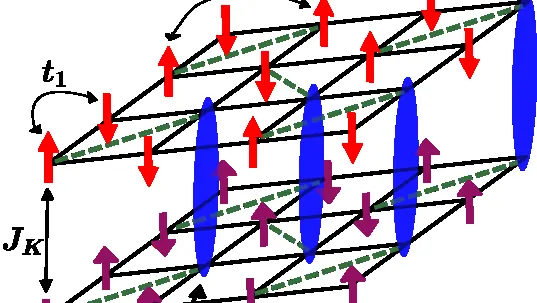
Inside a crystal, an invisible ballet unfolds: the magnetic moments of atoms, like dancers, sometimes align in unison, sometimes scatter in antiphase. The choreography is dictated by quantum exchange — music sensitive to the geometry of bonds.
Deep underground, iron glows white-hot, and the pressure is so intense that an ordinary instrument would be crushed flat. To peer into this world, physicists built a special microscope based on tiny diamond defects (so-called NV centers).
In the pitch darkness of a vacuum chamber, a tiny magnet floats. It touches no walls and loses almost no energy — an ideal sentinel, ready to catch the faintest nudge. Such a sentinel is exactly what you need for axion hunting. These particles are prime suspects in the case of the Universe's hidden mass, which we call dark matter.
Red giants are swollen, aging stars. Deep inside, an ocean of plasma churns: heat forces its way from the core to the surface, generating waves like a mighty surf. The star's magnetic field acts like an invisible seabed – it steers these waves, changing their height and speed.
Two teams pull a rope with equal force in opposite directions — the rope doesn't move, and the net force is zero. That's how many antiferromagnets behave: the magnetic moments of atoms are aligned oppositely and cancel each other out.
Two magnets on a table either attract or repel — depending on how their poles are oriented. Inside each piece hide tiny regions where all the magnetic arrows point in the same direction. These regions are called domains, and their arrangement determines how the material behaves in an electrical circuit.
In altermagnets, a new class of materials, domains are trickier.
In the first moments after the Big Bang, the universe was a boiling cauldron. But then, according to a new hypothesis, it suddenly cooled dramatically — far more than previously thought. In this icy world, dark matter particles, like tiny pendulums, froze and did not begin their oscillations.
The magnetic field increases, but the magnetization stays put. It's like a scale where you add weight, yet the needle doesn't move until enough has accumulated to jump to the next mark. That's exactly how rare-earth tetraboride crystals behave, and physicists have been puzzled for decades.
A vast, dark cloud of gas stretched across the young universe. Inside it, like invisible fingers, magnetic field lines left over from the very birth of the cosmos threaded through. These fields act on charged particles, pushing them together, like a gentle breeze gathering fallen leaves into piles.
Biologists often tag cells with glowing molecules — it's like searching for a dim light in the smoke. The light quickly fades, and the smoke creates interference.
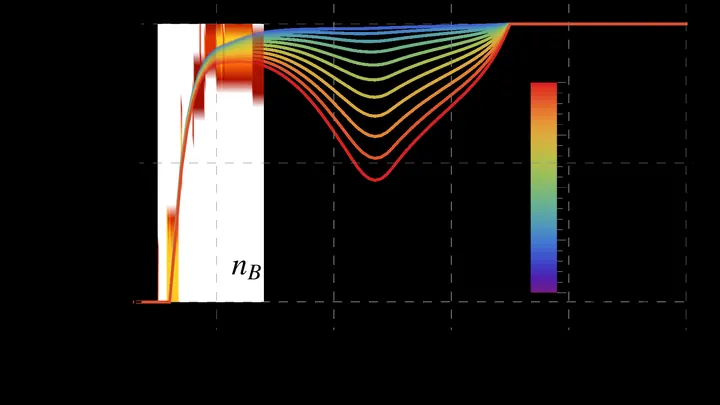
The magnetic refrigerator of the future won't hum with a compressor. Instead, it will cool your groceries by exploiting a special material that heats up in a magnetic field and cools down when the field is removed. This cycle resembles the compression and expansion of gas in a conventional fridge, but here a magnet does the work of a piston.
You can make a light beam look like a flower with several petals. If you send such a beam through a cloud of cold rubidium atoms and switch on a magnetic field, the petals start to rotate. The angle of rotation is directly linked to the field's strength.
The atomic nucleus is not just a ball of protons and neutrons. Inside it, like a tiny magnet, there is its own distribution of magnetization. Until now, it has been difficult to see: nuclei live for tiny fractions of a second, and their magnetic field is weak. Now physicists at CERN have found a way to look inside.
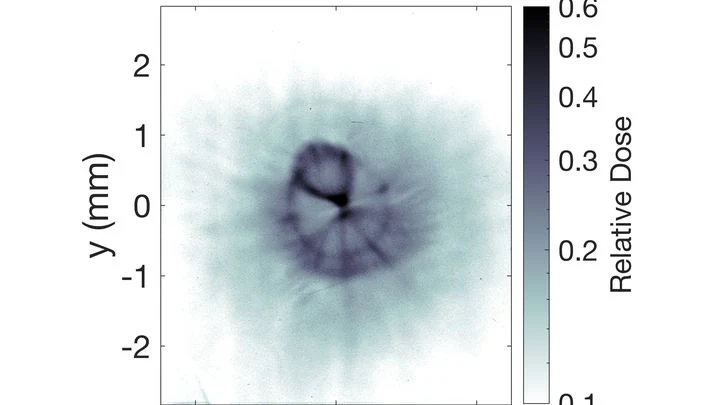
A powerful laser strikes a tiny target, and it instantly turns into a cloud of scorching gas — plasma. Within this cloud, magnetic fields spontaneously arise. Like invisible hands, they prevent heat from freely escaping the hot core.
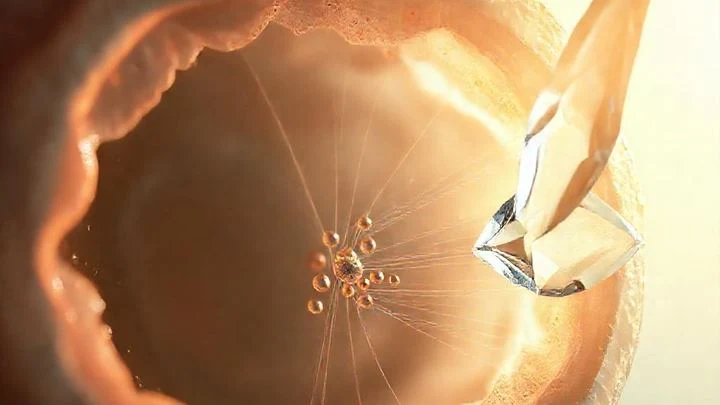
Deep inside every hard drive or flash drive lies a material that can 'remember' an electric field. Such a material is called a ferroelectric. When you apply a voltage, tiny regions inside the crystal (domains, like compass needles) flip. Flip the needle one way, you've written a one; flip it back, a zero. But what happens to the atoms at the moment of that flip?
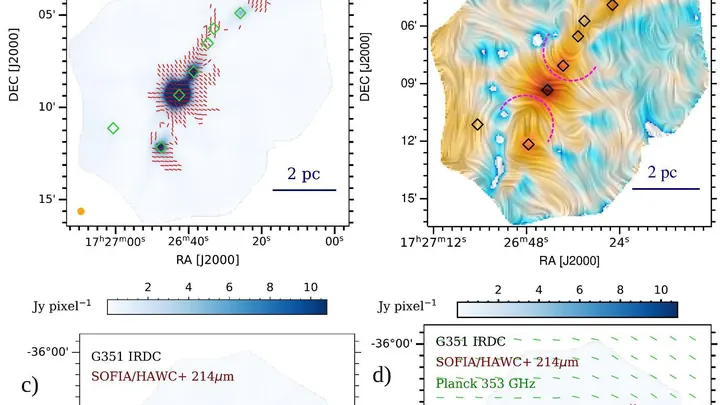
In the dark cloud G351, where new stars are about to emerge from gas and dust, the magnetic field has bent into an hourglass shape. Such a shape is a sign that the field is not just watching star birth from the sidelines but is actively taking part.
Scientists used the SOFIA telescope, mounted on an airplane, to see the dust in the cloud.
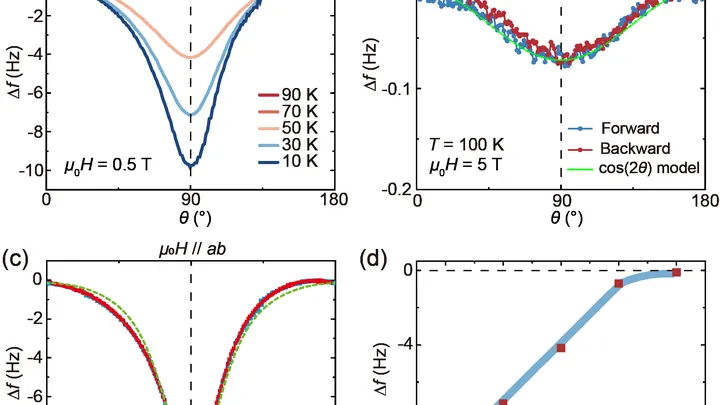
A magnet, like a compass needle, likes to point in a certain direction. But what if the material is layered, like a stack of pancakes? Scientists took just such a magnet made from a compound of chromium, germanium, and tellurium and set out to find out how stubbornly it resists having its magnetization turned.
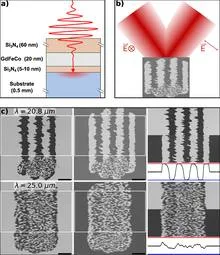
Magnetic moments in a crystal are like compass needles fixed at lattice sites. In the normal state, they line up in neat order, but if an electromagnetic wave strikes the crystal, the needles start to sway, like wheat stalks in the wind. These oscillations are called magnons, and they carry energy without the atoms themselves moving.
A white dwarf is what remains of a star like the Sun after it sheds its outer layers. What's left is a hot core the size of Earth but with a mass close to that of the Sun. A teaspoon of this material would weigh as much as a truck. Some of these stars have extremely strong magnetic fields — a billion times stronger than Earth's.
An ordinary superconductor expels magnetic fields, but this ring does the opposite: it creates a magnetic field inside itself. The ring is made of Fe(Te,Se) — a compound of iron, tellurium, and selenium that loses its electrical resistance at very low temperatures.
In laboratories where atoms are cooled to near absolute zero, even a tiny change in the magnetic field throws off all the settings. Conventional sensors, Hall plates or coils with ferrite cores, sit a few centimeters away from the vacuum chamber because they themselves create interference.
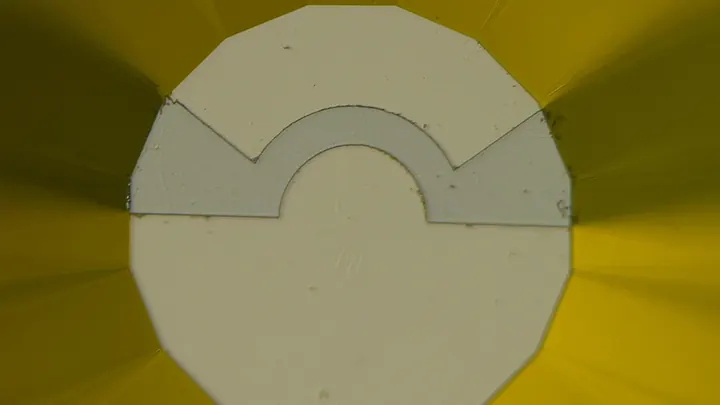
A beam of charged particles, like a fine pen, draws an invisible pattern on a metal film. Where it touches, the material changes its internal atomic order: from a close-packed arrangement, like a pyramid of oranges in a crate, the atoms rearrange into a looser one, like cubes stacked in a box.
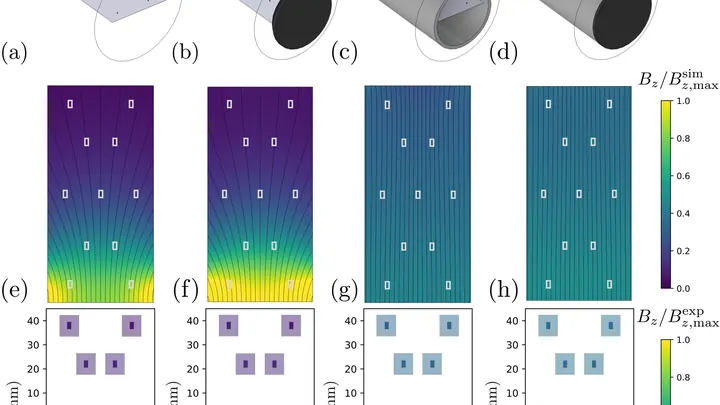
A magnetic field is like a shadow cast by an object: it changes with the shape of the source. But if you put a lens in the path of light, you can alter the shadow. Here, the authors devised a 'lens' for magnetic fields — an assembly of ordinary materials with different magnetic permeabilities (their ability to let the field through).
In its first moments, the universe resembled dough that alternately rises rapidly and then pauses for a second. During these short bursts, called expansion of the universe with interruptions, even tiny magnetic fields could have grown like bubbles in well-beaten dough.
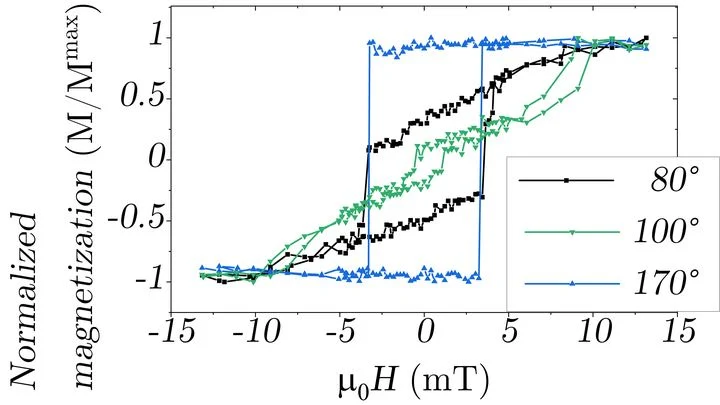
An ordinary magnet can be imagined as a row of soldiers all facing the same direction. An antiferromagnet is arranged differently: neighboring 'soldiers' face opposite directions, but the row as a whole remains ordered. Flipping such a row is difficult: it doesn't respond to weak external fields.
Two stars orbit so closely that their outer layers merge into a shared envelope. Matter flows from one to the other, like water spilling from an overfull cup into its neighbor. In this cosmic dance, where stars literally touch each other, astronomers have for the first time detected magnetic fields in large numbers.
A magnetic field is invisible, but you can make it 'glow'. To do that, take a tiny diamond with defects — places where a carbon atom is replaced by nitrogen and a neighboring lattice site is vacant. These defects, like sensitive compass needles, respond to the slightest changes in the magnetic field and emit light of varying brightness.
An ordinary magnetic compass freezes when lightning strikes nearby. A sudden jump in the magnetic field throws the needle off. A similar problem has been hindering scientists trying to measure magnetism in strong pulsed fields: those that switch on for a thousandth of a second.
The new setup tackles this with a laser beam.
Metals are full of free electrons: they dart between atoms like a swarm of bees around a hive. If you poke such a metal with a thin magnetic filament, the electrons start to feel its field. A new calculation shows they don't just go around the field; they trap it inside, like a cork sealing water in a bottle.
A compass needle always points north because inside the material, all the atomic magnets are aligned in one direction. But there are materials where neighboring atoms face opposite ways, like rows of soldiers turned to face each other. Such materials are called antiferromagnets.