A magnetic compass built into a crystal ✛
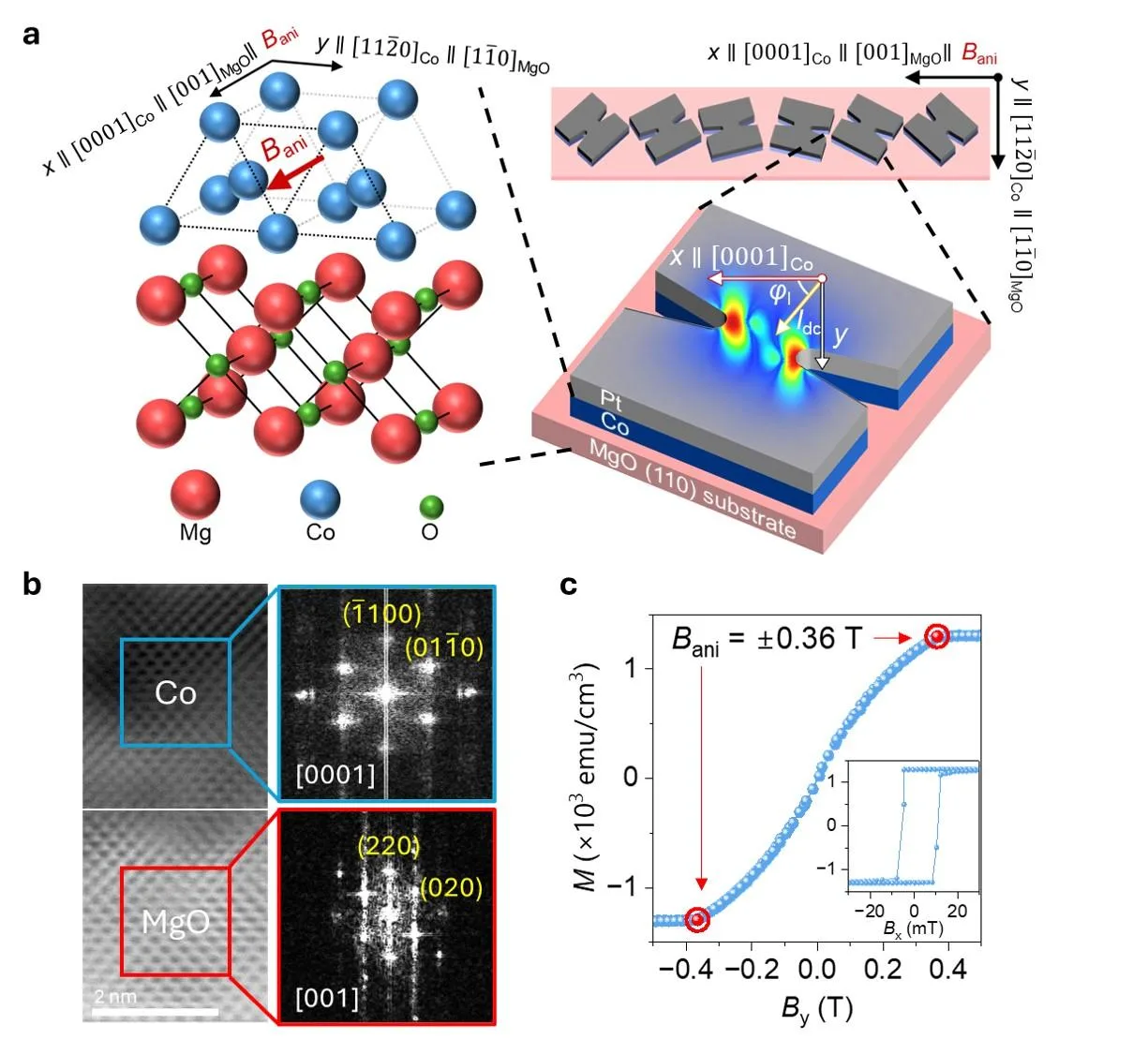
Every oscillator carries its own compass, built into the crystal lattice. Until now, spin Hall nano-oscillators, tiny microwave sources driven by spin current, could not do without an external magnet: it was the magnet that set the common axis around which the magnetization oscillated. Without such a magnet, all the elements in an array lost their common alignment, and with it their ability to synchronize.
The authors grew an epitaxial layer of hexagonal cobalt on an MgO(110) substrate so that the easy magnetization axis lay in the plane of the film. The crystal lattice itself became a magnet: it produces an anisotropy field that holds the magnetization in the desired direction. This field was measured from the hysteresis loop, giving 0.36 T, while a check against the resonance frequencies gave 0.337 T. After lithography, the anisotropy survived.
At zero external field and with remanent magnetization along the x axis, auto-oscillations appeared above a current threshold and stayed at frequencies above 10 GHz. Reversing the direction of the remanent magnetization flipped the polarity of the current at which oscillations arise. The oscillator switches without an external magnet: the direction of the built-in compass determines which current will start the generation.
Micro-focused Brillouin light scattering showed that the intense mode is localized in the waist region, while a weaker and broader mode is spread across the device. At angles of 105°, 120° and 135° between the current and the anisotropy axis, two spectral branches merged into one dominant branch, which points to mutual synchronization of the edge modes. The threshold current decreased as the angle grew, following the law Ith = Ith,0 / sin φI.
Now every oscillator carries its own compass, built into the crystal lattice. No external magnet is needed anymore, and the direction of the remanent magnetization can be switched with current pulses. This opens the way to locally programmable oscillator networks for neuromorphic computing and microwave generators, where external magnets are unacceptable and independent control of the elements is required.
The anisotropy field of 0.36 T is about 7000 times stronger than Earth's magnetic field, and the auto-oscillation frequency above 10 GHz falls in the range used by radars and satellite communications.
The idea of tunable oscillators without an external field echoes the concept of 'neuromorphic chips' from William Gibson's novel Neuromancer, where computing networks mimic biological neurons.