El baile desacompasado de dos planetas en torno a TOI-4495 exprés
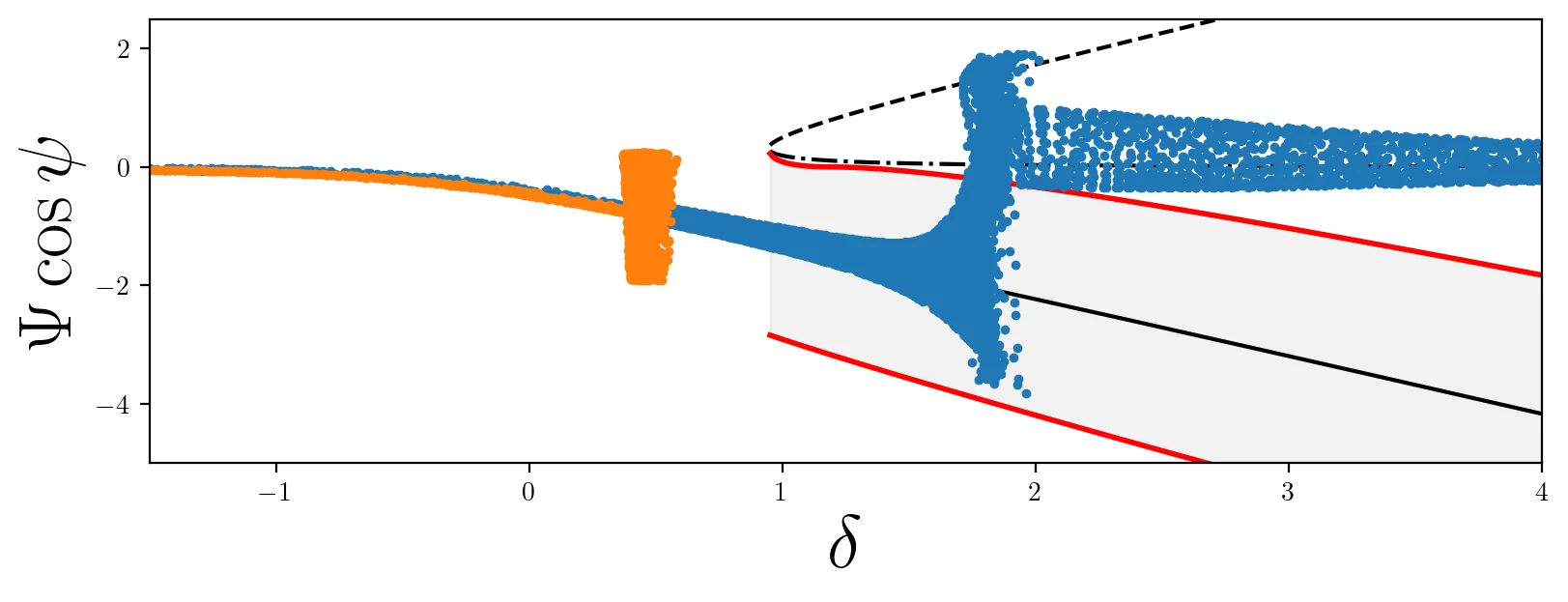
Dos planetas alrededor de la estrella TOI-4495 bailan un baile desacompasado: mientras el interior logra dar dos vueltas, el exterior solo una. Pero el ritmo está roto: el planeta interior ora acelera, ora frena, como una pareja que tropieza en un paso de danza.
Usando el método de tránsito —observar cómo los planetas atenúan momentáneamente la luz de la estrella—, los astrónomos pesaron estos mundos. La idea se debe a William Borucki. El planeta interior tiene la masa de 7,7 Tierras, el exterior de 23. Ambos están envueltos en gruesos abrigos de gas y sus órbitas yacen casi en el plano ecuatorial de la estrella, una rara sincronía.
La causa del desajuste probablemente se oculta en el pasado: un choque con enjambres de cometas pudo haber sacado al sistema de la resonancia perfecta. Ahora los planetas se balancean al borde del umbral, y cualquier empujón podría hacer que intercambien energía, aumentando el caos.
Resumen original
tal como lo escribieron los autores, en inglés arXiv:2601.02665v1
We report the discovery of a sub-Neptune and a Neptune-like planet ($$R_b = 2.48^{+0.14}_{-0.10}\,R_\oplus$$, $$R_c = 4.03^{+0.23}_{-0.15}\,R_\oplus$$) orbiting the F-type star TOI-4495. The planets have orbital periods of 2.567 days and 5.185 days, lying close to a 2:1 mean-motion resonance (MMR). Our photodynamical analysis of the TESS light curves constrains the planetary masses to $$M_b = 7.7 \pm 1.4\,M_\oplus$$ and $$M_c = 23.2 \pm 4.7\,M_\oplus$$. The measured masses and radii indicate the presence of volatile-rich gaseous envelopes on both planets. The Rossiter-McLaughlin effect and the Doppler shadow of TOI-4495 c reveal a well-aligned orbit with a projected stellar obliquity of $$\lambda = -2.3^{+8.3}_{-7.8}\,\mathrm{deg}$$. Combined with the low mutual inclination constrained by the photodynamical analysis ($$\Delta I < 8.7\,\mathrm{deg}$$), the planetary orbits are likely coplanar and aligned with the host star's spin axis. We show that the planets are near, but not in, the 2:1 MMR, with a circulating resonant angle. We also find substantial free eccentricity for the inner planet, TOI-4495 b ($$e_b = 0.078^{+0.020}_{-0.013}$$). Given the observed proximity to the 2:1 resonance and the more massive outer planet, TOI-4495 b and c are particularly susceptible to resonant overstability, which can convert resonantly excited eccentricity into free eccentricity. However, additional mechanisms (e.g., planetesimal scattering) may be required to further excite the eccentricity by $$\sim 4\%$$. To prevent tidal damping from reducing the eccentricity below the observed level over the star's lifetime (1.9 Gyr), the reduced tidal quality factor of TOI-4495 b must be $$Q' \gtrsim 10^5$$, consistent with the presence of a thick envelope on the planet.
La resonancia orbital 2:1 también existe en el Sistema Solar: los satélites de Júpiter Ío y Europa se mueven con el mismo ritmo, pero sin desajustes.