Fei Dai

7 articles · 30 co-authors · latest: 2026-08-24
271 citations · h-index 9 · 40 papersData: Semantic Scholar

We have retold 7 papers by this author. 1 of them with a full read. most often about: topological defect, exoplanet, brown dwarf. 30 co-authors across our retellings.

Links in the knowledge graph
Exoplanets2026-01-061 minarXiv:2601.02665express
The Stumbling Dance of Two Planets Around TOI-4495
Two planets around the star TOI-4495 perform a stumbling dance: while the inner one completes two laps, the outer manages just one. But the rhythm is off — the inner planet speeds up and slows down, like a partner stumbling in her steps. Using the transit method, watching as the planets briefly dim the star's light, astronomers weighed these worlds.

Stellar2026-03-172 minarXiv:2603.17039express
A Star Slowly Devours Its Companion
A sugar cube sits on a saucer next to a cup of hot tea. Drop it in, and it dissolves within minutes. But if you lower it slowly, the sugar melts gradually, releasing its sweetness into the drink. Something similar is happening in two newly discovered stellar pairs, except the sugar is a brown dwarf and the tea is a star.
Exoplanets2026-05-312 minarXiv:2606.00974express
A Sulfur Key to Planetary Childhood
A kindergarten where some kids are busy making sandcastles while others are already assembling building blocks. That's roughly what the V1298 Tau system looks like: it's only 20 million years old — by cosmic standards, it just left the nursery. Several planets orbit it, and two of them, b and e, turned out to be surprisingly different.
Exoplanets2026-06-161 minarXiv:2606.18355express
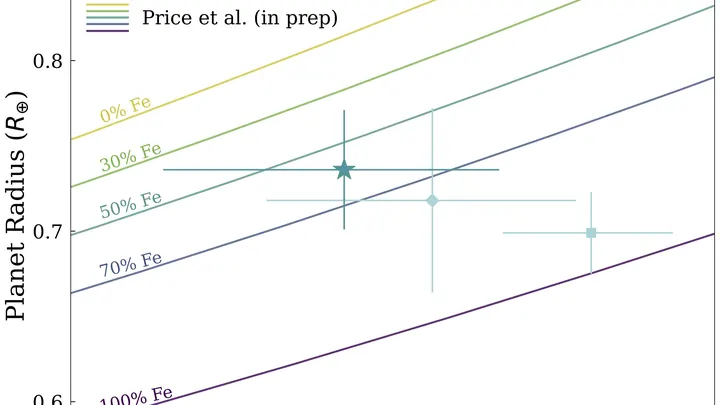
The Iron Planet Isn't So Iron After All
A cosmic sprinter on a short track: that's how you might describe planet GJ 367 b. It whips around its star in just 7.7 hours. This world is slightly smaller than Earth but has a personality: it was once thought to be nearly a solid ball of iron.
Exoplanets2026-06-161 minarXiv:2606.18410express
Super-Earths and Mini-Neptunes: Two Fates
In the catalogs of exoplanets, there are many worlds with sizes between Earth and Neptune. They are divided into two groups: rocky super-Earths and gaseous mini-Neptunes. The Solar System has none of these, and scientists debate where they come from. The authors of the study looked into each planet's 'passport'—its orbit.
Exoplanets2026-06-222 minarXiv:2606.23899express
The Glow of an Escaping Atmosphere
A world where a year lasts just one and a half Earth days, and the star in its sky is hundreds of times larger than our Sun. This is KELT-9 b — a gas giant heated to temperatures at which iron vaporizes. Its atmosphere is not just hot; it is literally boiling away into space, like steam rising from a giant cauldron.
A Cosmic Shoal and an Airless Valley
The JWST space telescope aimed its lens at the scorching rocky world 55 Cancri e, and spotted a dense gas envelope. But the cooler TRAPPIST-1 b, which orbits a dim red dwarf, showed no envelope: just bare rock. The picture came out upside down: hot planets hold onto atmospheres, while cooler ones lose them.