David W. Latham

5 articles · 30 co-authors · latest: 2026-08-30
2,185 citations · h-index 7 · 52 papersData: Semantic Scholar

We have retold 5 papers by this author. 1 of them with a full read. most often about: topological defect, exoplanet, planetary migration. 30 co-authors across our retellings.

Links in the knowledge graph
Exoplanets2026-01-061 minarXiv:2601.02665express
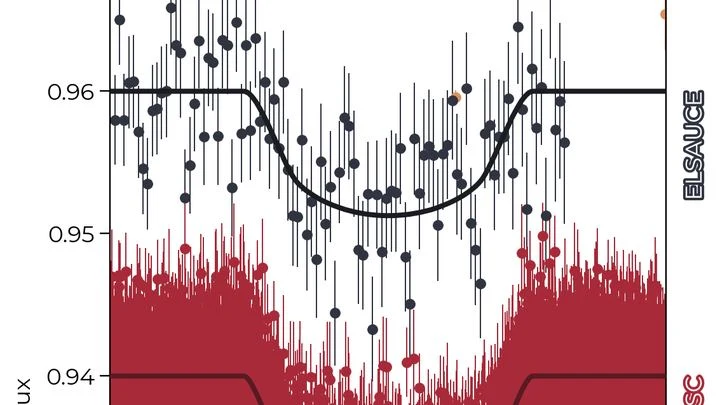
The Stumbling Dance of Two Planets Around TOI-4495
Two planets around the star TOI-4495 perform a stumbling dance: while the inner one completes two laps, the outer manages just one. But the rhythm is off — the inner planet speeds up and slows down, like a partner stumbling in her steps. Using the transit method, watching as the planets briefly dim the star's light, astronomers weighed these worlds.
Exoplanets2026-01-192 minarXiv:2601.13302express
Exoplanets2026-02-181 minarXiv:2602.16646express
Two Restless Planets: Light but Different Inside
NASA's TESS space telescope monitors thousands of stars, catching the moment when a planet crosses its star's disk — the star's light dims slightly. That's how astronomers spotted two planets orbiting stars similar to our Sun. One, TOI-883 b, completes an orbit in ten days; the other, TOI-899 b, takes nearly thirteen.
Exoplanets2026-03-191 minarXiv:2603.19402express
A Quiet Star: How They Searched for a Planet and Found Nothing
The Gaia space telescope measures star positions with an accuracy of a microarcsecond, like spotting a coin on the Moon from Earth. In 2022, it noticed that the bright star HD 12800 was wobbling slightly, as if tugged by an invisible companion. Astronomers hypothesized that a planet orbits the star. But a wobble can be deceiving.
Gamma Cephei: How 45 Years of Observations Rewrote the Family Portrait of a Binary Star
The family album of this stellar pair has been filling up for 45 years, but the pictures were blurry and the captions contradictory. Now astronomers have pulled out the old photographs, taken new sharp shots, and put everyone back in their proper places. Gamma Cephei is a bright star visible to the naked eye, and it has an invisible companion that orbits it every 70 years.