Océanos de lava de exoplanetas exprés
El planeta, cuya órbita es ligeramente alargada, en cada giro se zambulle más cerca de la estrella y luego se aleja. La atracción variable lo calienta, y las rocas sólidas se funden, convirtiéndose en un océano de lava.
En el lado nocturno, la corteza solidificada hace las veces de costa. Las olas de marea chocan contra ella, se entrechocan y crean manchas calientes errantes. Por eso el brillo del planeta titila de forma impredecible, como la llama de una vela. La altura de las olas alcanza varios kilómetros: son murallas de roca que se deslizan lentamente por la extensión incandescente.
Resumen original
tal como lo escribieron los autores, en inglés arXiv:2601.07080v2
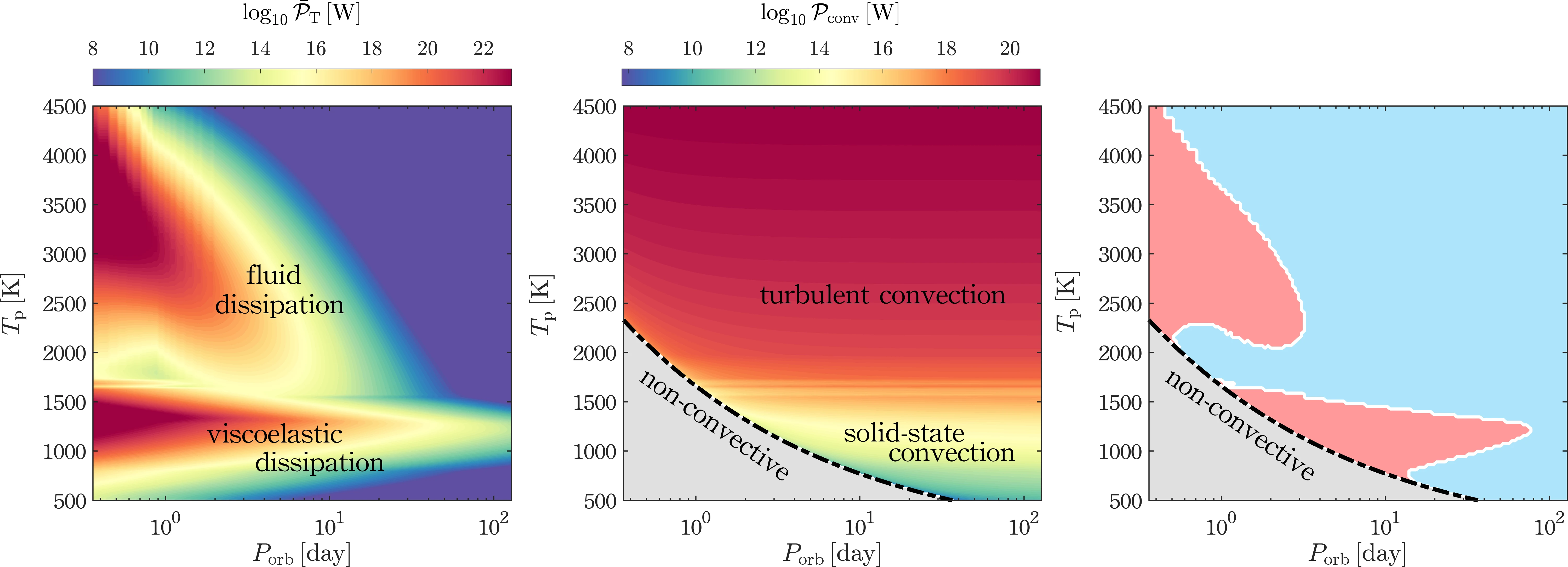
Lava worlds are rocky planets with dayside skins made molten by stellar irradiation. Tidal heating on these shortest-period planets is more than skin deep. We show how orbital eccentricities of just a few percent (within current observed bounds and maintained secularly by exterior companions) can create deep magma oceans. ``Lava tidal waves'' slosh across these oceans; we compute the multi-modal response of the ocean to tidal forcing, subject to a coastline at the day-night terminator and a parameterized viscous drag. Wave interference produces a dayside heat map that is spatially irregular and highly time-variable; hotspots can wander both east and west of the substellar point, and thermal light curves can vary and spike aperiodically, from orbit to orbit and within an orbit. Heat deposited by tides is removed in steady state by a combination of fluid, mushy, and solid-state convection in the mantle. For Earth-sized planets with sub-day periods, the entire mantle may be tidally liquified.
La temperatura de estos océanos de lava es más alta que en un horno de fundición: alrededor de 3000 grados Celsius.
Mundos de lava como Mustafar de «Star Wars», debido a las mareas, resultan aún más turbulentos que en la ficción.