Por qué la presión no cae: bucles en los vasos sanguíneos exprés
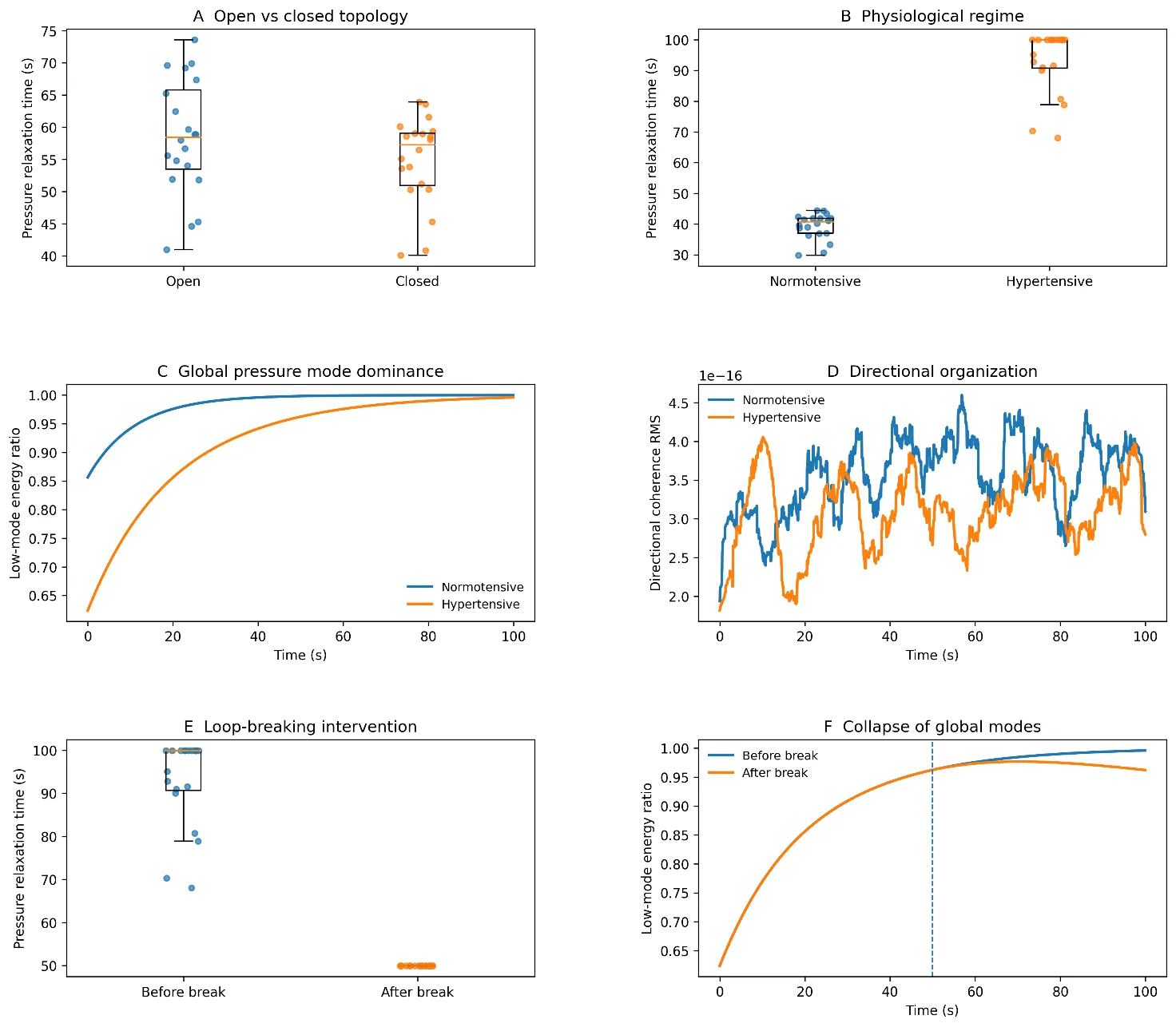
El agua en una manguera circular impulsada por una bomba no se detendrá incluso si se pinza un tramo: el flujo encontrará un camino alternativo y seguirá corriendo en círculo. Así están organizadas algunas partes de nuestro sistema circulatorio, no como tubos individuales, sino como bucles cerrados.
Los científicos construyeron un modelo computacional del flujo sanguíneo y compararon dos casos: un vaso abierto y un anillo cerrado. En el vaso abierto, la presión cae rápidamente y solo permanece cerca del punto de acción. En el anillo, la presión puede seguir circulando incluso si la resistencia aumenta en un punto.
Esto explica el misterio de la hipertensión resistente: los medicamentos reducen la presión en un área, pero el bucle redistribuye el flujo y mantiene el nivel general. Cuando el bucle se rompe —por trombosis, cirugía o embolización— la presión cambia bruscamente en todo el sistema. Así, la topología de los vasos (cómo están conectados) resulta tan importante como su tono.
Resumen original
tal como lo escribieron los autores, en inglés arXiv:2602.10011
Blood pressure regulation is commonly addressed in terms of local mechanisms such as vascular resistance, compliance and neurohumoral control. However, the human vasculature encompasses multiple quasi-closed flow loops under both physiological and pathological conditions. To test whether these loops could influence pressure dynamics beyond local control, we address the role of vascular topology in blood pressure regulation. Using one dimensional flow simulation models, we compared pressure dynamics in open vascular segments and closed vascular loops. We found that in open segments pressure fades away and remains spatially localized, whereas in closed loops pressure can keep circulating around the loop even if resistance in one spot is modified. Since parallel pathways within loops are dynamically coupled rather than independent, pressure changes in one place can affect the entire closed loop, allowing system level pressure patterns to emerge. Also, we assessed the temporal evolution of pressure fluctuations within closed vascular loops in normotensive and hypertensive parameter regimes, before and after loop breaking intervention. This topological approach helps clarifying why drugs or local interventions may fail to lower blood pressure in looped vascular architectures, providing a theoretical interpretation of some forms of resistant hypertension. Because disrupting a loop restores pressure relaxation, it may also help explain the disproportionate pressure changes observed after topology altering events like thrombosis, vascular surgery or embolization of arteriovenous malformations and shunts. Therefore, vascular topology can influence cardiovascular physiology by coupling local pressure flow relations to global constraints on blood pressure regulation, with physiological, pathological and clinical implications.
Los humanos tenemos varios bucles vasculares naturales, como el círculo de Willis en el cerebro, un anillo de arterias que protege contra el ictus si una de las ramas se obstruye.