Las espículas solares: cómo la corona recibe su calor exprés
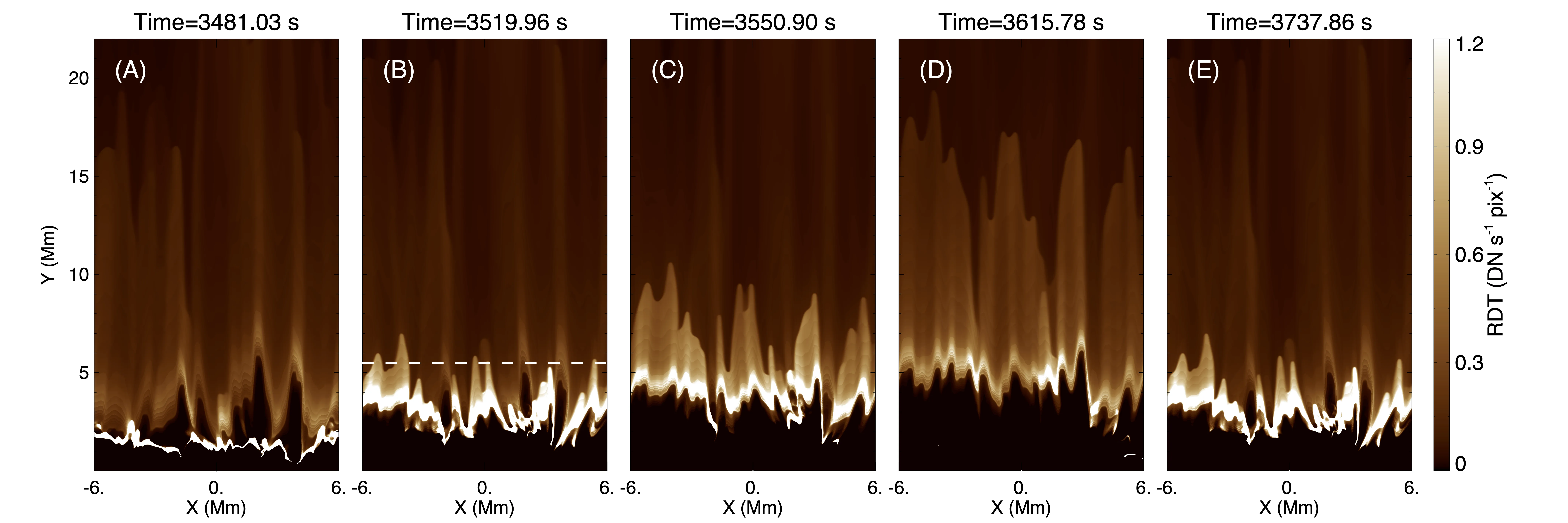
La superficie del Sol hierve como el agua en una olla. El gas caliente asciende, se enfría y desciende: eso es la convección. Alrededor bullen los campos magnéticos, que se rompen y se vuelven a conectar. En ese ajetreo nacen las espículas: estrechos chorros de plasma que se disparan miles de kilómetros hacia arriba. Viven solo unos minutos, pero alcanzan a transferir energía a la atmósfera exterior del Sol.
Las espículas no solo se elevan: empujan ante sí ondas y frentes de choque. Estas ondas comprimen el gas y lo calientan. Así, la energía de la superficie llega hasta la corona — la tenue capa exterior que está cientos de veces más caliente que la propia superficie. Sin las espículas, la corona se enfriaría y el viento solar en los agujeros coronales se agotaría.
Así, un pequeño chorro tras otro, como una bomba, impulsa calor hacia la corona. Las espículas no son solo un bonito espectáculo en el borde del disco solar: son la clave de un enigma que ha desconcertado a los astrofísicos durante 80 años: por qué la corona está más caliente que la superficie.
Resumen original
tal como lo escribieron los autores, en inglés arXiv:2602.19953
How the solar atmosphere is heated from a temperature of about $$5,000-6,000$$\,K in the lower atmosphere to about $$1-2$$\,MK in the corona has challenged the astrophysical community for about 80 years. The same puzzle exists for the stellar coronae heating as well. In this study, we present a series of findings on solar spicules and their subsequent impact on the corona within a coronal hole environment, characterized by locally open magnetic field lines, combining insights from MHD simulations with observations. We find that the convective and turbulent motions around the solar surface cause plenty of shocks and small-scale magnetic reconnection in the lower atmosphere. The combined effects of shock compression and reconnection outflows then drive the formation of groups of spicules with a quasi-period of about $$300$$\,s and width of $$\sim 200-500$$\,km. The spicule upflows provide an averaged mass flux above $$10^{-9}$$\,kg\,m$$^{-2}$$\,s$$^{-1}$$ in the lower corona to sustain the solar wind in coronal holes, and they continuously trigger further new local slow-mode waves and shocks. These waves supply an energy flux of $$10-100$$\,W\,m$$^{-2}$$ in the lower corona, and they are dissipated by heat conduction and compression heating to sustain the corona temperature of about $$1$$\,MK. The results also indicate that the upward propagating disturbances (PDs) observed in extreme ultraviolet (EUV) passbands are caused by both spicule upflows and slow-mode waves and shocks. Our findings help to understand the long standing problem of coronal heating and the origin of solar winds in coronal hole regions.
La temperatura de la corona solar es de alrededor de un millón de grados, mientras que la superficie apenas alcanza los 5500 grados. Es como si el aire alrededor de una hoguera estuviera más caliente que la propia llama.