Polvo en los vientos galácticos: cómo ver lo invisible exprés
En el centro de cada galaxia grande, incluida nuestra Vía Láctea, habita un agujero negro supermasivo. No se queda quieto: de vez en cuando atrae gas y polvo, y parte de esa materia la expulsa de vuelta en potentes flujos. Estos flujos, o «vientos», arrastran material lejos del centro e influyen en toda la galaxia. Pero hasta ahora los astrónomos no podían decir con certeza si hay polvo en estos vientos y cómo se mueve.
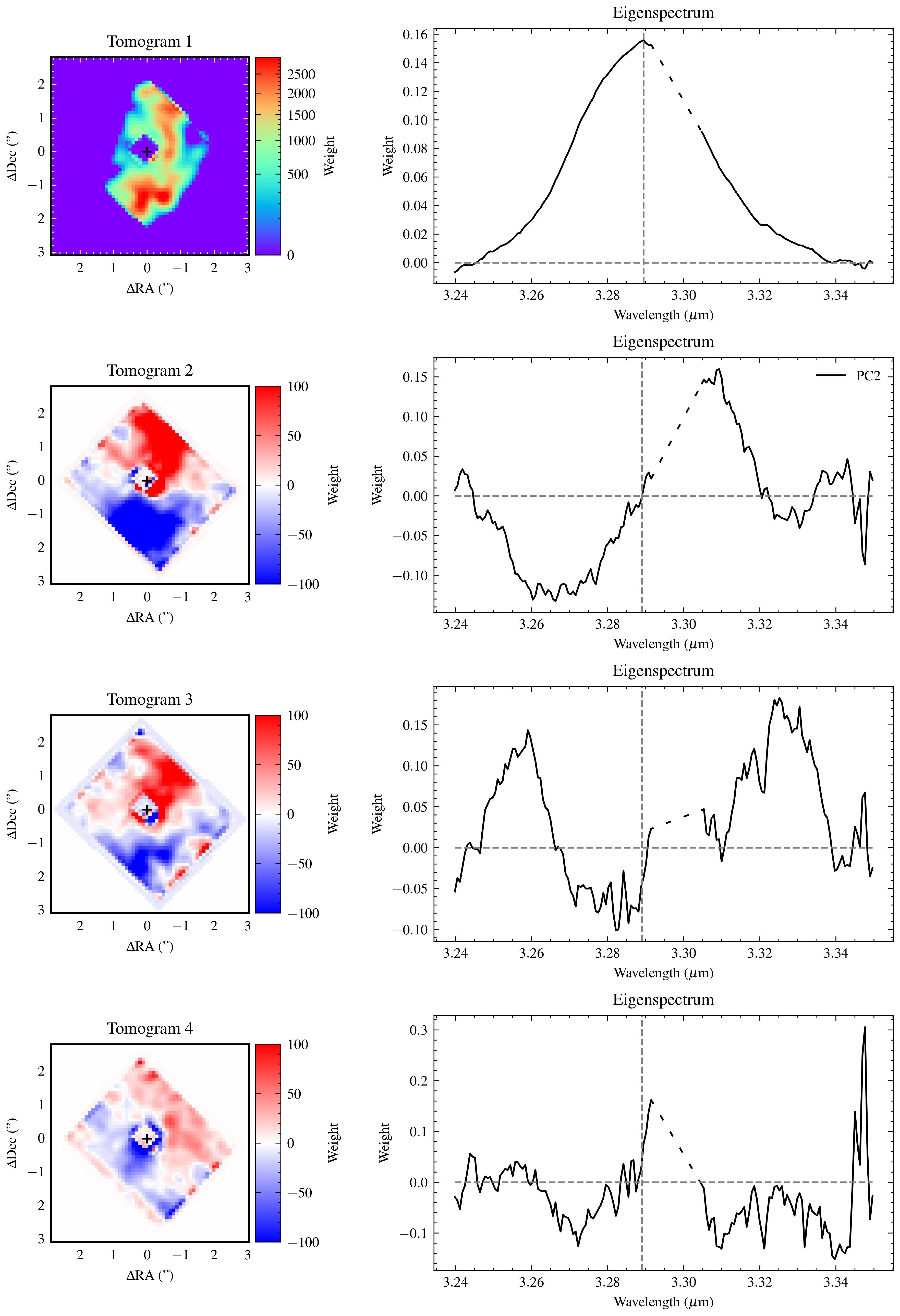
El telescopio James Webb ha permitido por primera vez asomarse a esta región invisible. Los científicos usaron sus instrumentos infrarrojos para examinar diez galaxias cercanas con núcleos activos. Buscaban rastros de hidrocarburos aromáticos policíclicos: las partículas de polvo más pequeñas del medio interestelar, parecidas a diminutas motas de hollín. Estas moléculas brillan en el infrarrojo, pero su señal es muy débil y difusa. Para aislarla, aplicaron un método similar a separar voces en una habitación ruidosa: un análisis computacional extrajo las «notas» relevantes del rumor general.
El resultado sorprendió: el polvo se mueve junto con el gas que expulsa el agujero negro. En dos galaxias, NGC 5728 y NGC 7582, se pudo ver simultáneamente el disco en rotación alrededor del centro y el flujo que sale de él. Además, el polvo en ese flujo viaja a la misma velocidad que el gas ionizado, calentado a millones de grados. Es como si ligeras motas de polvo y pesadas rocas volaran a la misma velocidad en un huracán: eso significa que el viento es realmente fuerte.
¿Por qué es importante? El polvo es el material de construcción para nuevas estrellas y planetas. Si los agujeros negros lo expulsan de la galaxia, pueden frenar la formación estelar. Ahora los astrónomos tienen una herramienta para medir este proceso directamente. La próxima vez que mires al cielo nocturno, recuerda: incluso en los rincones más oscuros de las galaxias ocurre un trabajo invisible: el polvo viaja en las alas del agujero negro.
Resumen original
tal como lo escribieron los autores, en inglés arXiv:2603.12200
We present the first spatially resolved kinematic evidence for dust in the outflows of Active Galactic Nuclei (AGN). We utilise observations from JWST with NIRSpec IFU and MIRI MRS data of 10 local Seyferts and use Principal Component Analysis (PCA) tomography to extract the kinematics of Polycyclic Aromatic Hydrocarbon (PAH) features. PAHs comprise the smallest carbonaceous dust molecules in the Interstellar Medium (ISM), and produce emission features in the infrared providing the potential to measure kinematics. This is however challenging due to their broad shapes and variations in their intrinsic profile, prompting the need for techniques such as PCA tomography. We find that the velocity of the PAHs is similar to the molecular gas as traced by the rotational transitions of H$$_2$$, where for NGC 5728 and NGC 7582, both disk and outflow are present. We detect the outflow in the kinematics of large and neutral PAHs, namely the 11.3 $$\mu$$m and 17 $$\mu$$m PAH features, where after subtracting the disk, the velocity field matches that of high-ionisation potential lines such as [NeVI] (7.65 $$\mu$$m, IP = 158 eV). Finally, we fail to detect kinematics of the 6.2 $$\mu$$m PAH due to an altered intrinsic profile while the the 3.3 $$\mu$$m PAH kinematics purely trace the circumnuclear disk. This suggests the PAHs in the outflow are more neutral and larger than in star-forming regions, consistent with PAH band ratios in previous studies of AGN.
Las partículas de polvo de las que hablamos son tan pequeñas que un millón de ellas, puestas en fila, apenas cubrirían el grosor de un cabello humano.