La caza de los neutrinos estériles exprés
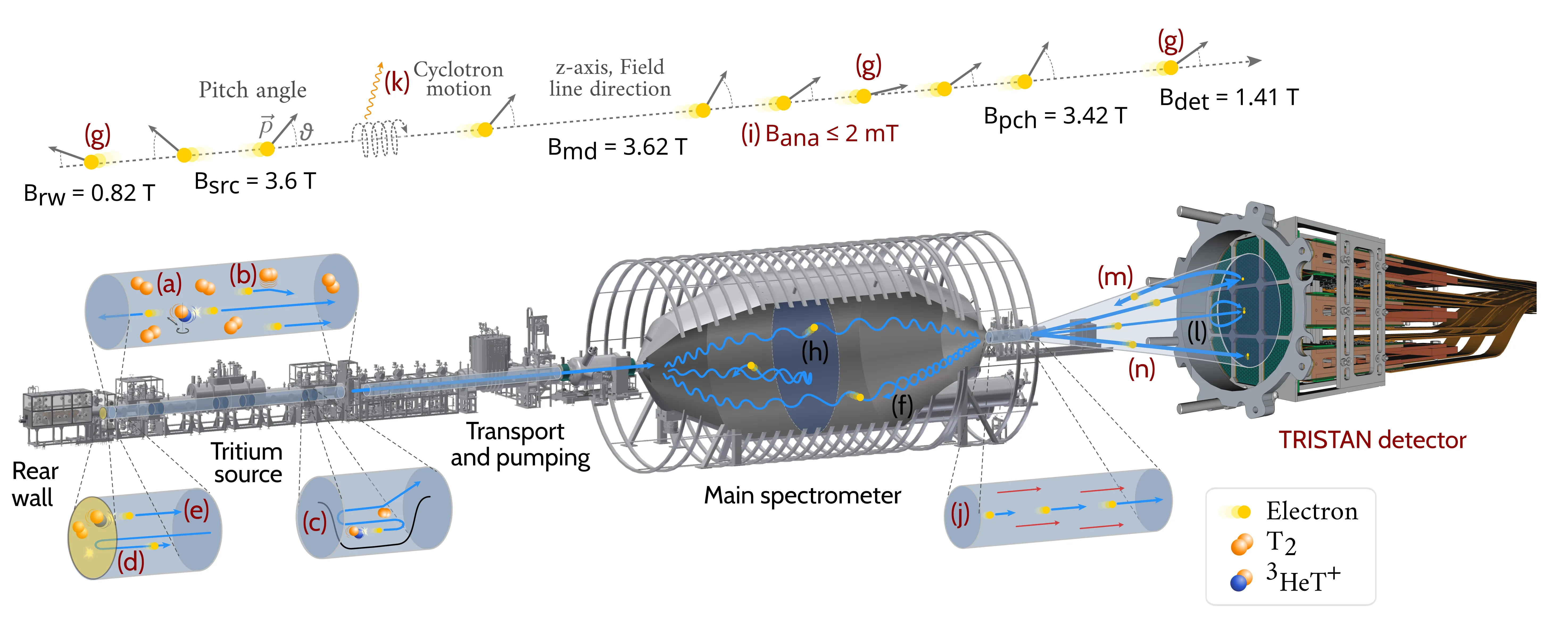
El tritio radiactivo se desintegra y expulsa un electrón. Su energía es casi siempre la misma, pero a veces es un poquito menor. Ese 'déficit' podría significar que, junto con el neutrino ordinario, nació otra partícula oculta.
El modelo estándar describe tres tipos de neutrinos, pero los científicos sospechan que hay un cuarto: el estéril. No participa en ninguna interacción excepto la gravedad, por lo que no se puede capturar directamente. Pero se le puede calcular por la torcedura en el espectro de electrones: como si a una escalera uniforme le faltara un escalón.
En cuatro meses de funcionamiento, KATRIN podría detectar una mezcla de neutrino estéril incluso si esta fuera de solo una millonésima parte. Esto es decenas de veces mejor que las búsquedas anteriores.
Si se encuentra la torcedura, sería el primer rastro real de una partícula que podría componer la materia oscura, la sustancia invisible que mantiene unidas a las galaxias.
Resumen original
tal como lo escribieron los autores, en inglés arXiv:2603.23256
Sterile neutrinos in the keV mass range are a well-motivated extension of the Standard Model and viable dark matter candidates. Their existence can be probed in laboratory experiments, as the admixture of a sterile state would induce a characteristic kink-like distortion in the $$\beta$$-decay electron energy spectrum. The KATRIN experiment is designed to measure the effective electron neutrino mass with sub-eV sensitivity by analyzing the endpoint region of the tritium $$\beta$$-decay spectrum. Following the completion of its neutrino mass program, KATRIN will extend its physics reach to the search for keV-scale sterile neutrinos. This effort will be enabled by the TRISTAN detector, a newly developed silicon drift detector array optimized for differential measurements at high rates and energies well below the endpoint. In this article, we present the projected sensitivity of KATRIN to keV-scale sterile neutrinos using a dedicated simulation framework. With four months of detector livetime, KATRIN has the statistical power to probe mixing amplitudes at the level of $$|U_{e4}|^2 \sim 10^{-6}$$ for sterile neutrino masses in the (4$$-$$13) keV range, significantly extending the reach of previous laboratory searches. The major experimental systematic uncertainties investigated in this work reduces the sensitivity by a factor of 10$$-$$50 over the same mass range.
El neutrino estéril se llama así porque es 'estéril' respecto a la interacción débil, la única en la que participan los neutrinos ordinarios.