El halo galáctico: cómo pesar lo invisible exprés
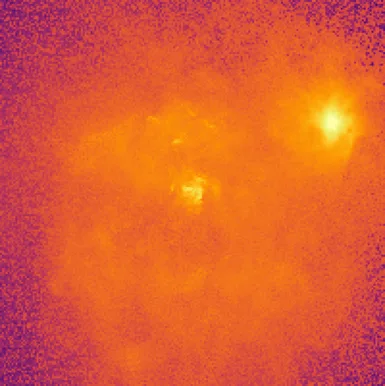
Alrededor de cada galaxia existe una envoltura invisible de gas caliente, como el vapor que se eleva sobre una olla de agua hirviendo. Este gas apenas brilla en rayos X, por lo que es muy difícil de medir. Pero en él se guarda la memoria de las explosiones estelares y del crecimiento de la galaxia.
El nuevo método aprovecha la luz del brillante centro galáctico. Cuando los rayos X atraviesan las capas externas del gas, una parte se dispersa en los átomos de oxígeno, igual que un haz de linterna en la niebla. Comparando el brillo del centro con el de la luz reflejada por la niebla, se puede calcular cuánto oxígeno hay en la envoltura y, a partir de ahí, cuánto gas hay en total.
El método se probó con el modelo computacional de galaxias TNG50. Resultó que, para la mayoría de las galaxias, el error es de solo el 10%, como si pesaras un saco de patatas y te equivocaras por un solo tubérculo. Incluso cuando las galaxias son asimétricas o el gas se mueve en su interior, el método funciona, siempre que se descarten los casos más extremos.
Así, lo invisible se vuelve medible: la luz reflejada por el gas nos cuenta lo que está oculto a la vista.
Resumen original
tal como lo escribieron los autores, en inglés arXiv:2603.25600
The circumgalactic medium (CGM) regulates galaxy growth and retains the imprint of feedback from supernovae and supermassive black holes. However, the bulk of the hot CGM produces little X-ray emission and is challenging to study with X-ray telescopes. We propose a novel method for evaluating the CGM mass using resonant scattering of the helium-like oxygen (\ovii) resonant line at $$E=574$$ eV. In a spherically symmetric and static CGM halo with a sharp central X-ray peak, the number of \ovii\ ions within an outer radial shell can be calculated from the ratio of the two directly observable quantities: the \ovii\ flux from the bright inner region and the scattered \ovii\ flux from the shell (where the scattered flux can be much higher than the intrinsic emission). To evaluate the accuracy of this geometric estimate for realistic galaxies -- with satellites, asymmetries, and gas velocities -- we use a sample of galaxies from the TNG50 cosmological simulation. We find that, when the most irregular systems are excluded based on their X-ray observables, we accurately predict the \ovii\ mass in the outer halo (e.g., in an $$r=R_{\rm 500c}-R_{\rm 200c}$$ shell) from the ratio of the fluxes in the corresponding annulus and the central peak region ($$r<0.2R_{\rm 500c}$$), with only a 10\% bias and an rms scatter of $$\sim 0.2$$ dex. As \ovii\ mass strongly correlates with the total oxygen and gas mass, this direct \ovii-counting method enables indirect estimates of those quantities by future X-ray microcalorimeter missions, such as {\em NewAthena}\/ and {\em HUBS}.
La envoltura exterior de una galaxia puede contener más materia ordinaria que la propia galaxia, como una despensa invisible de la que solo nos enteramos gracias a la luz reflejada.