Cómo capturar el temblor de una molécula exprés
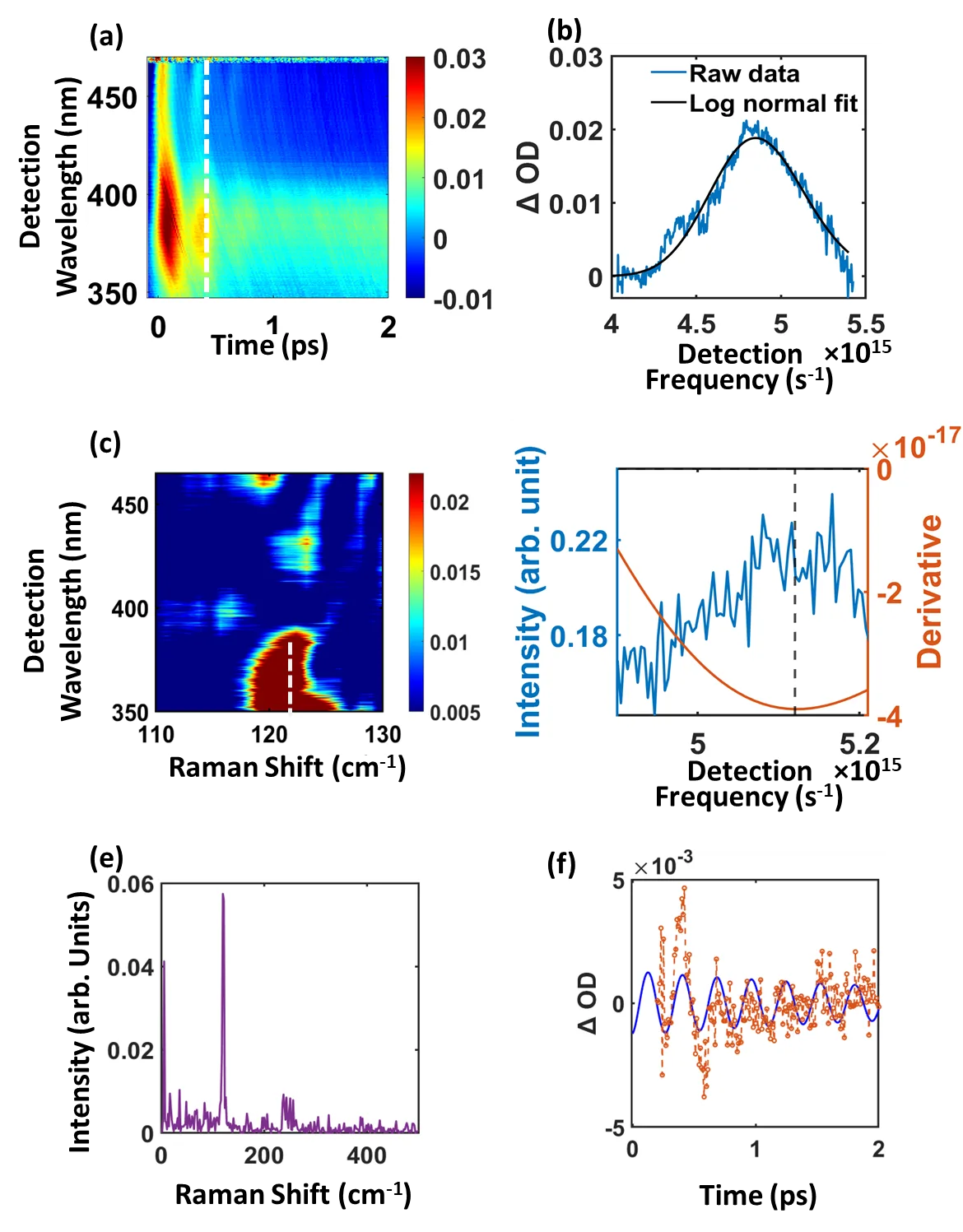
Un pulso láser corto golpea la molécula de yodo y sus átomos comienzan a vibrar como una bola atada a un muelle. Los científicos siguen estas vibraciones con un segundo pulso de banda ancha que registra el espectro en diferentes instantes.
Resulta que las vibraciones en el estado excitado B se desplazan rápidamente en frecuencia y se amortiguan, y luego aparecen vibraciones en el estado A. Es como una carrera de relevos: la molécula se disocia, pero el disolvente, como una jaula, mantiene los fragmentos cerca, y estos se vuelven a unir, transfiriendo la energía vibratoria al nuevo estado.
El análisis mediante wavelets (los "microscopios" matemáticos de las frecuencias) permitió ver cómo las frecuencias de vibración cambian de picosegundo a picosegundo. Esto ayuda a separar señales que en el espectro ordinario se superponen.
Este enfoque es como un estetoscopio que no solo oye los latidos del corazón, sino también cada susurro dentro del pecho. Abre el camino al estudio de la coherencia en procesos fotoquímicos complejos.
Resumen original
tal como lo escribieron los autores, en inglés arXiv:2604.23731
Vibrational wavepacket dynamics in the ground (X) and excited (B) electronic states of iodine under impulsive-pump/broadband-probe excitation are revisited. A method for accurate chirp correction, necessary to determine the zero time for each component of spectrally dispersed data and thereby separate coherent vibrational dynamics from coherent artifacts and population kinetics, is introduced. While from these processed time-domain data the absolute Raman cross-section in the ground electronic state can be calculated using steady-state absorption, we show that the same can be done using the pump-probe data itself, and further extend this method as a benchmark to calculate the same for the excited electronic state; these cross-sections report on vibronic couplings specific to these states. Further, since the Fourier transform of the processed data yields information on vibrational modes averaged over the dephasing time, a wavelet analysis is performed to yield a joint time-frequency distribution of the vibrational modes, demonstrating how the time evolution of their frequencies can be extracted. The vibrational modes of the ground and excited electronic states are shown to exhibit distinct dispersion characteristics. Since overlapping spectral features appear at different time windows, such an analysis can disentangle spectral congestion, even from a simple one-dimensional measurement. Most interestingly, a rapid time-dependent spectral shift and decay of the B state mode, followed by the appearance and growth of the A-state mode, directly correlates with the pre-dissociation, followed by solvent caging-induced recombination. Thus, the present work reveals transfer of vibrational coherence from one electronic state (B) to another (A), mediated via nonadiabatic coupling to the intermediate dissociative state (a), underscoring the importance of electronic coherence.
El yodo en disolución se ve violeta, pero sus vapores son azul-violeta; el color depende de cómo interactúan las moléculas con el entorno.