Las sombras de los agujeros negros ponen a prueba la gravedad cuántica exprés
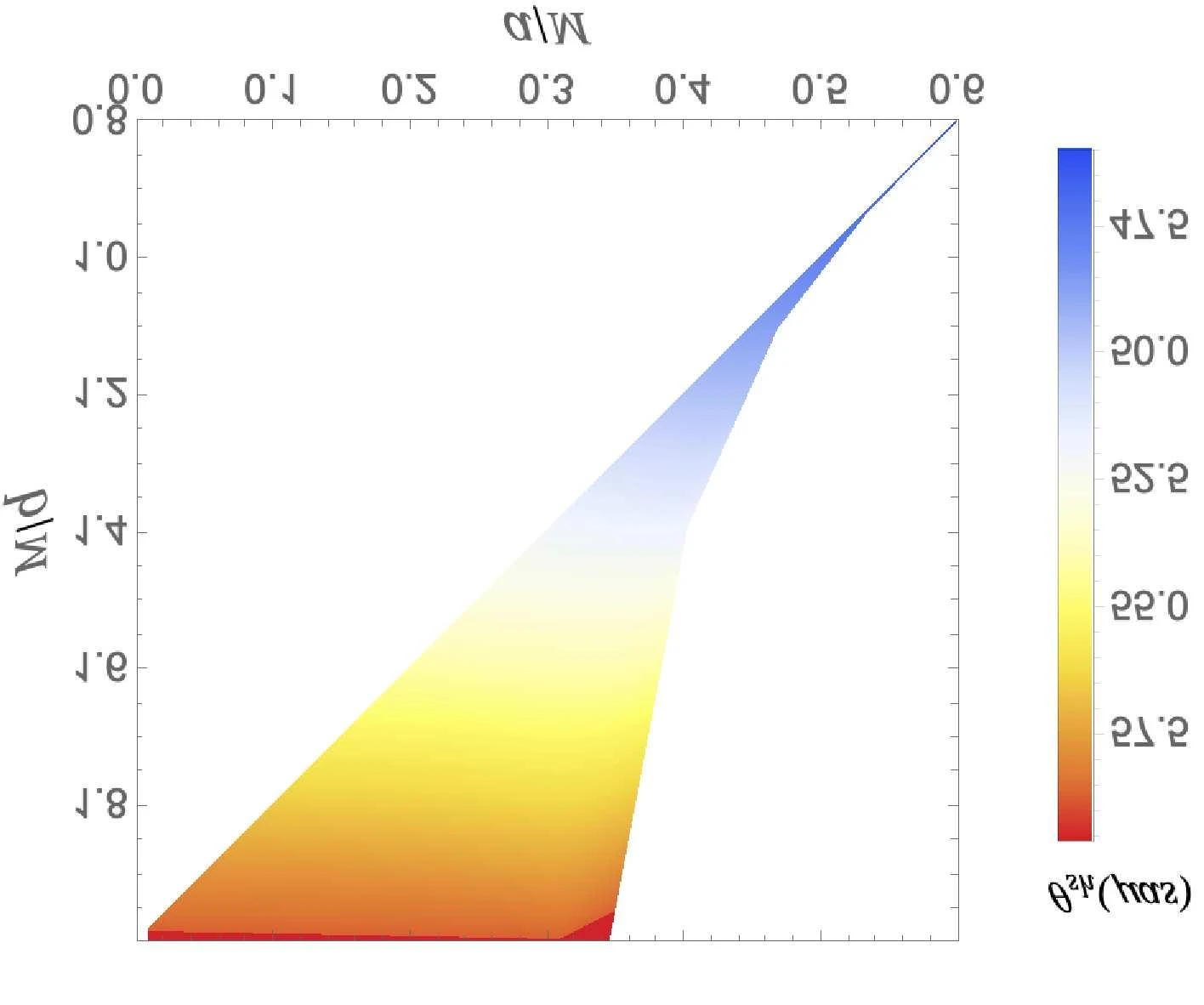
La sombra de un agujero negro no es solo una silueta. Es el borde del abismo, donde el espacio y el tiempo están tan retorcidos que incluso la luz se ve obligada a girar, como una astilla en un remolino. Este «remolino cósmico» surge de una masa monstruosa que curva el espacio-tiempo.
Los físicos comprobaron qué sucede si se añaden efectos cuánticos a este remolino: pequeñas correcciones de la teoría de la gravedad cuántica de bucles, donde el propio espacio está compuesto de lazos microscópicos. Los cálculos mostraron que las correcciones cuánticas agrandan la sombra de manera apenas perceptible. Pero lo principal: incluso si se elimina el «agujero de desagüe», es decir, el horizonte de sucesos, el embudo sigue siendo cerrado y la sombra sigue siendo un anillo. La verdadera sorpresa: dentro de un agujero negro así no hay un punto de singularidad, solo una maraña de bucles.
Resumen original
tal como lo escribieron los autores, en inglés arXiv:2605.28871
The Event Horizon Telescope (EHT) has provided a new tool for testing the strong-field regime of gravity by imaging the shadows of M87* and Sgr A*. These observations provide the first real opportunity to test whether quantum gravity--specifically loop quantum gravity--leaves observable imprints on spacetime. We use the EHT observations of M87* and Sgr A* to examine the observational signs of rotating holonomy-corrected black holes (RHCBHs). We discover that, in comparison to the typical Kerr black hole, the quantum correction parameter $$b$$ increases the size of the black hole shadow. As the deviation parameter $$b$$ increases in RHCBH, the prograde photon orbits shift outward, indicating a weaker effective gravitational field near the central region. Unlike Kerr naked singularities, which produce open arc-like shadows, the RHCBH spacetime can still produce closed shadow rings even in the absence of an event horizon. We find that photon rings continue to exist in the parameter range $$b_E \leq b \leq b_p$$, due to the presence of unstable circular photon orbits.We apply the Kumar--Ghosh method based on the shadow observables: the shadow area $$A$$ and the oblateness $$D$$ that together allow a unique determination of the spin parameter $$a$$ and the quantum correction parameter $$b$$. At $$\theta_o=17$$\textdegree~, the angular diameter bound of M87$$^{*}$$ yields $$b \leq 0.1319\,M$$ at $$a = 0\,$$ and $$b \leq 0.421\,M$$ at $$a = 0.784\,M$$, while at $$\theta_o=50$$\textdegree~, the angular diameter bound of Sgr A$$^{*}$$ yields $$b \leq 0.5764\,M$$ at $$a = 0\,$$ and $$b \leq 0.7482\,M$$ at $$a = 0.6253\,M$$ the Sgr~A$$^{*}$$. Our results show that nonzero values of the holonomy correction parameter are consistent with current EHT data, indicating that RHCBHs provide viable alternatives to the classical Kerr geometry in the strong-gravity regime and are strong astrophysical black hole candidates.
La luz en la sombra de un agujero negro puede dar vueltas, creando una infinita sucesión de reflejos, como en un pasillo de espejos.
En «Interstellar», la sombra de Gargantúa se modeló con ecuaciones clásicas; las correcciones cuánticas la habrían hecho un poco más ovalada.