Cómo los electrones pesados encienden un sol artificial exprés
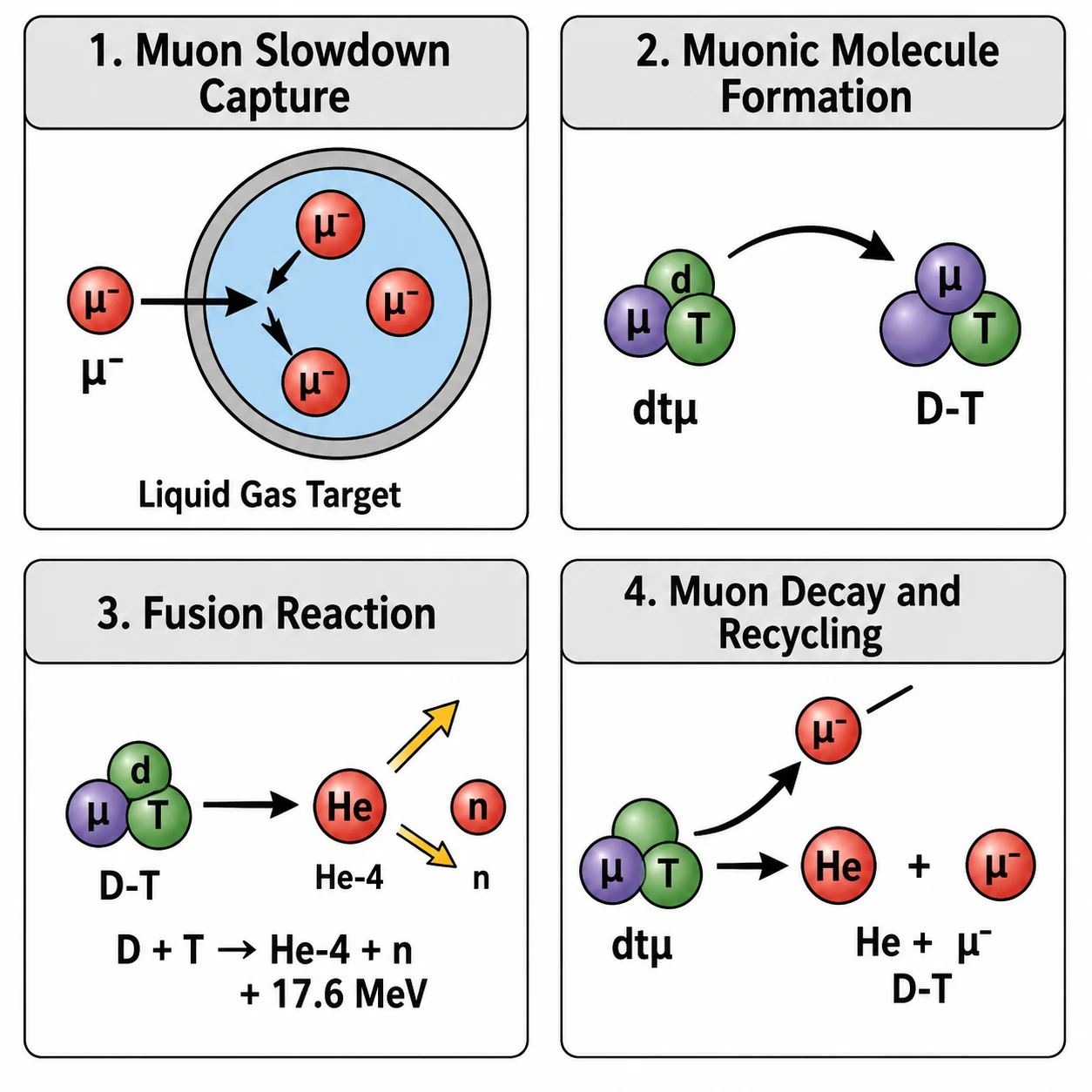
Núcleos atómicos envueltos en esponjosos abrigos de electrones: con semejante ropa, no hay abrazo que valga. Pero cambia el abrigo ligero por uno pesado: el muón, una partícula del modelo estándar, comprime la nube casi 200 veces. Entonces, los núcleos de hidrógeno (deuterio y tritio) se fusionan solos a temperatura ambiente, creando helio y una explosión de energía.
El problema es que, después de la fusión, el abrigo pesado a veces se pega irremediablemente al helio, y el muón queda fuera de juego. Actualmente, un solo muón solo inicia 150 reacciones. Pero campos eléctricos y condiciones especiales hacen que se deslice, alargando la cadena hasta 500 fusiones. Esto produce más energía de la que se gastó en crear el muón.
Estas instalaciones podrían convertirse en reactores híbridos: el flujo de neutrones de la micro-fusión convierte el uranio-238 común en plutonio-239, combustible para las centrales nucleares clásicas.
Resumen original
tal como lo escribieron los autores, en inglés arXiv:2605.26432
Muon-catalyzed nuclear fusion (\mucf) replaces atomic electrons with negative muons, compressing atomic orbitals by about two orders of magnitude and enabling deuterium--tritium (D--T) fusion under near-room-temperature conditions. This paper reviews the physical principles of \mucf{} and formulates its essential dynamics as a four-step cycle: muonic-atom formation, muon transfer, resonant \dtmu{} molecular formation, and D--T fusion with muon release and recycling. A kinetic model is used to quantify the number of catalysis cycles per muon and the corresponding energy gain. We focus on the central limitation of catalytic efficiency, namely the alpha-sticking effect, and discuss possible breakthrough routes including nuclear-spin and muon dual polarization, in-flight muon-catalyzed fusion, and heavy-ion-driven magneto-inertial fusion. Within the idealized assumptions of the present model, a four-dimensional synergistic scheme combining dual polarization, high-density confinement, electric-field-assisted muon recovery, and resonant enhancement may increase the number of catalysis cycles per muon from the present experimental record of about 150 to more than 500, potentially enabling an energy gain \(Q>2\). On this basis, we propose a conceptual fusion--fission fuel-breeding hybrid reactor, denoted as \mucf-FBR, which exploits the 14.1-MeV neutron yield of \mucf{} to breed \({}^{239}\mathrm{Pu}\) from a \({}^{238}\mathrm{U}\) blanket in a decoupled fusion--fission operating mode. This concept may offer advantages in engineering robustness, radiation-damage tolerance, and natural-uranium utilization.
El fondo natural de muones se utiliza para escanear pirámides y buscar cavidades ocultas en estructuras.