Cable vivo de ladrillos de níquel exprés
En el lodo turbio, entre dos electrodos, se forman largas cadenas de bacterias, finas como un cable microscópico. Cada uno de estos filamentos conduce corriente a lo largo de un centímetro entero, una verdadera maratón para un microbio. El secreto está en unas fibras incrustadas en la propia envoltura celular: por ellas la electricidad viaja casi sin pérdidas, como por un hilo de cobre.
Al observar el interior de la fibra con cálculos cuánticos, los investigadores vieron que está formada por nanocintas, unas tiras planas de una sola molécula de grosor. Cada cinta se ensambla, como una torre de piezas infantiles, a partir de anillos idénticos de níquel y materia orgánica (los químicos los llaman bloques NiBiD). Los anillos se apilan de dos maneras: o bien justo uno encima del otro (apilamiento AA), o bien desplazados, como ladrillos en una pared (apilamiento AB). La segunda opción resultó ser más resistente: entre las capas se encajan enlaces adicionales, y los átomos de níquel se sujetan con cinco "patitas" en lugar de cuatro.
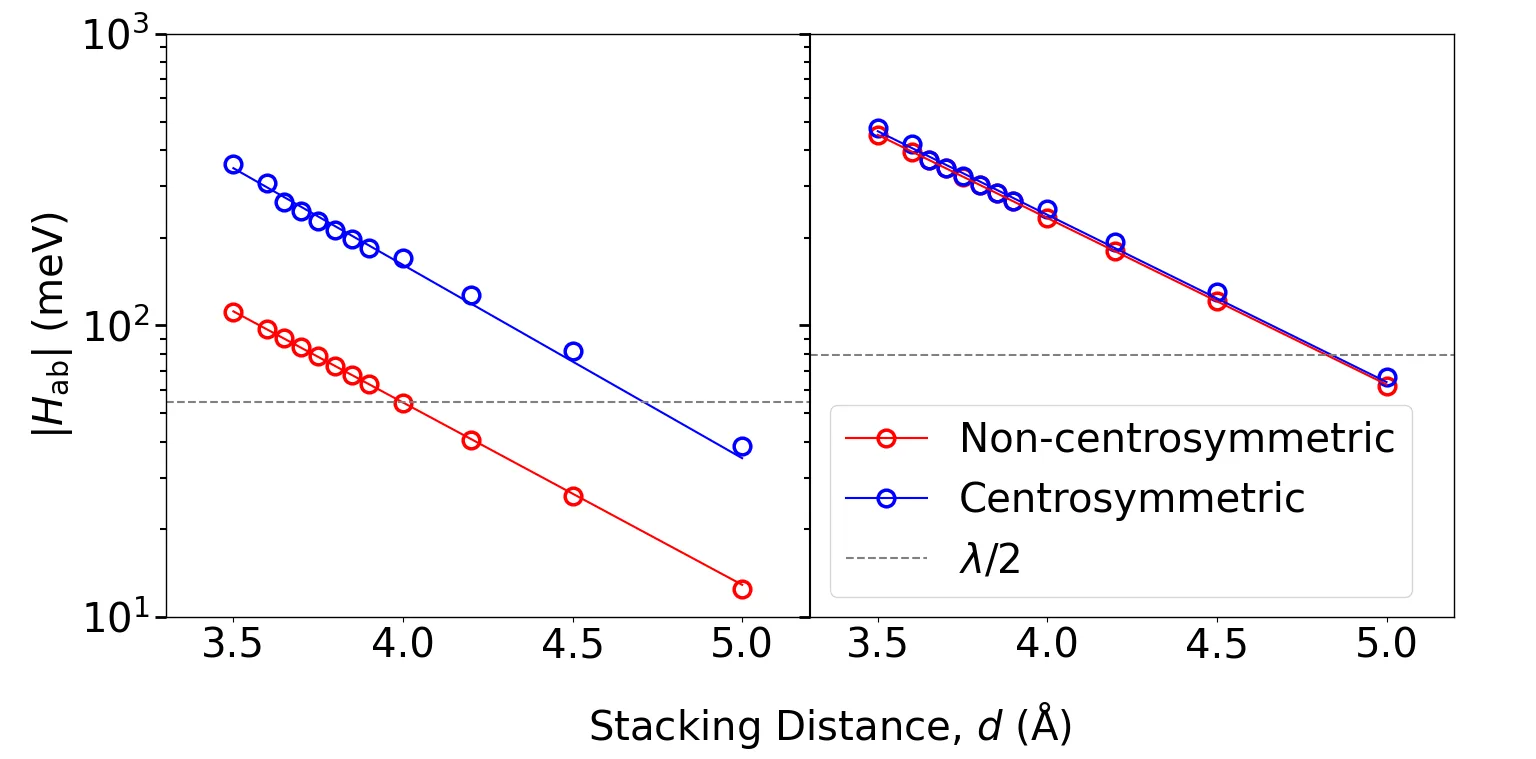
La gran sorpresa es cómo se mueven los electrones. En los apilamientos más estables, la nube electrónica de un anillo se solapa con la del vecino tan intensamente que la carga no se queda quieta, sino que se reparte por toda la cinta. No es un salto de piedra en piedra, sino un flujo suave, casi como en un metal. Este mecanismo permite que la fibra conduzca corriente sin sobrecalentarse y con pérdidas mínimas, un hallazgo prometedor para futuros conductores biocompatibles.
Resumen original
tal como lo escribieron los autores, en inglés arXiv:2606.13117
Cable bacteria are multicellular bacteria capable of centimeter-scale conduction through a regular fiber network embedded in their cell envelope. The conductivity of these fibers is extremely high for biological materials, and rivals that of the best synthetic conductive polymers, but the underlying electron transport mechanism remains elusive. Recent microscopic and spectroscopic evidence indicates that each fiber embeds a bundle of intertwined nanoribbons as the conductive conduit. Each nanoribbon consists of a one-dimensional nickel-organic framework, built from stacked nickel bis(1,2-dithiolene) oligomers (NiBiD units) as molecular building blocks. Here we performed DFT calculations of nanoribbon model structures, in order to characterize their electronic properties, examine potential stacking configurations and verify whether these structures can support efficient conductance. Our simulations indicate that nanoribbons are comprised of tightly stacked AA or AB-type packings of NiBiD units. In the most energetically stable structure (AB-type) some Ni centers are predicted to be 5-fold coordinated due to formation of an inter-layer Ni-S coordination bond. In several energetically low-lying structures, the electronic coupling between neighboring molecules exceeds the critical threshold for charge delocalization permitting efficient charge transport beyond small polaron hopping. Our results hence reveal that nanoribbons based on NiBiD units exhibit favorable charge transfer properties that may explain the unusually high conductivities measured in the fibers of cable bacteria.
Las bacterias cable son los únicos organismos multicelulares conocidos que transportan electrones a distancias de centímetros a través de su propio cuerpo, y no por pilas o cables externos.