Des lunes chaudes autour des planètes vagabondes express
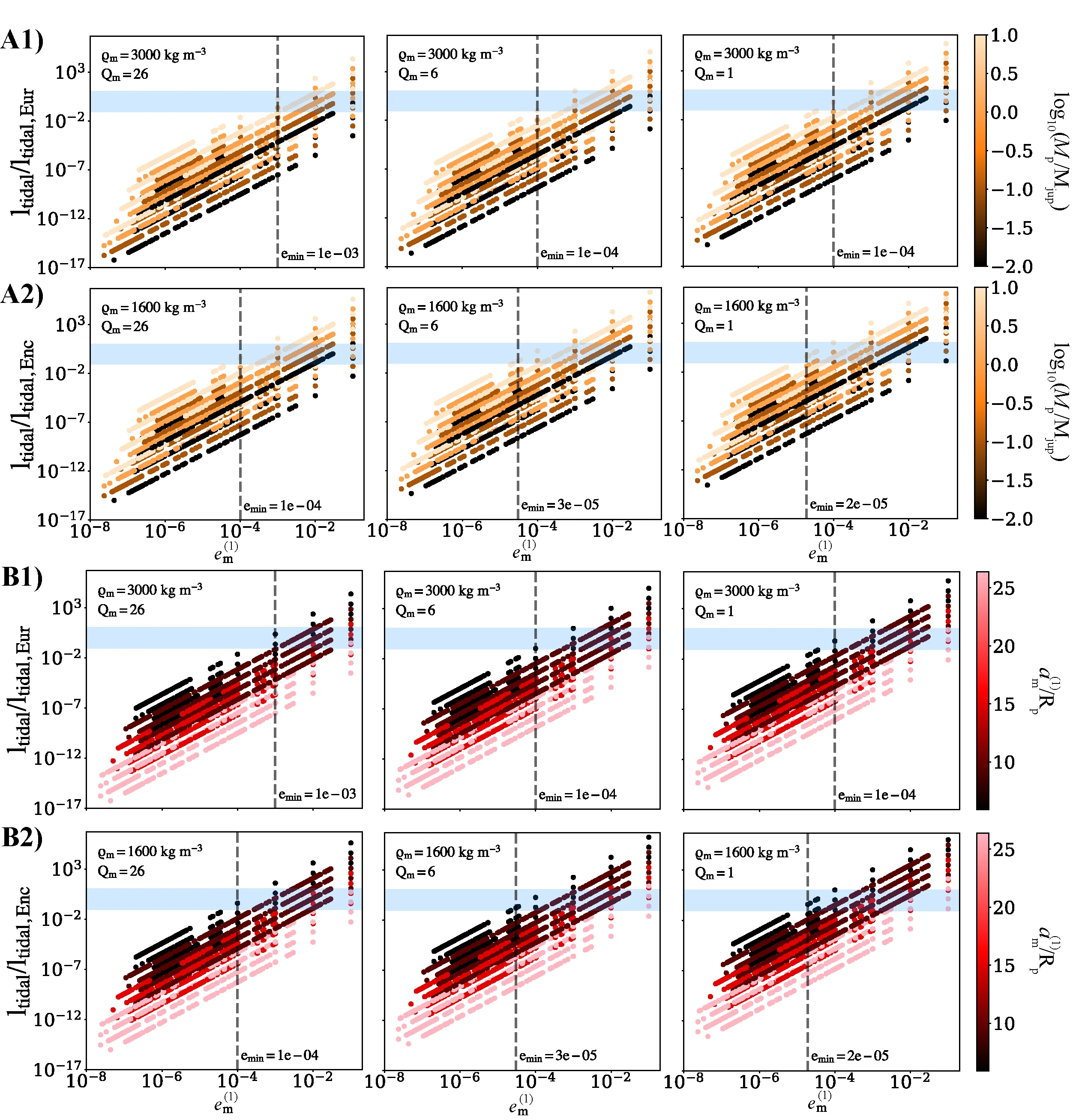
Dans la galaxie, les planètes errantes ne manquent pas, éjectées par une explosion de supernova. Ces planètes flottantes libres sont privées de soleil, mais elles retiennent souvent leurs lunes. La modélisation a montré qu'après la catastrophe, les orbites des satellites deviennent à peine allongées, et cela suffit à déclencher un échauffement interne. Dans 12 à 15 % des cas, la puissance de cet échauffement est comparable à celle qui réchauffe les océans d'Europe et d'Encelade. Étonnamment, ce processus s'atténue extrêmement lentement : pour les lunes situées à plus de dix rayons planétaires, l'échauffement durera plus longtemps que l'âge du système solaire. Ainsi, les océans d'eau sous la croûte de glace peuvent rester liquides pendant des milliards d'années. La prochaine vie extraterrestre pourrait bien être découverte non pas près d'une étoile, mais dans l'obscurité éternelle de l'espace interstellaire.
Résumé original
tel que rédigé par les auteurs, en anglais arXiv:2511.03392
Free-floating planets are thought to be numerous in the Galaxy and may retain their moons after ejection from their natal systems. If those satellites acquire or preserve orbital eccentricity, tidal dissipation could provide a long-lasting internal heat source, potentially creating urable environments (capable of enabling abiogenesis) in the absence of stellar radiation. We explore (i) whether moons remain bound to planets expelled by a core-collapse supernova, (ii) how the explosion reshapes their orbits, and (iii) under which circumstances tidal heating can sustain urable subsurface oceans. We carried out three-dimensional N-body simulations with an 8th-order Runge-Kutta scheme, modelling homologous stellar mass loss for progenitors of 10 M$$_{\odot}$$. Post-explosion orbital elements of single moons and resonant moon systems were analysed, and tidal heating power was estimated with a constant phase-lag model for several tidal dissipation functions and moon densities. All simulated moons survive the supernova and remain bound to their planets. The explosion excites moon eccentricities up to $$\sim7\times10^{-4}$$ and $$\sim3\times10^{-3}$$ for single moons of planets with circular and eccentric orbits, respectively. For resonant pairs, an eccentricity of $$\leq2\times10^{-2}$$ is preserved. The semi-major axis of the moons changes by $$\leq0.2\%$$. For 12-15\% of cases -- preferentially moons at $$a\leq15\,R_{\mathrm{planet}}$$ and with $$e\geq10^{-3}$$ -- the specific tidal heating power lies between 0.1 and 10 times what is estimated on Europa or Enceladus, sufficient to maintain liquid oceans beneath an ice crust. Eccentricity damping timescales exceed the age of the Solar System for $$a\geq10\,R_{\mathrm{planet}}$$, implying billions of years of continuous heating on the moons. Such worlds represent promising targets for future searches for extraterrestrial life.
Il pourrait y avoir plus de planètes errantes dans notre galaxie que d'étoiles — ce qui signifie que les lunes chaudes avec des océans sont incroyablement nombreuses dans l'univers, comme les grains de sable sur toutes les plages de la Terre.