L'air des planètes : la recette d'une étoile express
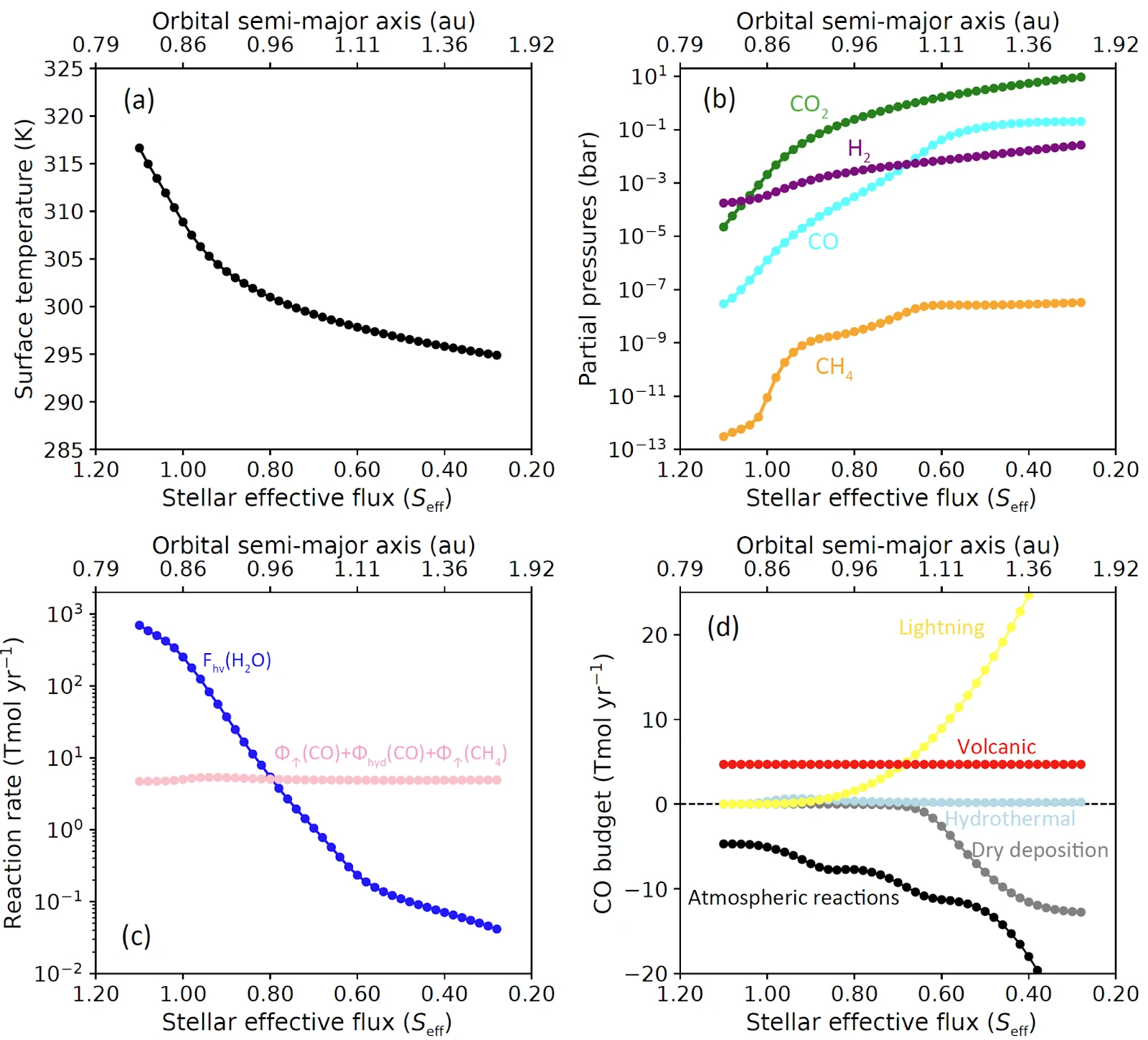
Une exoplanète rocheuse autour d'une autre étoile, c'est comme un plat au four. L'étoile règle la température : plus on s'éloigne, plus il fait froid. Du mode de cuisson et du type d'étoile (comme le soleil ou plus faible) dépend le mélange de gaz à carbone dans l'air : dioxyde de carbone, monoxyde de carbone, méthane.
Le formaldéhyde — une brique pour les sucres et les acides aminés — se « cuit » le mieux près des étoiles chaudes, juste avant l'effondrement. Les télescopes, comme le James Webb, analyseront la lumière des mondes lointains et trouveront les endroits où la recette de la vie est presque prête.
Résumé original
tel que rédigé par les auteurs, en anglais arXiv:2601.05480v1
The abundances of atmospheric carbon species--carbon dioxide (CO2), carbon monoxide (CO), and methane (CH4)--exert fundamental controls on the climate, redox state, and prebiotic environment of terrestrial planets. As exoplanet atmospheric characterization advances, it is essential to understand how these species are regulated on habitable terrestrial planets across a wide range of stellar and planetary conditions. Here, we develop an integrated numerical model that couples atmospheric chemistry, climate, and the long-term carbon cycle to investigate the atmospheric compositions of lifeless, Earth-like planets orbiting Sun-like (F-, G-, and K-type) stars. Our simulations demonstrate that CO2, CO, and CH4 generally increase with orbital distance, and that planets near the outer edge of the habitable zone may undergo CO runaway--a photochemical instability driven by severe depletion of OH radicals. The threshold for CO runaway depends strongly on stellar spectral type and is most easily triggered around cooler, lower-mass stars. In contrast, the atmospheric production of formaldehyde (H2CO)--a key precursor for prebiotic organic chemistry--peaks around planets orbiting more massive, UV-luminous stars and is maximized at orbital distances just interior to the CO-runaway threshold. These results establish a quantitative framework linking observable system properties--stellar type and orbital distance--and the atmospheric carbon chemistry of lifeless Earth-like planets, providing new context for interpreting future spectroscopic observations and for evaluating the potential of such planets to sustain prebiotic chemistry.
Sur les planètes sans vie, le monoxyde de carbone peut s'accumuler jusqu'à des niveaux des centaines de fois supérieurs à ceux de la Terre — et tout cela à cause des particularités de la lumière de l'étoile.