La galaxie naine qui a cessé de former des étoiles express
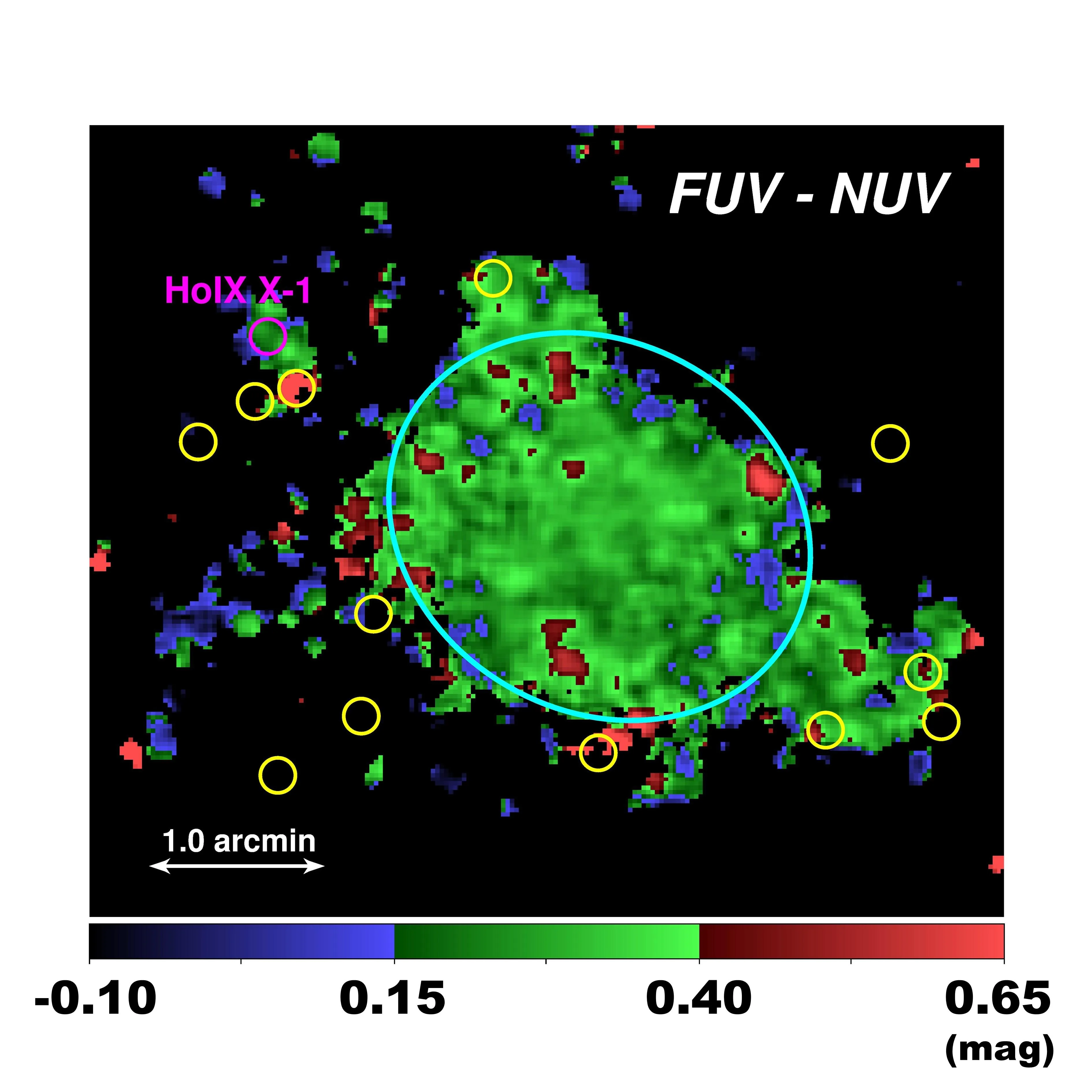
La galaxie Holmberg IX ressemble à une ville où l'on cesserait soudain de construire de nouveaux immeubles, alors que les matériaux ne manquent pas. Les astronomes l'ont observée avec différents télescopes et ont vu une scène étrange : le gaz et les éléments lourds abondent, mais la poussière est presque absente. En général, là où il y a du gaz, de nouvelles étoiles se forment, mais ici, c'est tout le contraire.
Grâce à la lumière ultraviolette et à l'hydrogène, les scientifiques ont compris que presque toutes les étoiles sont nées il y a environ 130 millions d'années, lors d'une brève salve. Depuis, la formation d'étoiles a brutalement cessé, et au cours des 80 derniers millions d'années, très peu de nouvelles étoiles sont apparues. Aujourd'hui, de faibles foyers de formation stellaire ne subsistent qu'aux confins de la galaxie. C'est comme si le centre-ville s'était figé, tandis que la vie s'accroche encore en périphérie.
Et ensuite ? Si la formation d'étoiles ne reprend pas, la galaxie pourrait devenir semblable à un amas globulaire d'étoiles ternes, ou au contraire se dissoudre progressivement dans l'espace. Mais une autre possibilité existe : si elle ne forme que des étoiles très faibles, difficiles à détecter, elle pourrait rester dans cet état pendant longtemps. Quoi qu'il en soit, Holmberg IX nous oblige à revoir nos idées sur la vie des galaxies naines.
Résumé original
tel que rédigé par les auteurs, en anglais arXiv:2604.02831
In this Letter, we report a novel discovery of unique characteristics for the tidal dwarf galaxy (candidate) Holmberg IX via a multiwavelength investigation. New observations are taken for deeply mapping H{\alpha} emission and combined with archival/published data for comprehensively probing dust, gas, and stellar populations in this galaxy. We find in Holmberg IX a dearth of dust incompatible with its rich gas and metal; globally young stellar populations with prominent far-ultraviolet but deficient and marginal H{\alpha} emissions, distinct from other tidal dwarf galaxies ever known. By assuming a normal initial mass function (IMF), Holmberg IX is suggested to be born ~130 Myr ago from a bursty star formation event, which then rapidly ceased, with very few stars formed in the past ~80 Myr that demarcates a lower age limit for the galactic mainbody; current star formation occurs only in outskirts, bringing a conundrum about the reason for the recent quenching in such a gas-rich environment. Contradicting the general expectation for tidal dwarf galaxies hosting continuous star formation, the present quiescence implies Holmberg IX currently staying in a rarely-seen transient period. Without star formation continuing, Holmberg IX is likely transforming into a dwarf spheroidal galaxy, or oppositely into a(n) (ultra-)diffuse system which will probably dissolve in the end. Instead, if Holmberg IX possesses peculiar IMF and hosts low-mass, weak-H{\alpha} star formation, it is able to maintain long-term survival in its current status. On whichever evolutionary pathway in reality, Holmberg IX appears as a special case updating conventional understandings of tidal dwarf galaxies and hinting potential existence of similar analogs in the Universe.
Holmberg IX se trouve à proximité de la grande galaxie M81 et pourrait être étirée par ses forces de marée, comme une pâte que l'on étire à la main.